

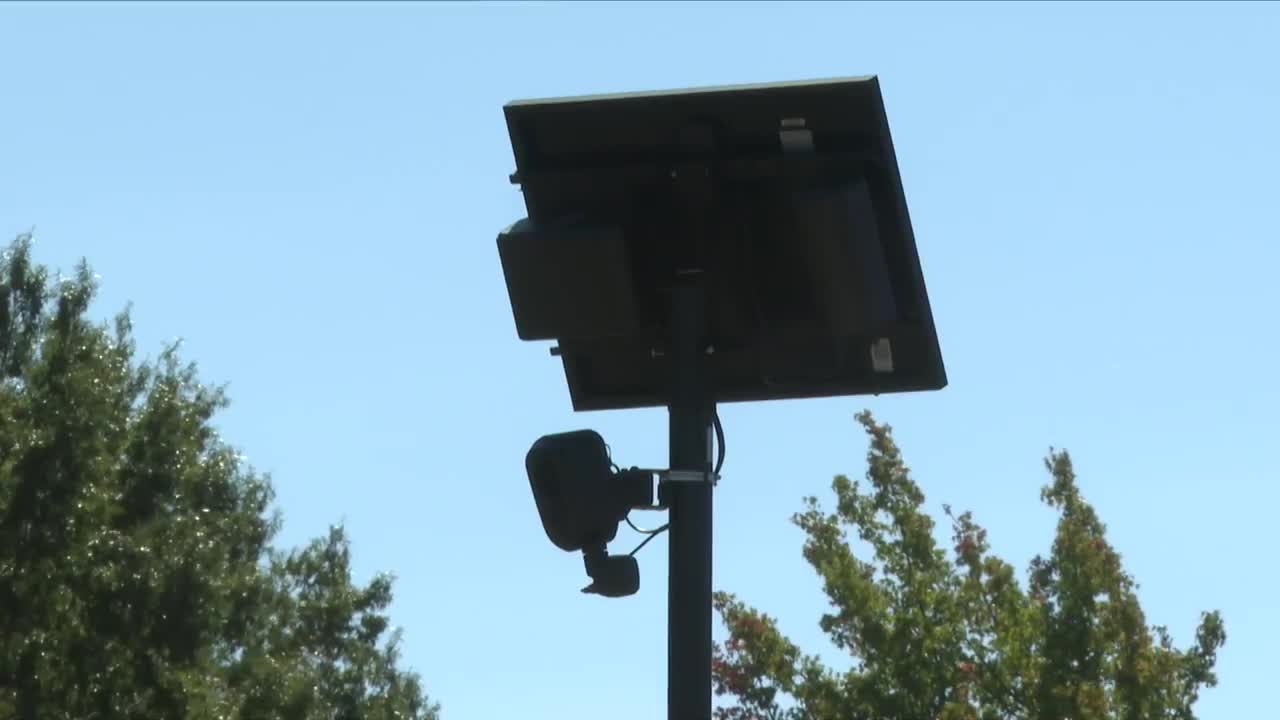


RICHMOND, Va. — Virginia state lawmakers seem poised to bring legislation next session to further direct how police departments are allowed to use automated license plate readers, or ALPRs.
It comes after an annual report from the Virginia State Crime Commission on the use of the technology in the Commonwealth found multiple examples of its misuse. And at the same meeting, some members of the public called on lawmakers for an outright ban.
"Seems to me that we need probably stronger consequences for law enforcement agencies that are not following the laws that we pass," said Sen. Scott Surovell (D-Fairfax). "It strikes me that the consequences that we have are not really adequate to deter agencies from not following our statute."
The report was released at a time when many Virginia localities are re-assessing their use of ALPRs and staff noted that at least 27 localities have announced such a step since they sent out the survey in August that formed the basis of the report.
Among those localities are Richmond and Henrico, which both announced they would end their current ALPR contract.
The report said of the 191 agencies that responded using ALPRs, most said they complied with state law.
But the report said there were several instances of non-compliance, including keeping data longer than 21 days, not having an ALPR policy, or sharing data with federal or out-of-state agencies without following proper protocol.
It adds 20 agencies reported unauthorized use by its employees.
"Seven charges of unauthorized use have been filed in two different Virginia General District courts as of October 2026. Those charges are still pending," a VSCC staff member told the commission last Thursday.
One of those cases was in Chesterfield County, where a professional staff intelligence investigator is accused of unauthorized access.
One of the commission members, Hampton Commonwealth's Attorney Anton Bell, asked why not all instances led to charges.
"It was a discretionary matter on the on the part of the Commonwealth's Attorney in several of the instances that were identified," a staff member responded.
"Would you find it beneficial if there were there were some type of legislation that would make enforcement non discretionary by Commonwealth's Attorneys or by the law enforcement locality?" Bell asked.
"I think that's a policy decision for us and I think we can certainly pull that in to the mix," said VSCC Chair Del. Charniele Herring (D-Alexandria).
Bell added that while ALPRs have their benefits, there need to be guardrails.
"We have seen great benefits to the license plate readers. However, with any law enforcement tool, we recognize there has to be always be checks and balances on anything where there's the availability or opportunity for abuse," Bell said.
Meanwhile, in a public comment period that followed the presentation, all speakers either called for further restrictions on their use or their outright ban.
"No mass surveillance, not better regulated mass surveillance, not audited mass surveillance, no mass surveillance," Duane Barron, a public defender in Staunton and Lexington, said.
The Crime Commission leadership said they will meet again Tuesday, November 10 and will discuss potential increased penalties for departments or officers not in compliance with state law.
CBS 6 is committed to sharing community voices on this important topic. Email your thoughts to the CBS 6 Newsroom.
-
-
Eat It, Virginia! with Scott and RobeyUntold with Catie Beck
-
-
-
This story was initially reported by a journalist and has been converted to this platform with the assistance of AI. Our editorial team verifies all reporting on all platforms for fairness and accuracy. To learn more about how we use AI in our newsroom, click here.
 Facebook
 TikTok
 YouTube
 Blue Sky
 Instagram
 Threads
 X
