

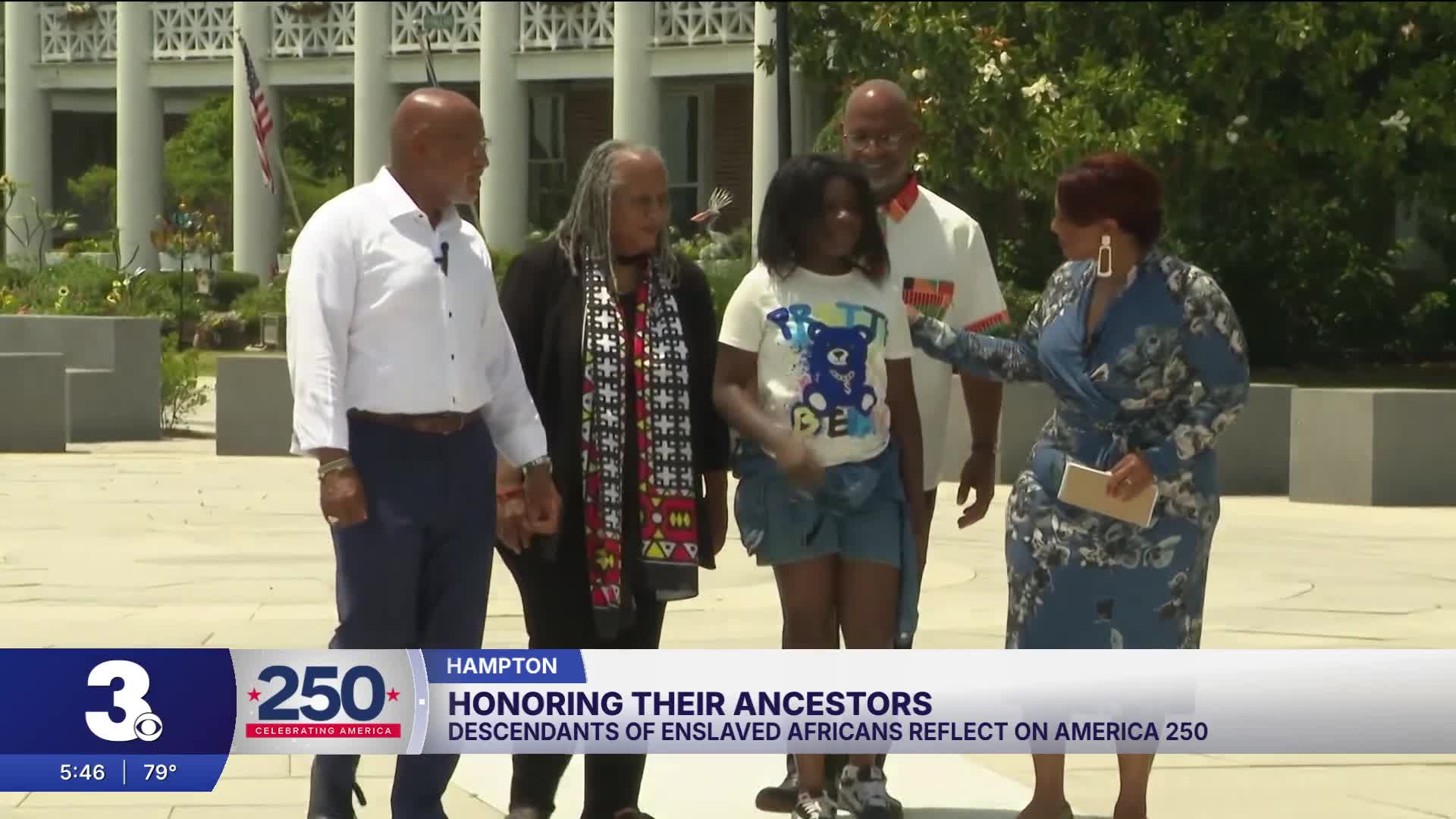


HAMPTON, Va. — As the United States marks 250 years of independence, descendants of the first enslaved Africans to arrive in English North America are reflecting on what that milestone means to them — and on the history that unfolded at what is now Fort Monroe in Hampton, Virginia.
In 1619, more than 20 people stolen from Angola landed at what was then called Point Comfort, beginning America's foundation for the enslavement of Africans. The African Landing Memorial Plaza at Fort Monroe pays homage to those first enslaved Africans, who arrived on a slave ship that year.
"This is symbolic, this shows this important piece of history," Verrandall Tucker said.
"We still have the blood of our ancestors running through our veins," Wanda Tucker said.
Watch "African Landing Memorial at Fort Monroe honors enslaved Africans and descendants"
The Tucker siblings say their family has passed down stories for generations about the ancestors this monument honors.
"Our cousin made sure she kept telling the story that we were descendants of William Tucker," Wanda Tucker said.
William Tucker was born at Point Comfort in 1624, according to census records. He was likely named after Captain William Tucker, the commanding officer of Point Comfort — modern-day Fort Monroe. Listed under Captain Tucker's household were baby William's parents, Antony and Isabella — two of the 20 or more people stolen from Angola who landed there in 1619 on the White Lion slave ship.
"We may have been brought here under great duress," said Wanda Tucker. "But we established anew. The birth of William was the establishment of a new family, of a new hope, and a new vision."
The siblings say they are not certain whether baby William was enslaved, but at some point, some of their family line was.
"My ancestors were strong and independent survivors, providers, so I, I, I hold on to that," Vincent Tucker said.
Watch "Fort Monroe’s role as 'Freedom’s Fortress' remembered ahead of Juneteenth"
The Tucker story is one the family considers inseparable from American history itself.
"Our ancestors contributed to the construction of America," Wanda Tucker said.
For descendants of the enslaved, the Tuckers say marking America's 250th anniversary is complex.
"I do struggle with that," Vincent Tucker said.
"It's like we celebrate the independence, but what did it take?" he said.
"We give honor to all of those who survived and the traumas that kept coming," Wanda Tucker said.
The African Landing Memorial Plaza sits on ground that holds both pain and progress. A straight line built into the monument points toward Angola — a geographic marker connecting the descendants to the land their ancestors were taken from.
"The line they did not create, but they were a part of the line making," Wanda Tucker said.
"I can imagine the struggle walking for miles and days to get to a ship," Vincent Tucker said.
Watch "Historians shine light on lesser-known Black History at Bacon's Castle in Surry County"
"The means and the methods that were in place that seemed destined to destroy us in a way, we said no," Wanda Tucker said.
The memorial is still in progress. In time, a sculpture of a man, woman, and child will be added — a symbol of Antony, Isabella, and baby William.
"We will never forget our ancestors. They will never be forgotten," Verrandall Tucker said.
The next generation of Tuckers is already preparing to carry the story forward.
"I think it's very important," Savannah Tucker said.
