

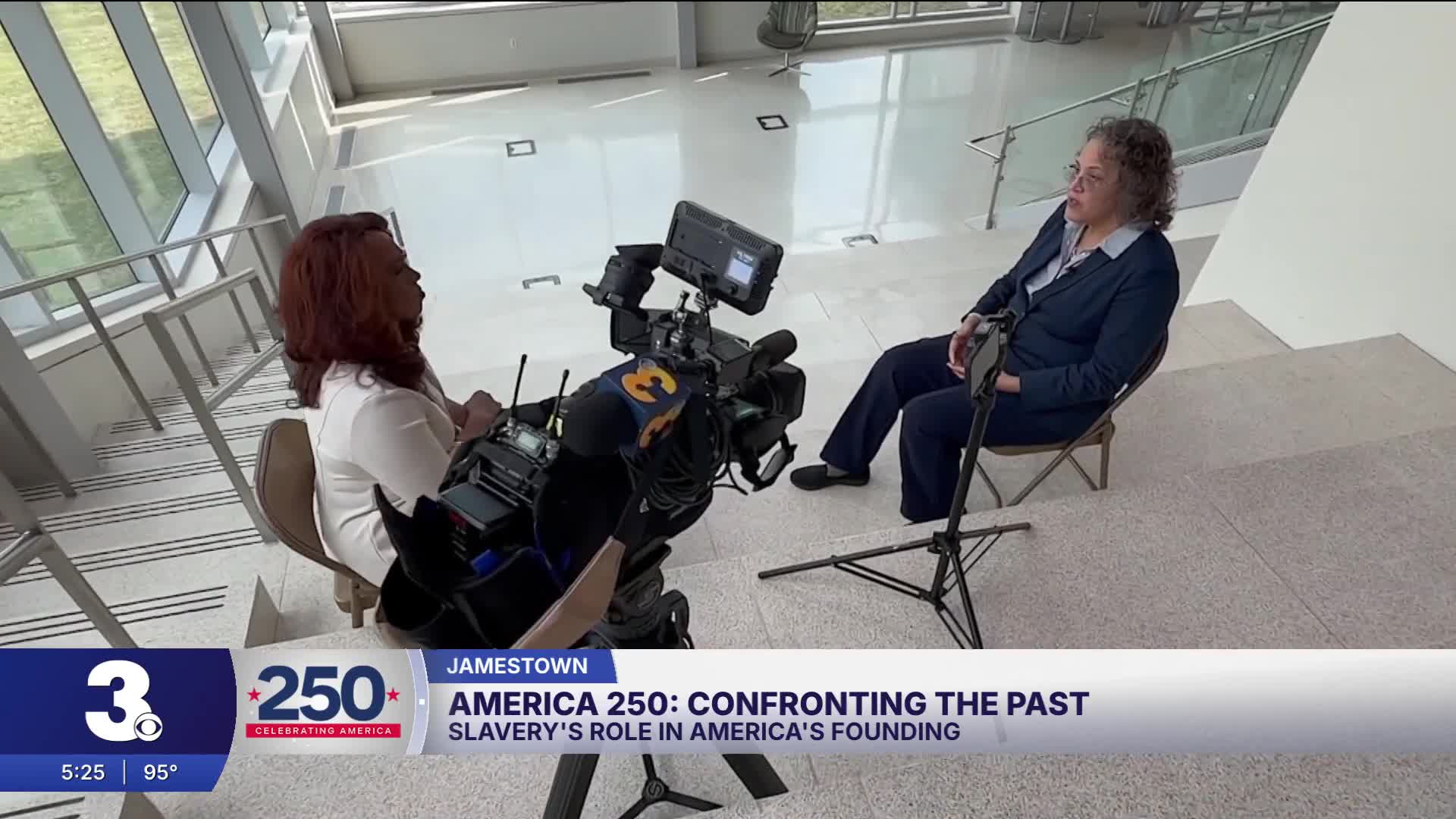


As we mark the 250th anniversary of the signing of the Declaration of Independence, I think about abolitionist Frederick Douglass' haunting question in 1852 — years before slavery in the United States came to an end: "What to the Slave is the Fourth of July?"
That question rings true for many Americans who are descendants of enslaved Africans.
Watch "Descendants of first enslaved Africans to arrive in Virginia reflect on America's 250th anniversary"
It's a reality rooted in the history of Jamestown, where America's story began as the first English settlement in North America in the 1600s. It is also where the enslavement of Africans and their descendants became the law of the land in the Virginia colony. In turn, the wealth slavery generated helped fund the Revolutionary War — an ironic bid for freedom Great Britain, while numerous colonies allowed the enslavement of human beings based on the color of their skin.
"History is always controversial," historian Mark Summers said.
When Summers leads tours at Historic Jamestown, he does not shy away from the shameful scenes in the country's story.
"We can acknowledge, I think, our great achievements and acknowledge where we're flawed," says Summers. "We can't ignore the contradictions because then we're whitewashing our past."
Watch "Historians shine light on lesser-known Black History at Bacon's Castle in Surry County"
As the capital of the Virginia Colony, Jamestown shaped laws by the 1660s that ensured slavery was based on race.
"The very laws were being created to keep one group enslaved," Summers told me.
Summers confirmed that enslavement was a wealth generator: profits that propelled the economy of colonies and helped their push for independence from Great Britain.
"And that profit is based on having labor that's not paid by having people tied to the very plantation," Summers said.
Watch "Billy Flora's heroic stand at the Battle of Great Bridge helped shape American independence"
Norfolk State University historian Dr. Cassandra Newby-Alexander reflects on the irony of Thomas Jefferson as a primary author of the Declaration of Independence in 1776 while owning slaves.
"We hold these truths to be self-evident that all men are created equal," Newby-Alexander said, quoting the Declaration of Independence.
"The Declaration posited the Americans in a position saying that the British government is treating us as slaves, so how can you not talk about slavery when the very document that you're celebrating mentions that we're just in a different way," Newby-Alexander said.
Watch "Fort Monroe’s role as 'Freedom’s Fortress' remembered ahead of Juneteenth"
The 1781 victory at Yorktown essentially sealed America's independence — but it was far from the country Jefferson described in the Declaration.
"And so when you plug into the very essence of humanity and you say this is what we're standing on, standing for the respect of all human beings to be equal, that they all have a right given to them by God or their creator for and to those rights, and no government can remove those rights when you start at that point, you're going to see a demand," Newby-Alexander said.
It's a demand that led to the end of slavery during the Civil War; a demand that evolved into the Civil Rights and Women's Rights movements; a demand that lives 250 years into America's story.
"I think we need to remember that there is an enduring story of freedom," Newby-Alexander said.
"You have to recognize that you can't really separate what you like and don't like in history," said Summers. "You can't possibly make things better if you don't know how, when and where they went wrong in the first place."
Click here to see how we use AI at WTKR News 3.
