



Pope Leo XIV is expected to sign his first encyclical as he begins his second year as leader of the Catholic faith. Indications from the Vatican suggest the letter will focus on the role of artificial intelligence in the church and the lives of the faithful.
An encyclical is a letter outlining the church's position on doctrine, morality, or social issues. While it does not carry the weight of infallible dogma — a truth obtained through divine intervention in the Catholic faith — it is considered a significant message within the church.
Pope Leo has spoken frequently about artificial intelligence during his first year leading the church. TIME included him on its 2025 list of the most influential people in AI, calling the pope a top thinker and "spiritual counterweight" to the emerging technology.
Dr. Andrew Chesnut, Professor and Bishop Walter Sullivan Chair of Catholic Studies at Virginia Commonwealth University, said the timing is notable.
"This is a centuries old institution. Right after we see the advent of chatbots and ChatGPT and such, just a couple years later, he's going to be weighing in with a major encyclical is really impressive. I think it's very fitting that an American pope is weighing in on what has mostly been American innovative technology," Chesnut said.
Leo has urged priests to resist "the temptation to prepare homilies" with AI and not to use the technology to gain "likes" on social media. Speaking to the National Catholic Youth Conference in November 2025, he issued a warning to students.
"Be prudent, be wise, be careful that your use of AI does not limit your true human growth. Use it in such a way that if it disappeared tomorrow you would still know how to think, how to create, how to act on your own," Pope Leo XIV said.
RELATED STORY | Palestinian students from Gaza meet Pope Leo XIV at historic university visit
The pope has often said the mission of the church is a "human" one, based in faith and belief — things he says cannot be found online. He has expressed concern that AI is becoming less of a tool and more of a main character in the lives of millions, regardless of their faith.
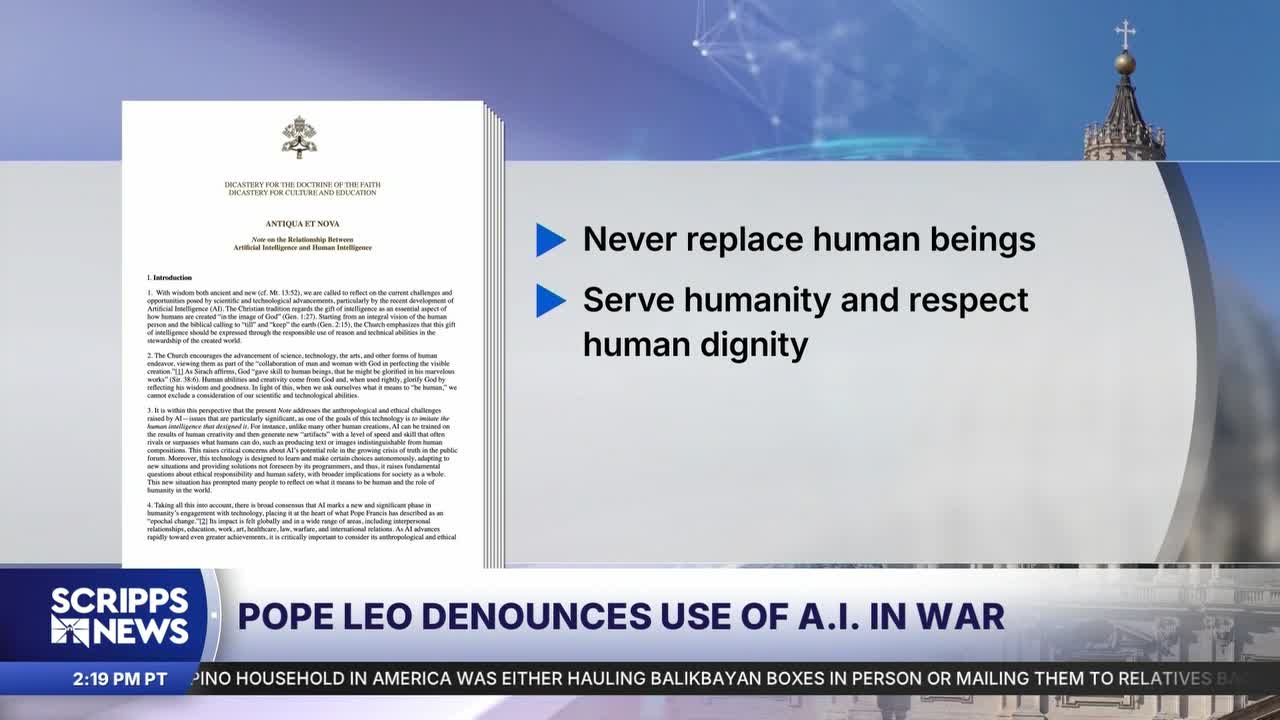
Leo follows in the footsteps of his predecessor, Pope Francis, who was instrumental in the creation of formal AI guidelines and monitoring structures at the Vatican, including a 13-page policy that states in part that technological innovation cannot and should never overtake or replace human beings and that AI should serve humanity, and support and respect human dignity and foster well-being and progress, without compromising ethical and social principles.
The Vatican is expected to release a written copy of the encyclical in the next few weeks.
