

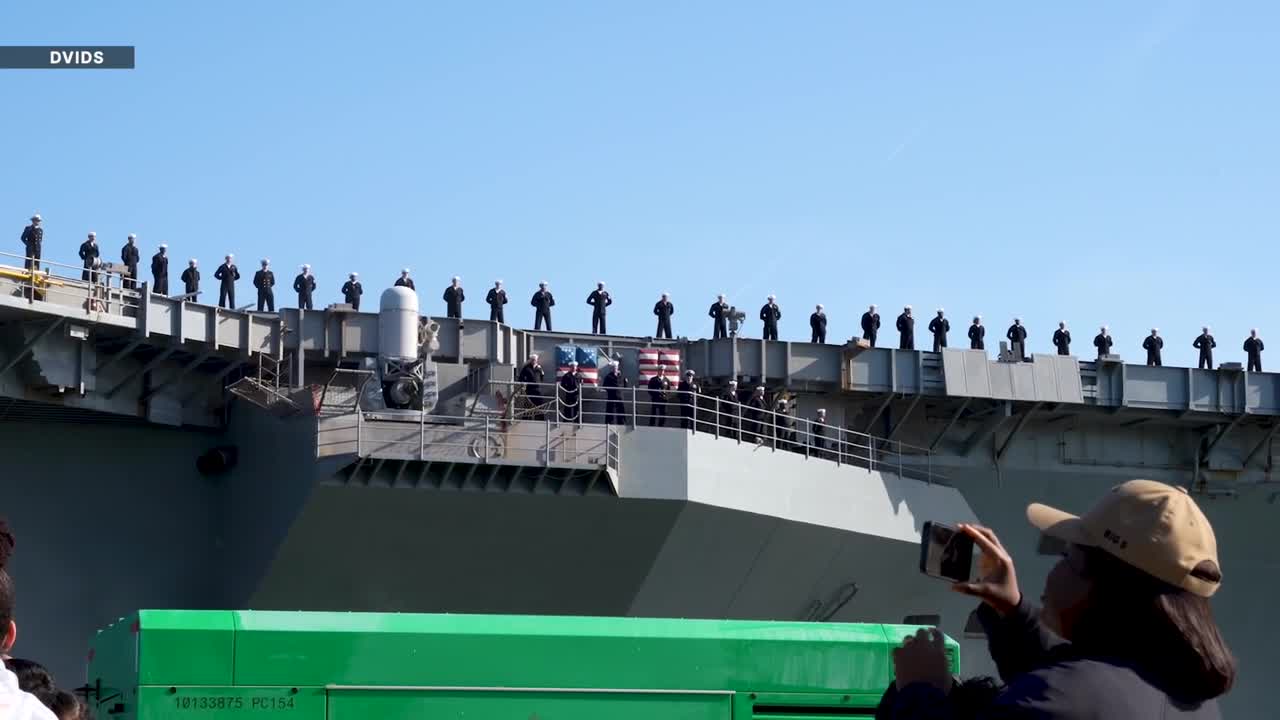


NORFOLK, Va. — Military families across Hampton Roads are facing more uncertainty after learning that the USS George H.W. Bush Carrier Strike Group's deployment is being extended for a second time, potentially keeping thousands of sailors away from home for an entire year.
The strike group departed Naval Station Norfolk on March 31 for what was originally expected to be a standard six- to seven-month deployment. More than seven months later, families are now being told to prepare for the possibility that their loved ones could remain deployed for as long as 12 months.
According to reporting from MS NOW, Navy leaders delivered that news during a Nov. 9 town hall at Naval Station Norfolk, telling families their loved ones would miss the upcoming holidays and that a yearlong deployment was a worst-case scenario.
For military spouses and families who have already spent months waiting for a homecoming, the possibility of another extension brings new challenges.
"These are families who are now facing the potential of a full calendar year without their their person," said Sarah Streyder, a military spouse and the executive director and co-founder of Secure Families Initiative, an organization that advocates for military families.
Streyder spoke with News 3 about the emotional toll extended deployments can have on military households, particularly when families have already begun preparing for their loved ones to return.
"That is a whole calendar year of missed birthdays, holidays, t-ball games, homecoming dances, you name it, right? A whole year," Streyder said.
While deployments are a familiar part of military life in Hampton Roads, Streyder said there is a significant difference between preparing for a lengthy separation and learning that an expected homecoming is being pushed back.
"Long deployments suck. Extended deployments are even worse in some cases because you have this light at the end of the tunnel that you start to make plans around, and you start to allow yourself that glimmer of hope that the light at the end of the tunnel is coming, and for all of a sudden that to be yanked further or to be indeterminate," she said.
That uncertainty can affect everything from family celebrations and childcare arrangements to the emotional well-being of spouses and children.
For parents managing a household while their spouse is deployed, an extension can mean additional months of handling daily responsibilities alone. For children, it can mean more missed milestones and continued uncertainty about when a parent will return.
Streyder said those challenges are especially difficult when families do not have a clear timeline for a reunion.
The USS George H.W. Bush Carrier Strike Group has already been deployed for more than 200 days. The latest reported extension would be the second since the strike group departed Norfolk in March.
Although families have reportedly been told to prepare for the possibility of a 12-month deployment, that does not necessarily mean the Navy has formally ordered the strike group to remain at sea for an entire year.
The distinction matters for families trying to plan their lives around a homecoming date that remains uncertain.
The challenges associated with extended deployments have also been acknowledged by senior Navy leadership.
Adm. Daryl Caudle, the chief of naval operations, previously discussed the importance of providing sailors and their families with more predictable deployment schedules during remarks in Norfolk.
Caudle said seven months should be the goal for deployments and emphasized the need for better communication about how long sailors can expect to remain away from home.
The impact of an extended deployment is not limited to families.
Retired Navy Vice Adm. Herm Shelanski previously told News 3 that longer deployments can place additional strain on both sailors and the ships on which they serve.
"It gets pretty rough. It gets rough on the ship because of maintenance, it gets rough on the crew morale," Shelanski said.
Shelanski also raised concerns about how repeated lengthy deployments could affect the Navy's ability to retain experienced sailors.
"You know if they're extended for these extended periods then the consequence of that is that many of these experienced sailors may be disheartened and say I don't want to go through that again and get out," he said.
The reported extension is also drawing attention from Virginia lawmakers.
U.S. Sen. Mark Warner told News 3 that he is pressing the Navy for answers about the deployment and the strain it is placing on military families.
"The men and women of our military serving as part of the USS George H.W. Bush Carrier Strike Group have already spent more than 200 days away from home and are facing extensions to that deployment that add to the challenges they and their families have navigated now for months," Warner said in a statement.
Warner linked the prolonged deployments to the ongoing war with Iran, criticizing the Trump administration's handling of the conflict.
"These prolonged deployments, driven by President Trump's war of choice in Iran, are taking an enormous toll on our servicemembers and their families in Virginia and across the country," Warner said.
The senator said military families deserve greater certainty about when their loved ones will return.
"Our sailors and their loved ones deserve more than uncertainty and indefinite extensions. They deserve clear answers and a concrete plan to end this war and bring them home," Warner said.
"I am pressing the Navy for answers about its plans to bring these sailors home and how it intends to address the serious strain these decisions are placing on our military families."
For Streyder, the situation highlights the challenges families face when deployment schedules change with little certainty about what comes next.
Military spouses may be accustomed to adjusting plans and managing unexpected challenges, but that does not make prolonged separations any easier.
"It's so hard. It's so hard," Streyder said.
News 3 has reached out to the Navy seeking additional information about the reported extension, the expected deployment timeline and what resources are available to support affected families.
As families await those answers, many are left preparing for another holiday season apart — without knowing exactly when their loved ones will finally return home.
Click here to see how we use AI at WTKR News 3.
