

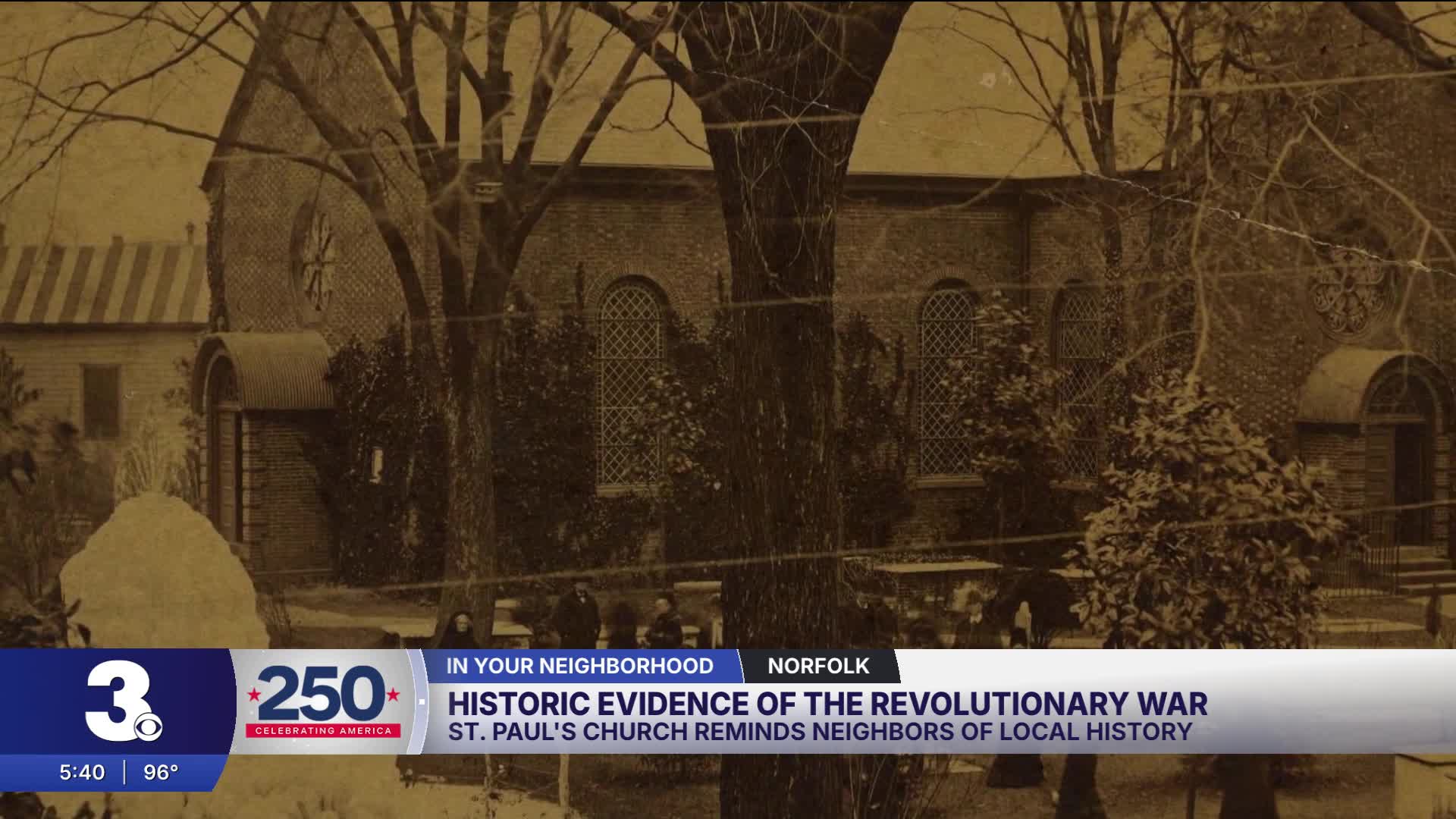


NORFOLK, Va. — Saint Paul's Church in downtown Norfolk holds a cannonball fired during a British naval bombardment on Jan. 1, 1776 — a piece of physical evidence from the Revolutionary War still embedded in its walls nearly 250 years later.
The parish dates back to 1637, with the current building constructed in 1739, making it one of the oldest structures in the region.
"You can't tell the story of the revolution in Norfolk without coming to Saint Paul's Church," parishioner Nat McCormick said.
Parishioner Ken Marks said the church's roots run deep.
"In this particular church, the parish dates back to 1637, the building to 1739," Marks said.
McCormick and Marks have studied the church's history extensively. They noted that in colonial Virginia, Saint Paul's was the only religious institution in Norfolk.
"When you're in colonial Virginia, your choice of religious institution is a choice of one. It's the Anglican Church that is the established church. There was no other church building in the city of Norfolk until after the revolution," McCormick said.
The church was not always at its current location. Marks said the parish's origins trace to a different site.
"When the parish was established in 1636, the original building in 1637 was at Sewell's Point," Marks said. "We don't know exactly where that was. We suspect somewhere near the Navy base."
McCormick pointed out the age of the current structure.
"You are looking from this corner east — we're pointing east here — this is the 1739 church, which is 287 years of history," McCormick said.
The church provided photographs believed to date to 1876, among the oldest images they have of the building.
The bombardment of Jan. 1, 1776
The cannonball embedded in the church's wall came from a British naval assault that followed a significant colonial victory. British forces suffered a defeat about 10 miles south in Chesapeake at the Battle of Great Bridge, causing British Royal Governor Lord Dunmore to retreat to his ships in the Elizabeth River in Norfolk Harbor.
Marks said Dunmore commanded four gunships during the assault.
"He has the Dunmore, the Liverpool, the Kingfisher, and the Otter," Marks said.
The bombardment began in the afternoon and continued through the night.
"At 3 o'clock in the afternoon on January 1st of 1776, he opens fire and he continues shelling until about 10 o'clock at night," Marks said. "There's a pause until the early morning hours and then he resumes again."
At least one of those shots struck Saint Paul's Church. McCormick confirmed the cannonball still lodged in the wall is authentic.
"That is the real cannonball. It has been examined and authenticated," McCormick said.
The cannonball was fired from a ship positioned in the river — likely near what is now the Waterside area of downtown Norfolk, in the middle of the Elizabeth River.
The only walls left standing
The bombardment and subsequent fires destroyed virtually all of Norfolk.
"Norfolk is burned to the ground," the historians said, "and so it took about 10 years for this church to be brought back to life again."
Old photographs on display inside the church show the city's rebirth more than 100 years after the burning of downtown Norfolk. Marks described the destruction the fire caused to the building itself.
"It did a lot of destruction. The only description we have of the interior is, even though the wall stood, the roof caved in," Marks said.
Saint Paul's walls survived because of how they were built, McCormick said.
"These walls are 30 inches thick of solid brick. I can tell you no building is built like that today, so it's no surprise that a large cannonball made a small dent and that this building survives," McCormick said.
The fact that the church was the only structure left standing carries deep meaning for McCormick.
"The fact that this building has sat here for 287 years watching over the city of Norfolk is profound," McCormick said.
Notable visitors
Over the years, Saint Paul's attracted notable guests, including possibly the nation's first president.
"George Washington is in this area in the Great Dismal Swamp beginning to construct the canal for trade purposes, so he's absolutely in the area and most likely he would have come to worship at Saint Paul's," McCormick said.
Church services continue to be held at Saint Paul's. Tours are available by appointment.
Click here to see how we use AI at WTKR News 3.
-
June 25–July 5, 2026
1776 the Musical in Colonial Williamsburg -
July 1, 2026
Wonder Wednesday: America 250 in Norfolk -
July 3, 2026
Celebrate Freedom at Chesapeake City Park -
July 4, 2026
Annual South Norfolk July 4th Parade & Picnic in the Park -
July 4, 2026
Stars and Stripes Spectacular at Constant’s Wharf Park and Marina -
July 4, 2026
4th of July Great American Picnic & Fireworks at Town Point Park -
July 4, 2026
July 4 Stars & Stripes Celebration at the VB Oceanfront -
July 4, 2026
Stars over Hampton: July 4th Celebration -
July 4, 2026
Fort Monroe hosts Fourth at the Fort -
July 4, 2026
Stars in the Sky at Victory Landing Park
