

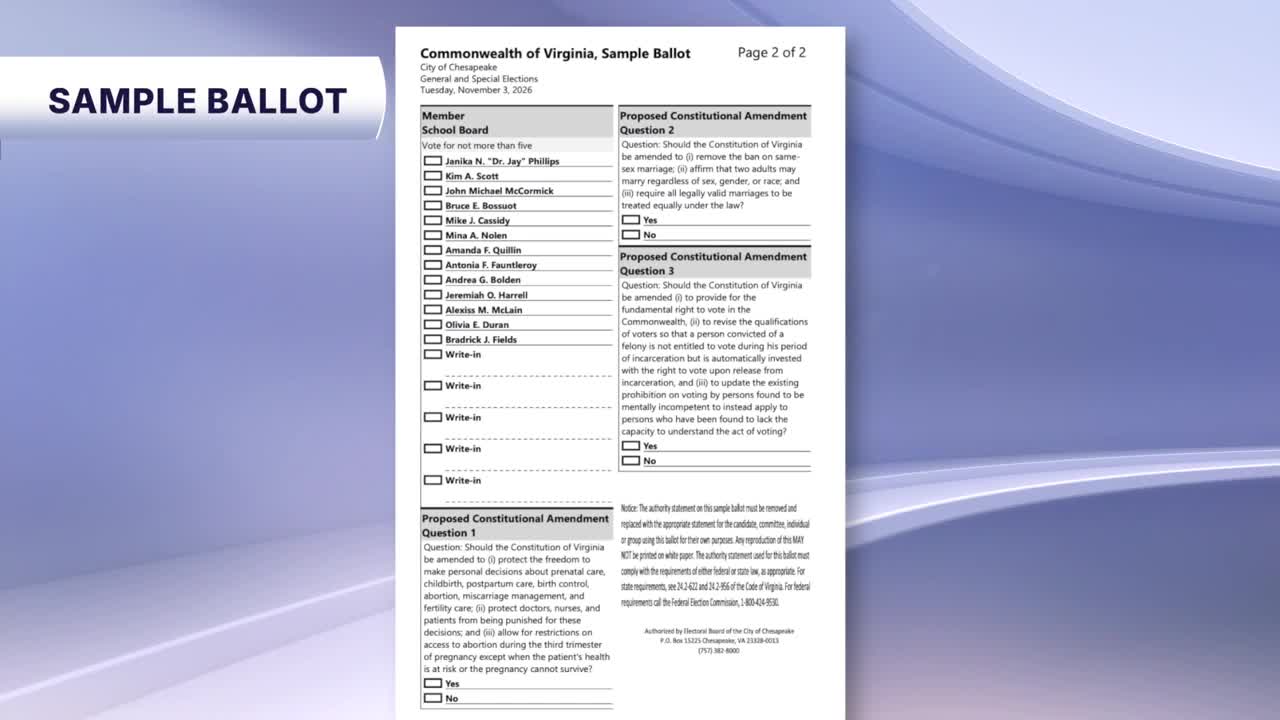


CHESAPEAKE, Va. — Beyond the candidates on Virginia ballots this election, voters are being asked to make three decisions that could change the state Constitution.
The three proposed constitutional amendments deal with reproductive rights, marriage rights and voting rights for people convicted of felonies.
But do voters know they're there, and do they understand what a "yes" or "no" vote means?
News 3's Chesapeake reporter Erin Holly spoke with early voters Friday at Indian River Library in Chesapeake about how prepared they felt to answer the three questions.
“I was not aware of that. I didn’t know it was gonna be on it,” voter Aiden Harris said.
Another voter, Sherri White, said the information she knew about the amendments came from conversations with other people.
“Mostly I learned about it through just word of mouth,” she said.
Other voters said they had researched the amendments and encouraged others to do the same.
“Oh, it was absolutely on purpose to confuse people. That is the point. You must do your own research,” Chesapeake voter Mikki H. said, expressing her opinion about the ballot language.
Dr. Jesse Richman, a political science professor at Old Dominion University, says it's possible some voters will arrive at the polls without knowing about the amendments.
“I think it's possible people won't know,” Richman said. “There's been some advertising, there's been some coverage, but we haven't been looking at the kind of saturation focus on the constitutional amendment provisions that we had in the spring.”
Richman called the amendments potential “sleepers,” saying some voters may arrive focused on congressional, U.S. Senate and local races before realizing they also have to decide whether to amend Virginia's Constitution.
So, what exactly are voters deciding?
The first amendment deals with reproductive rights. A yes vote would add protections for reproductive health care to Virginia’s Constitution, including abortion, birth control, pregnancy, miscarriage and fertility care. The state could still place restrictions on abortions in the third trimester, but there would be exceptions when a doctor determines the patient’s life or health is at risk, or the fetus is not viable. Virginia’s Constitution does not currently explicitly guarantee a right to reproductive freedom.
“The First Amendment deals with reproductive and abortion rights,” Richman said. “And this is an effort to place in the state constitution protections of reproductive and abortion rights.”
The second proposed amendment deals with marriage.
It would remove Virginia's existing constitutional prohibition on same-sex marriage and replace it with language establishing a right for two adults to marry regardless of sex, gender or race. It would also require legally valid marriages between two adults to be treated equally under Virginia law.
Richman explained that Virginia's constitutional prohibition on same-sex marriage is currently unenforceable because of the U.S. Supreme Court's 2015 Obergefell v. Hodges decision.
“Nonetheless, that provision is still in the Constitution, at least until this amendment takes effect,” Richman said. “And the result is, if the Supreme Court changed the Obergefell decision, Virginia might revert to that ban.”
The third proposed amendment deals with voting rights.
Under Virginia's current Constitution, a person convicted of a felony loses voting rights unless those rights are restored by the governor. The proposed amendment would instead prevent someone convicted of a felony from voting while incarcerated and automatically restore the person's voting rights upon release from incarceration.
It would also establish a fundamental right to vote for qualified voters and change the Constitution's existing provision concerning mental capacity. Under the proposed language, a person could be prohibited from voting after being found to lack the capacity to understand the act of voting.
Richman summed up the choices this way:
“Do we want to change the Constitution to enshrine abortion and reproductive rights? Do we want to change the Constitution to enshrine rights to same-sex marriage? Do we want to change the Constitution to make it easier for people to get the right to vote back?”
Richman also stressed that voters are the final step in Virginia's constitutional amendment process.
“The Constitution can't be amended except with the assent of the voters,” Richman said. “And so these amendments have been through the General Assembly twice in two different sessions with an intervening election. And now they're coming to voters.”
If voters approve an amendment, Richman said, the state Constitution is amended. He noted that in some cases additional action by the General Assembly or executive branch may be needed to implement the new constitutional provisions.
“This is the final step,” Richman said. “It's gone through the state legislature twice, then it comes to the voters.”
For voters still unsure what the questions mean, the people News 3 spoke with offered straightforward advice.
“If you're in doubt, look it up,” one voter said.
“I would say do your research before you come, do more research so you know,” another said.
Ultimately, Virginia voters will decide whether each of the three proposed changes becomes part of the state Constitution.
Watch for Erin Holly's reporting on News 3 and WTKR.com. Have a story idea or tip for Erin? Email her.

Click here to see how we use AI at WTKR News 3.
