



NEWPORT NEWS, Va. — The Navy's next aircraft carrier, the John F. Kennedy, has completed sea trials and is back at Newport News Shipbuilding for further testing and evaluation ahead of its scheduled delivery to the Navy in March 2027.
The Kennedy will be the second carrier in the Gerald R. Ford class. The USS Gerald R. Ford returned in May after a record-setting 11-month deployment.
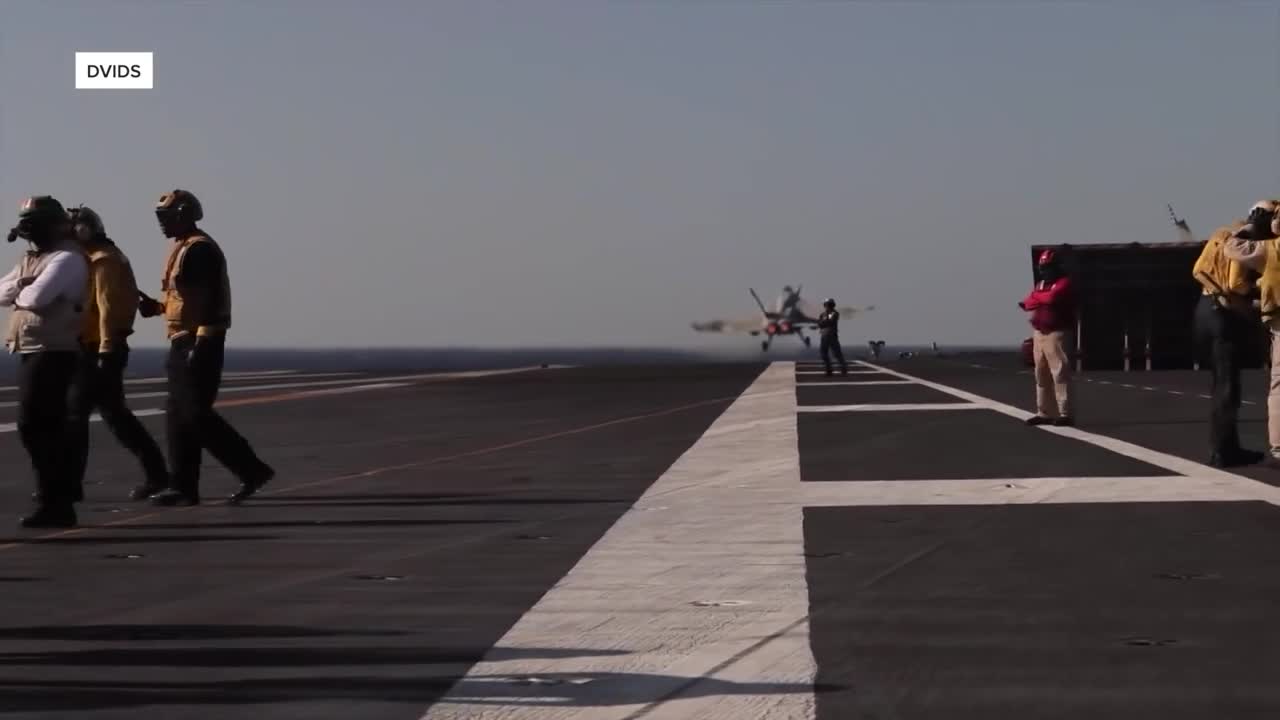
Now, a debate is growing over the design of a future carrier. President Trump is asking the Navy to develop a plan to replace the Electromagnetic Aircraft Launch System and Advanced Weapons Elevators with steam and hydraulics systems in CVN-81, currently known as the future USS Doris Miller, the fourth carrier in the Ford class.
In a memorandum, Trump addressed the reasoning behind the proposed change.
"The United States Navy has experienced a series of shipbuilding setbacks stemming from overly complex designs and iterative design change procedures, which have resulted in cost growth, delays, and cancellations," Trump said.
WATCH: Hampton Roads workforce leaders react to Navy's submarine contract award to HII
The announcement has drawn criticism, including from Virginia Sen. Tim Kaine, who was asked about it at a recent event in Newport News.
"I think the president's proposal to go back to steam is frankly idiotic," Kaine said.
Kaine said he recently spoke with sailors on the Ford after they returned from deployment, who told him the new technology worked well. There is also concern that a redesign would be costly.
"When you have a system that is proven under battlefield conditions in the longest deployment ever that it works, why would you say we gotta go back and do the old way?" Kaine said.
WATCH: Trump's new battleship class could be assembled at Newport News Shipbuilding facility
Virginia Rep. Jen Kiggans, a Republican, offered a different perspective in a statement.
"As the Navy considers changes to carrier construction, the experience and feedback of our Sailors and Aviators must be part of that process. I'm confident this Administration and Navy leadership are listening to our operators and will make the changes necessary to deliver a capable, reliable fleet," Kiggans said.
Chief of Naval Operations Admiral Daryl Caudle also weighed in on the potential costs of reverting to older technology, in comments published in the U.S. Naval Institute.
"If we were to go back to steam and hydraulics with the elevators, we need to really understand the total cost of that. I can tell you that will be a significant design change," Caudle said.
Kaine is vowing to fight the proposed redesign.
"I'm going to do everything I can as an armed services committee to stop him from scraping this technology and spending billions and billions of dollars on an inferior technology," Kaine said.
This story was reported on-air by a journalist and has been converted to this platform with the assistance of AI. Our editorial team verifies all reporting on all platforms for fairness and accuracy.
Click here to see how we use AI at WTKR News 3.
