

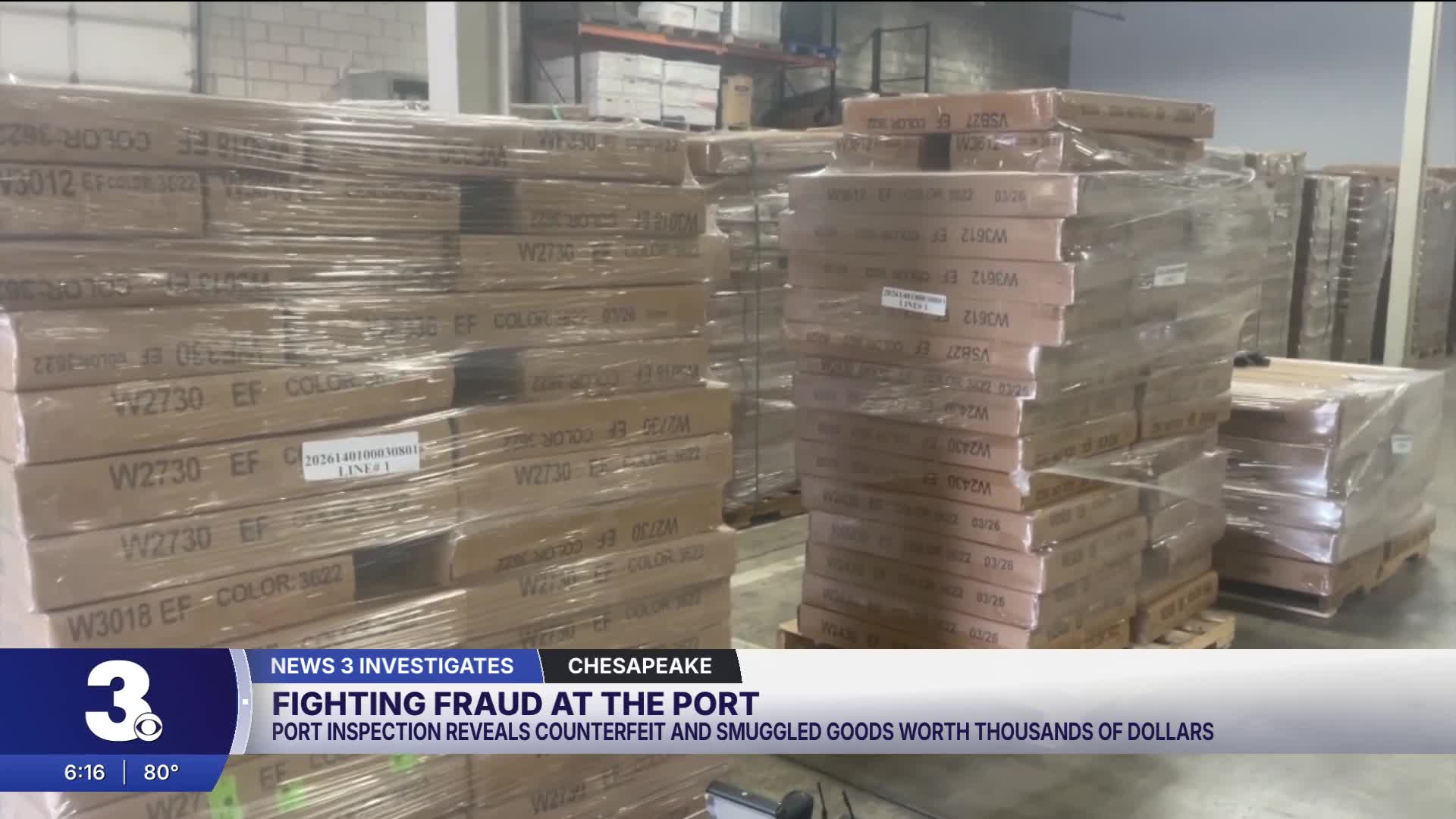


U.S. Customs and Border Protection agents in Chesapeake are intercepting stolen vehicles, weapons, drugs, and counterfeit goods moving through local ports — and WTKR got a behind-the-scenes look at how they do it.
Chief James Askew, who has 22 years of experience with U.S. Customs and Border Protection, walked Investigative Reporter Margaret Kavanagh through their Centralized Examination Station, where agents inspect shipping containers flagged as suspicious.
"It's different every day. It's like Christmas every day when you open up a container — you don't know what you're going to find," Askew said.
One 40-foot container agents deemed suspicious was being examined for possible weapons shipments.
"That one's being targeted for weapons possibly going to Honduras," Askew said.
Agents also confiscated an $80,000 Mercedes — a vehicle worth far more once it reaches overseas markets.
"These criminals are getting three times as much for cost of the car," Askew said.
High end stolen vehicles are frequently found inside shipping containers. Askew said agents have recovered 183 stolen vehicles so far this year, ranking the port second in the nation, behind only New York and New Jersey.
Marijuana is another recurring problem — particularly in outbound shipments.
"Marijuana is a big problem going outbound," Askew said, noting it is especially common in shipments heading to the United Kingdom.
Askew said a significant amount of what comes into the country originates from China. A growing concern involves fraudulent companies mislabeling shipments to avoid paying duties and tariffs.
"The cabinets that we saw — that's all based off fraud. The broker is a shell company using fraudulent IDs and they're undervaluing what the shipment is worth, therefore they're evading duties and tariffs," Askew said. "So, it's costing the American taxpayers money."
During the tour, agents pointed to a set of fences initially declared at a value of about $8,000. Askew said the actual value is likely closer to $156,000.
"It is increasing — it is a huge problem right now, and it is certainly being carefully examined and investigated," Askew said.
Some mislabeled or fraudulent products pose direct safety risks to consumers.
"If somebody uses that product, it could cause their house to catch fire — so we're protecting the American people by stopping bringing these products in," Askew said.
Intellectual property fraud is also on agents' radar. During the tour, agents examined a shipment bearing the Jessica Simpson label to verify the company had authorization to use it.
"If not, this will be a seizure," Askew said.
Tracking down the people behind these schemes remains a significant challenge.
"The lack of information that's provided, the false information that's provided, false phone numbers, false addresses — it's very difficult to track them down," Askew said.
When asked whether anyone would face criminal charges, Askew said cases can be referred to Homeland Security Investigations, but noted that agency is also stretched thin.
"These folks are just going to lose their stuff and it's going to go to auction," Askew said. "We don't have the time to open every container — we'd stop commerce, right? So our job is to keep commerce moving, keep legitimate trade travel going. We just try to pick off the ones we know are bad."
