



NORFOLK, Va. — For high-risk patients, the most stressful part of a lung scan isn't the test itself—it's the "watch and wait" that comes after.
Doctors could see a suspicious lesion on scans but had no way to reach it. Now, a new robotic technology at Sentara Leigh Hospital is changing that.
The first step is getting a low-dose CT scan.
"The scan takes no more than 5 or 10 minutes. It's a painless procedure," said Dr. Simanta Dutta, a pulmonary and critical care physician.
The real anxiety starts if doctors like Dutta see something in the lungs, but they can't get to it.
"I can't imagine what those patients go through thinking that they might have a cancer growing in their body," Dr. Dutta said.
"It's very frustrating to wait another three months for a CT scan to see if the lesion grew [large enough for us to get to]," Dr. Dutta said.
Dr. Dutta is a pulmonary and critical care physician at Sentara Leigh Hospital and tells me nodules on the lungs are no longer too small or deep for him to get to.
“Imagine the lung to be like a tree. The further you go from the stem; the branches get smaller and smaller. So, if you have a lesion in the furthest branch, you know, the older generation technology was limited because the cameras could go only so far. But no place is unreachable in the lungs right now. They can go to the furthest edges of the lung,” Dr. Dutta said.
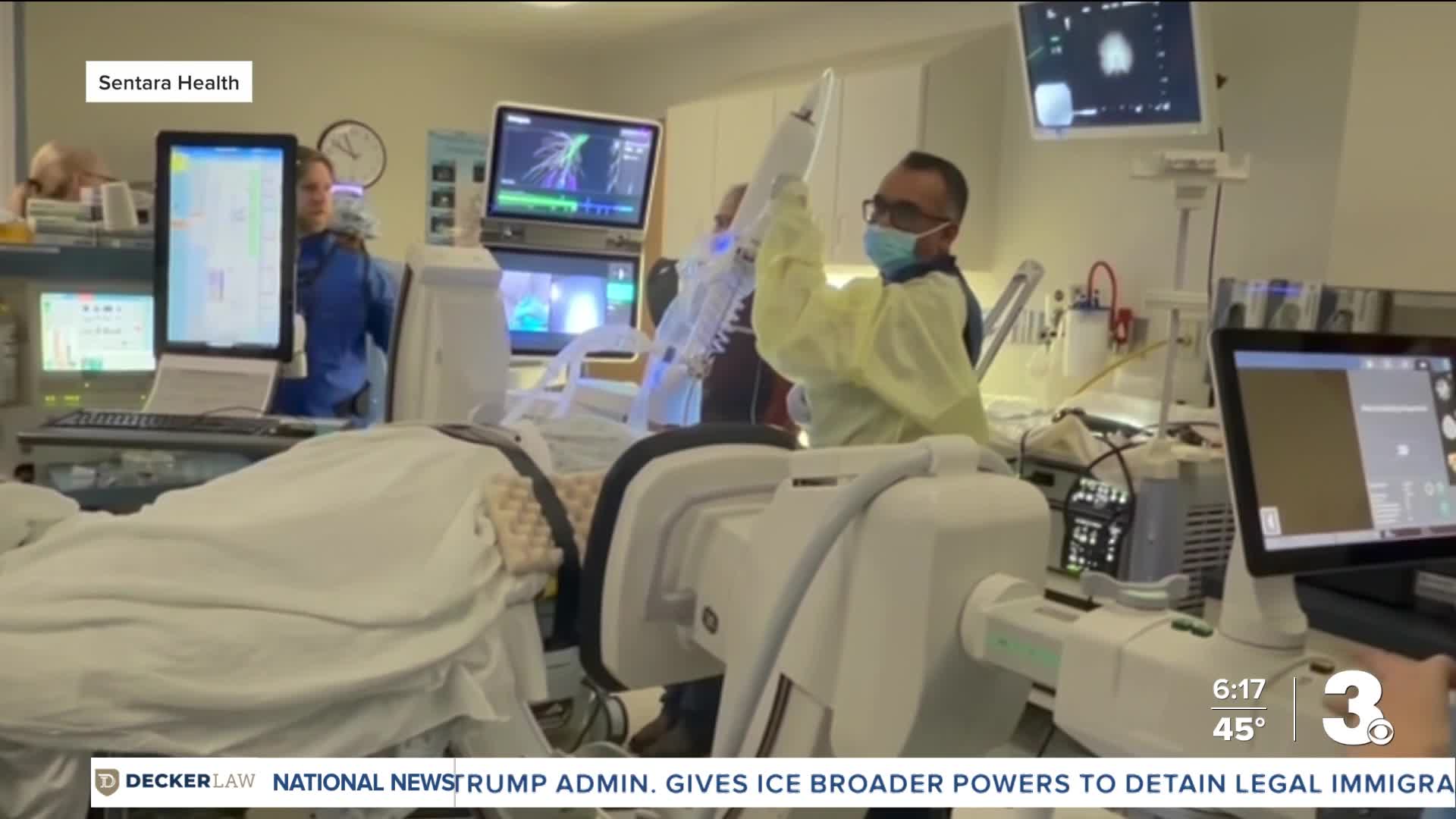
It's called a robotic bronchoscopy, and I was given the first look of the first time this tech was used on a patient at Sentara Leigh.
Dr. Dutta was in the driver's seat during the procedure.
He said, "[With this new machine] we are able to chart a pathway, like a GPS, to that lesion and then direct very fine catheters under virtual guidance with real-time imaging to that lesion and get biopsies from that targeted spot.”
I learned about this technology in December from Dr. Sherif El-Mahdy, and now I'm following through—seeing it successfully used on our neighbors. Because when cancer, especially lung cancer, is found early and small, then treated—people have more time.
"I am very confident, without being cocky, that we will be able to help our patients greatly," Dr. Dutta said.
Lung cancer is the second most common cancer in both men and women in the United States, but the leading cause of cancer deaths, according to the American Cancer Society.
Low dose CT screening is recommended for people who meet the following criteria:
- Aged 50 to 80
- Have at least a 20 pack-year history -- meaning they smoked one pack a day for 20 years or two packs a day for 10 years
- Current smoker or quit within the past 15 years
Other factors include secondhand smoke, environmental exposure, or a history of lung cancer.
"This story was reported on-air by a journalist and has been converted to this platform with the assistance of AI. Our editorial team verifies all reporting on all platforms for fairness and accuracy."
