

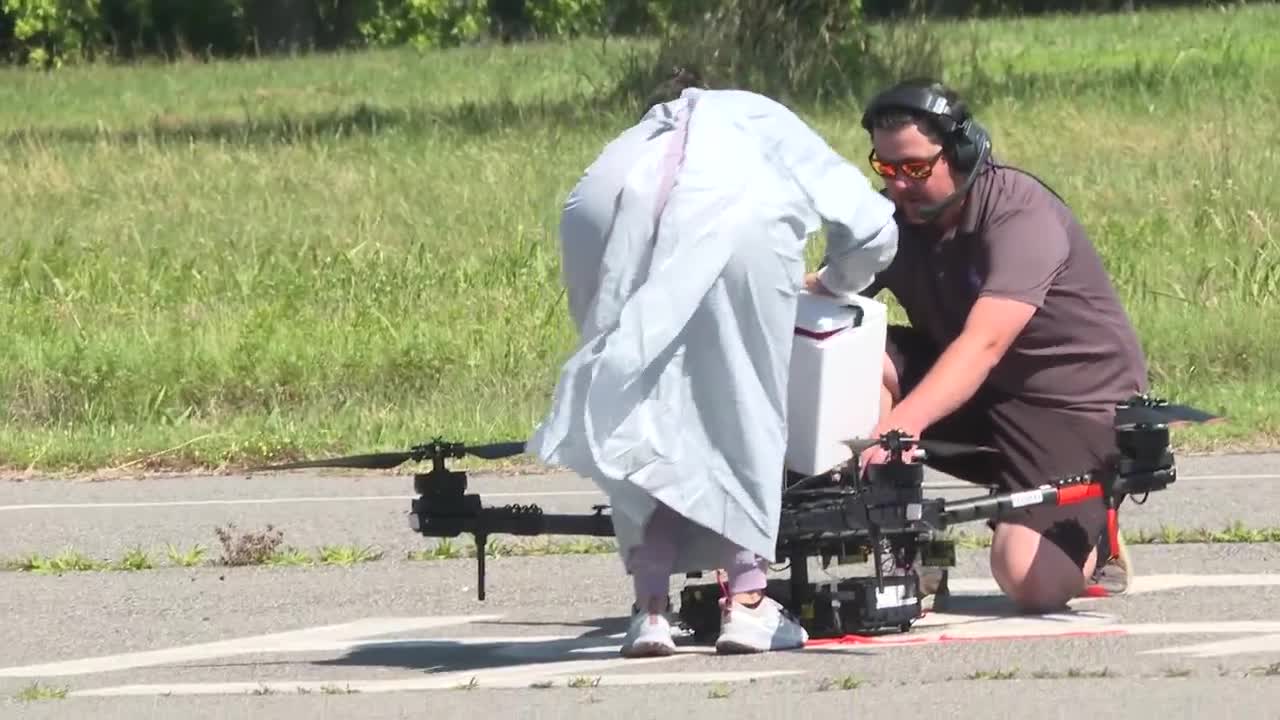


HAMPTON, Va. — A drone at NASA Langley Research Center in Hampton is helping revolutionize organ transport. Friday, a first-of-its-kind test was performed.
A human kidney, packed inside a white styrofoam container, was loaded onto a drone and flown away.
“When you talk about doing something that impacts people, everybody here just lights up," NASA Langley Aeronautics Research Directorate Dir. John Koelling said.
Watch: Race For Hope to raise funds, awareness for organ donation in Virginia Beach
The flight was the first for the NASA team with a human kidney and came after about four months of test flights with a sausage. The flight was also the first beyond visual line of sight.
“Moving from the visual line of sight where everyone’s eyes [are] on it t the beyond line of sight, there have been some learning issues and roadblocks and approval issues with that," NASA Aerospace Engineer Kyle Smalling said. "We are working through them, but that’s kind of why we’re here. It’s research.”
NASA is partnering with the United Network for Organ Sharing for the research. It’s an organization contracted by the federal government to run the country’s organ donation and transplant system.
Watch: NASA Langley engineers hope drone research will open door for air taxis
“We do think this capability can help save lives," said UNOS Senior Policy Analyst Kaitlin Swanner said.
The goal is to use drones to fly organs short distances, potentially up to 15 miles, between airports and hospitals. That could make transporting them faster and more efficient.
“It’s been really exciting in our partnership with NASA to see how many people, both in the aviation industry and the organ transportation industry are really excited about making progress in this area," Swanner said.
Watch: NASA Langley scientists playing important roles as part of Artemis II mission
The kidney used in the flight was not able to be transplanted into a human, which is why it was used. The drone flew for about 20 minutes, landing about a mile away from where it took off.
“The beauty of the Hampton Roads area in testing this kind of technology is that every one of the problems you’re going to have to face with small, low-altitude drone delivery, whether it’s organ transplant or whatever, all the problems you’re going to have to face are right here," Koelling said. "So if we can do it here, it can be scaled to anywhere in the country."
The drone research could also have other applications. One is the future of space exploration, according to Koelling.
Watch: Koelling explains how drone research could be useful for more than organ transport
As of Friday, NASA was working on setting up flights between a college medical facility in Richmond and Richmond International Airport. Swanner said the goal was to start the flights within a year.
Click here to see how we use AI at WTKR News 3.
