

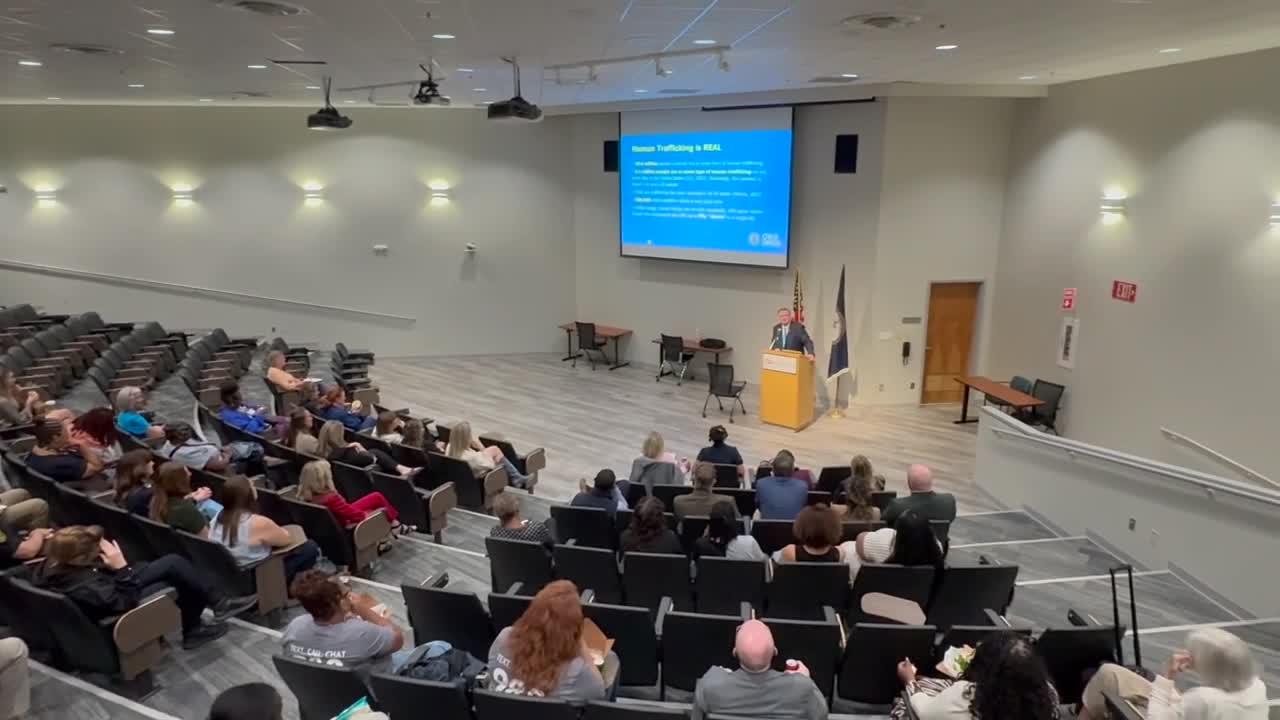


NORFOLK, Va. — Doctors, nurses, other healthcare professionals, community leaders and law enforcement gathered at Sentara Norfolk General Hospital Thursday for a first-of-its-kind training in Virginia aimed at helping them recognize and respond to human trafficking.
The training, led by the U.S. Department of Homeland Security's Blue Campaign, focused on breaking down misconceptions surrounding human trafficking, identifying potential warning signs and making sure healthcare workers know what to do when they believe someone may need help.
For one of the Sentara leaders who helped bring the training to Norfolk, the issue is deeply personal.
Lavinia Smith, Sentara's senior director of strategy and innovation, said a member of her family experienced human trafficking. When that family member sought care at a hospital outside Virginia, Smith said the response was not what they needed.
"My family member was shamed. They weren't believed," Smith said. "They were dismissive, not understanding."
Smith said that experience ultimately became a mission. She became involved in anti-human trafficking efforts and has spent the past two years working to bring the DHS training to Sentara.
"I made it my mission to make sure that when individuals came into our facilities, that we were going to make sure that our staff is trained appropriately," Smith said.
The training comes as human trafficking continues to be investigated across Virginia.
The National Human Trafficking Hotline identified 228 trafficking cases involving 342 people in Virginia in 2024, the most recent year for which the hotline currently publishes state-level annual data. The hotline received 661 signals from Virginia that year, including 112 directly from survivors or people experiencing trafficking.
Since 2007, the hotline has identified 2,222 trafficking cases involving 4,552 people in Virginia.
Virginia State Police also has a dedicated Human Trafficking Unit that administers the Hampton Roads Human Trafficking Task Force and the Virginia Capital Area Human Trafficking Task Force. In 2024, the unit made 34 arrests resulting in 135 charges.
Investigators and advocates caution that human trafficking does not always look the way people may expect.
Betsy Dixon, manager of Sentara's Behavioral Health Navigators, said one challenge for healthcare providers is that what a survivor tells them may initially sound difficult to believe.
Dixon said someone might describe being moved across state lines or, in the case of a child or teenager, being harmed by a parent. Those accounts can sometimes be interpreted as delusions rather than potential signs of trafficking.
One warning sign, Dixon said, can be when a patient is not allowed to be alone and another person remains with them throughout their care.
If a healthcare provider is able to speak with the patient alone, Dixon said listening without immediately passing judgment can be critical.
"It's very important that you are compassionate, warm, listening, and believing what they tell you," Dixon said. "Ultimately, even if the story sounds crazy, I think it's key that as a medical provider, it's not your job to decide if it's happening or not. It's your job to listen to the patient and then report it to the proper authorities."
Another misconception addressed during the training is who can experience trafficking.
Smith stressed that people should not assume survivors are always children, teenagers or young women. Adults, men, older people and professionals can also experience trafficking.
"Don't always assume that it's a child. Don't always assume that it's an adolescent or a female or male," Smith said. "But don't leave out the elderly because they are trafficked as well, and so are professionals."
DHS's Blue Campaign is part of the agency's Center for Countering Human Trafficking. The national awareness campaign works with law enforcement, government agencies, nonprofit organizations and the private sector to educate people about recognizing and responding to potential trafficking.
Tom Ruck, with the Blue Campaign, said healthcare professionals may be in a particularly important position to recognize when something does not seem right.
Potential warning signs could include someone who cannot provide consistent information about where they live or work, provides false identifying or insurance information, or appears to be controlled by another person.
Ruck said the training is not simply about spotting those indicators. Healthcare organizations also need procedures in place so workers know what to do next and whom to contact.
"If it doesn't feel right, say something, plain and simple," Ruck said.
The training also addressed risks outside hospitals, including what parents should watch for online.
Ruck told News 3 that some studies estimate more than 500,000 child predators are online at any given time. He urged parents to take an active role in understanding who their children interact with online and to make conversations about potential dangers routine.
"Know what your kids are doing when they're online. Get involved and understand what they're doing," Ruck said, adding that parents should "establish that communication between you and your kid."
Virginia State Police lists several other potential indicators of trafficking, including someone who appears fearful or submissive, shows signs of physical abuse or being denied basic necessities, appears coached on what to say or is accompanied by someone who appears to control where they go or whom they speak with.
Authorities stress that any one indicator by itself does not necessarily mean someone is experiencing human trafficking.
For Smith, the hope is that greater awareness means a survivor who walks into a hospital will encounter someone prepared to recognize what may be happening — and willing to listen.
"It takes a lot of guts to bring yourself to the hospital," Smith said. "They're very brave. So when they get there, it's vital for people to listen."
Click here to see how we use AI at WTKR News 3.
