

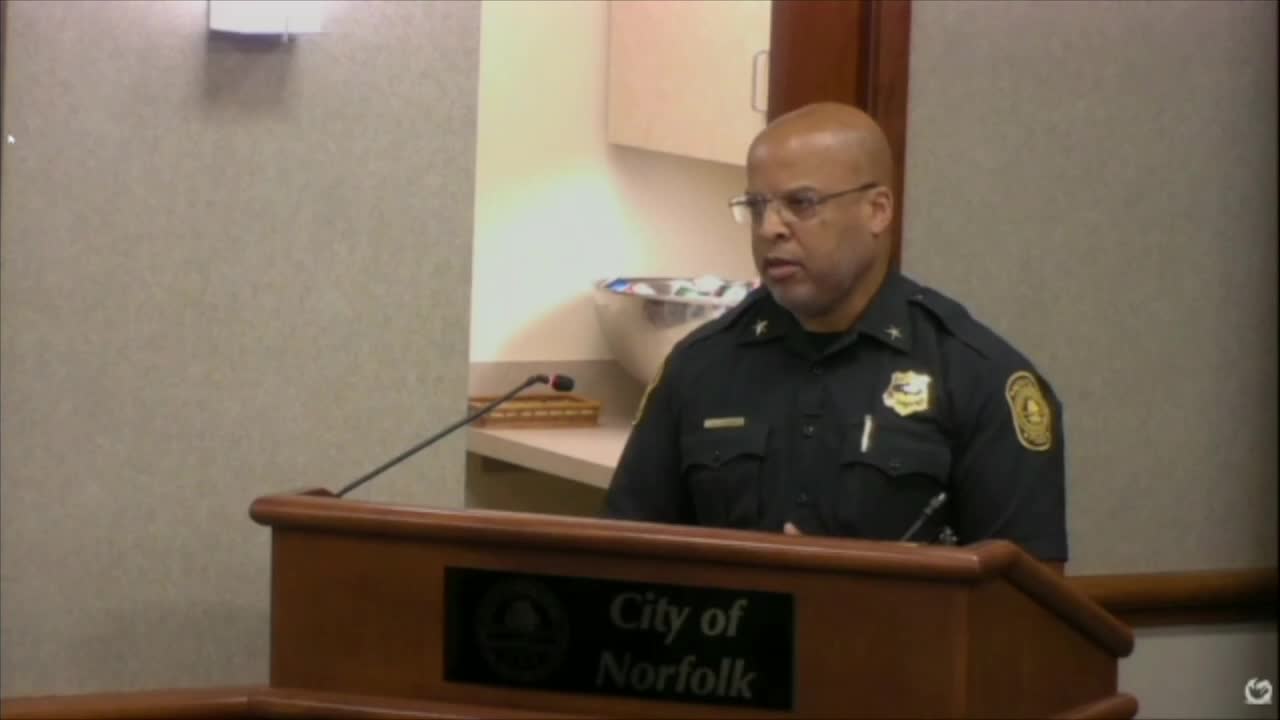


NORFOLK, Va. — Norfolk Police Chief Mark Talbot says the city is seeing an increase in homicides this year even as several other categories of violent crime are trending downward.
Talbot presented an update on crime, police staffing and technology to Norfolk City Council Tuesday night, telling council members that overall violent crime is down 3% year-to-date.
But homicides remain a significant concern.

Norfolk
Norfolk sees spike in 2026 homicides despite overall downward US trend: Report
Norfolk has recorded 28 homicide incidents involving 29 victims so far this year, Talbot said. He told council members that the increase is concentrated in some areas that have historically experienced higher levels of violent crime.
In response, Talbot said the department has developed a comprehensive plan aimed at reducing homicides. Police have increased the frequency of shooting-review meetings, stepped up targeted enforcement and deployed additional resources to areas experiencing violent crime.
"We've deployed additional leadership personnel and dozens of additional officers in our violent crime hotspots over the last several weeks," Talbot told council members, adding that the increased presence is expected to continue for the next few months.
While homicides have increased, other categories of violent crime have moved in the opposite direction.
Robberies are down 3% compared with last year, while aggravated assaults are down 10%, according to the figures Talbot presented. Sexual assaults, however, have increased.
When asked about the increase in homicides, Talbot said investigators are seeing some common factors.
He said one frequent motive involves young men who are already involved in criminal activity and become involved in disputes connected to guns or drugs. Those incidents often happen in areas police have historically identified as crime hot spots and frequently involve people who know each other.
Talbot said some of those individuals are connected through small, neighborhood-based groups. While those groups can sometimes be gangs, he said that is not always the case.
"They tend to be networked together in small groups that commit crimes together, and those small groups spur retaliation," Talbot said.
Talbot said those cases can also be among the most difficult for detectives to solve.
The city's shooting numbers have also increased compared with the past two years. Talbot said shooting incidents are 15 higher than at this point last year and 10 higher than at the same point the year before.
However, he said shootings remain significantly below levels seen several years ago. Norfolk has recorded less than half the number of nonfatal shootings seen at this point in 2021 and 2022.
Talbot also addressed the increase in sexual assaults. Unlike other types of violent crime, he said police have not identified the same kind of geographic or group-related pattern.
"What we're not seeing is cases in which strangers are engaged in the activity," Talbot said.
He added that police are not currently looking for a serial offender connected to the increase and said the department continues to monitor how frequently those cases are solved and whether detectives are conducting the necessary follow-up.
Property crime is another challenge for the city.
Property crimes are up 11% compared with last year and are largely responsible for pushing Norfolk's total crime rate up 10% year-to-date, Talbot said. Despite the year-over-year increase, he said property crime remains below most of the other recent years included in the department's comparison.
Police staffing trending upward
Talbot also pointed to progress in recruiting and retaining officers.
Norfolk currently has 546 sworn officers, up from 535 at the same point last year. Talbot said applications have increased substantially over several recent recruit classes and that the department is slowly growing.
The city's 911 center has also made progress.
Talbot said the average 911 call wait time is now 16.6 seconds, down from wait times in the 40-second range when the police department took over the operation.
The center currently has 16 vacancies and would be fully staffed with 83 employees, according to Talbot.
Talbot said higher salaries are helping attract applicants both for policing and the 911 center, though the departments are also losing a higher percentage of candidates during the hiring process than they have at other times.
Norfolk preparing to use AI on non-emergency calls
Council members also discussed a new technology that could soon change what some people hear when they call the city for non-emergency assistance.
City officials said Norfolk is preparing to deploy an Amazon-branded artificial intelligence tool that would serve as a virtual operator for some non-emergency calls.
The goal is to use the technology first on the non-emergency line, where lengthy calls can tie up resources, before considering whether it could eventually be used more broadly. Officials said residents would be notified that they may interact with a virtual operator.
Talbot said the department is close to moving forward but wants to be confident in the system before it is deployed.
"Humans make mistakes. So does AI," Talbot said.
He said the stakes are particularly high when someone calling police is already under stress.
"We want to make sure that it is good enough to get us through non-emergency, and then we'll look at the technology applied to the emergencies as well," Talbot said.
Chief defends use of Flock cameras
Another significant portion of Tuesday's discussion centered on Norfolk's use of Flock license plate-reading cameras.
Talbot defended the technology, saying it has become an important tool for investigating both violent and property crimes.
He pointed to several recent cases in which police say the cameras helped investigators identify suspects.
In April, Talbot said Flock cameras helped detectives investigate a shooting into an occupied home. Investigators were able to identify people connected to the case and recover an AR-15 from a vehicle.
In July, Talbot said the cameras helped police track down suspects and make arrests following a nonfatal shooting at a location where methamphetamine was being sold.
Talbot also credited the cameras with helping investigators quickly identify a suspect following a recent hit-and-run that critically injured a 9-year-old boy near Old Dominion University.
"They continue to help us to take dangerous people off the street," Talbot said.
The department has also added an auditing tool designed to monitor how Flock data is accessed. Talbot said the system allows police to determine whether someone accessing the technology is doing so appropriately and quickly identify potential misuse.
During questions from council members, Talbot said police are also seeing firearms circulate among people involved in crimes.
Through the National Integrated Ballistic Information Network, or NIBIN, investigators can connect shell casings recovered at crime scenes to firearms. Talbot said that technology has shown police that some guns are being passed from one person to another.
Rather than focusing primarily on where those guns originally came from, Talbot said the department's strategy is to identify the relatively small number of people most likely to use a firearm while committing a crime.
"We spend a disproportionate amount of our time focusing on those offenders," Talbot said.
Despite the increase in homicides, Talbot's presentation showed a mixed crime picture for Norfolk in 2026: homicides and property crime are up, while robberies, aggravated assaults and violent crime overall are down.
The department is responding by concentrating officers and enforcement in areas experiencing shootings and homicides while continuing to expand its use of technology and rebuild staffing.
Click here to see how we use AI at WTKR News 3.
