

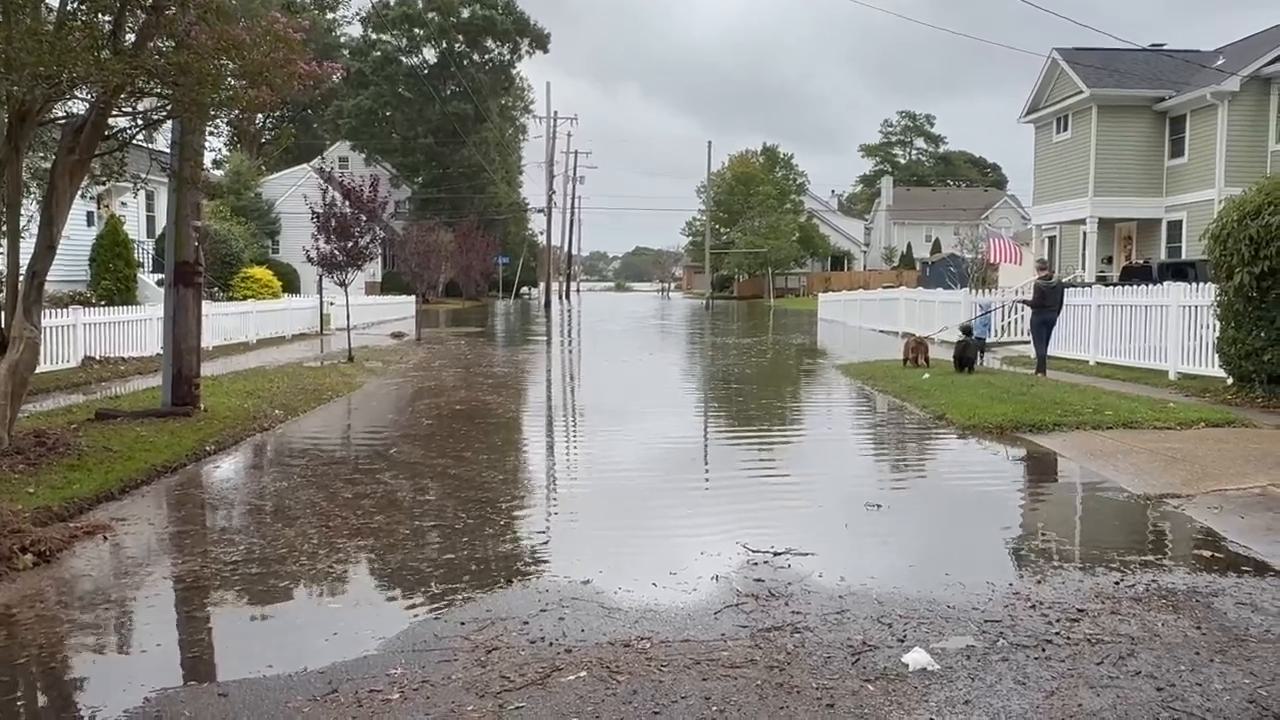


NORFOLK, Va. — For Michelle Rhodes, watching floodwater creep toward her Larchmont home is an all-too-familiar experience.
Rhodes has lived in the Norfolk neighborhood for nine years. On Thursday, she watched as water filled the street outside her home, reaching the steps of her front door.
She sent News 3 video showing just how close the water had gotten.
"I cry, and I think of all the yard work we have to do, and I sit there and watch and say, 'Please don't come up anymore.' And I'm constantly checking my basement," Rhodes said.
Rhodes is among the residents across Norfolk dealing with tidal flooding as strong northeast winds push water into the Chesapeake Bay during a period of higher astronomical tides.
News 3 neighborhood reporter Jay Greene traveled across the city Thursday, finding flooded streets in Larchmont, Colonial Place and the NEON District. Residents in Ocean View also reported rough surf and flooding that made getting around more difficult.
While flooding is nothing new for many Norfolk neighborhoods, Rhodes says a recent flood protection project is making a noticeable difference in her community.
Last October, News 3 reported on a berm project designed to help protect parts of Larchmont from flooding.
Nearly a year later, Rhodes says she's seeing the results.
"I feel like it has had a significant impact on this. It's been great," Rhodes said.
She recalled several storms over the summer when she expected the water to reach farther into her neighborhood.
"I know a couple storms passed this summer, like we expected it to be up to here, and it only made it to the intersection," she said.
Rhodes estimates the project has helped keep floodwater roughly 40 feet farther back during some previous storms, preserving parking spaces that otherwise might have been underwater.
"So I mean, even these cars parked right here. I'm surprised that they're okay because in the past they wouldn't have been okay there," she said.
Despite those improvements, Thursday's flooding still brought water close to her home.
Rhodes said the water had reached the second step of her house.
For residents in flood-prone neighborhoods like Larchmont, knowing where to park and how to navigate flooded streets has become part of everyday life.
"When someone new moves in, we always give them the tutorial. Hey, when you see this, make sure your cars are over here," Rhodes said.
While some residents were watching the water rise, others were finding ways to help their neighbors get around.
Rhodes said she and her husband spent Wednesday evening on their patio watching people try to navigate the flooded street.
When she noticed people struggling to get through, she offered them another route.
"I'm like, come through the gate," Rhodes said. "So I opened the gate last night for them so they could walk around there."
She said other neighbors were offering boots and looking for ways to help.
By Thursday morning, Rhodes was helping another neighbor who needed to get to work but couldn't get around the floodwater.
"My poor neighbor, like she needed to get to work, and she was stuck right there," Rhodes said.
Rhodes went inside to get a stepladder, allowing her neighbor to climb through the gate and cross her yard to reach the other side of the flooded street.
She said she was also waiting for the woman's husband to return so he could use the ladder.
Just down the street in Larchmont, Tommy Clarke was checking out the flooding with his young son.
Clarke has lived in the neighborhood for about 11 years and says he's learned how to prepare when the water starts rising.
"You actually get used to it. The first couple times, it's a little disconcerting, but when you see everyone start to line up on the road here and move their cars out, and you understand where the pockets are, you can plan around it," Clarke said.
With school canceled Thursday, Clarke decided to take his son outside to explore.
What started as an opportunity to splash in puddles quickly turned into a lesson about staying safe around floodwater.
"It turned into a let's go find a puddle to splash into. And then once we found the flooding, it's don't splash in those puddles, but we can go investigate and do some weather reporting," Clarke said.
Clarke said his home sits on higher ground, so his family doesn't experience the same impacts as some of their neighbors.
However, he sees how difficult flooding can make it for residents living along the lower portions of the street.
"I think that the neighbors that live on this side, it certainly impacts them, and they have to get a little creative in how they get in and out of their house," Clarke said.
He said those neighbors often move their vehicles to the main street when flooding is expected.
Clarke has also learned that conditions can become more difficult when multiple weather factors come together.
"Most of the time, when it's tidal, when storm surge comes in and rain starts to add onto it, really when you start to see problems," he said.
Across the city in Ocean View, residents have been dealing with a different view of the same coastal flooding event.
Shelby Reca, who has lived in Ocean View with her husband for five years, said they stopped by the beach Wednesday to check out the waves.
What they found surprised them.
"It was insane. We were out and about, and we decided to just stop by the beach and look at the waves, and there was no beach," Reca said.
Her husband sent News 3 video showing waves crashing along the shoreline near First View Street and Ocean View Avenue.
"The waves were literally like hitting us in the face, and we were standing on the sidewalk before you even get to the dune deck to walk down," Reca said. "So it was insane, a little scary, definitely crazy to see."
Reca said she had never experienced anything quite like it in Norfolk.
"The only time I've seen anything similar is maybe on the Outer Banks, and even then, I mean, the beach is much further from where you're standing to the ocean," she said.
"I've never seen it where it's just sidewalk straight down into massive waves, especially in Norfolk."
While Reca said her immediate neighborhood near First View Street doesn't typically experience significant flooding, getting out of Ocean View can become challenging when nearby roads are underwater.
"Out of Ocean View is a little tricky, especially if the interstate ramp at Fourth View floods really bad right there at that intersection," she said.
When that happens, Reca said she and her husband sometimes have to find another way out of the neighborhood.
"We do kind of have to get creative, and if it's flooded too bad, we might have to just backtrack a little bit and get off in Granby and come back through," she said.
"So you got to get creative in Ocean View, but there's always a way."
Reca said her neighborhood has generally fared well during flooding events, but the conditions along the beach Wednesday were unlike anything she expected to see without a hurricane directly affecting the area.
"The beach was completely gone, and yeah, we were standing on that sidewalk, and the waves were hitting us in the face," she said.
Jessica Whitehead, the Joan P. Brock Endowed Executive Director of the Institute for Coastal Adaptation and Resilience at Old Dominion University, says the timing of the coastal storm is a major factor behind the flooding.
Whitehead explained that September and October are part of what is commonly called king tide season, when some of the highest astronomical tides of the year occur.
The approaching full moon and the moon's gravitational pull contribute to higher tides.
But this week's flooding is not simply the result of higher tides.
Whitehead said an early-season nor'easter is bringing strong northeast winds that are pushing additional water into the Chesapeake Bay and toward Norfolk's shoreline.
"It's still really bad timing to line up with a very early season nor'easter," Whitehead said.
She explained that the wind can push water toward the coast in much the same way that blowing across a glass of water moves the water toward the opposite side.
"When we have that combined with where we are in the tides, it just creates a big mess," Whitehead said.
Unlike some flooding events driven primarily by heavy rainfall, Whitehead said this week's flooding is largely the result of wind and tidal conditions.
She also noted that the highest astronomical tides of the season are expected later in October.
During her interview Thursday afternoon, Whitehead said she was particularly concerned about the evening high tide.
She expected the high tide around 8:15 to 8:20 p.m. Thursday to produce the most significant flooding of the current storm event.
"Last night's tide a little bit lower than tonight's tide," Whitehead said.
She identified Larchmont, Surrey Crescent, areas around Old Dominion University and Naval Station Norfolk, downtown Norfolk, East Ocean View and Willoughby Spit as locations where residents should watch for flooding.
Whitehead did not provide a specific forecast for Friday during the interview.
Residents should continue monitoring updated forecasts, tide predictions and local road conditions as the coastal weather event continues.
Beyond the inconvenience of flooded roads, Whitehead says residents should understand the damage saltwater can cause to vehicles.
"It's salt water, y'all. Right now, everything is expensive," Whitehead said.
She warned that driving through saltwater can damage a vehicle's brakes and undercarriage, regardless of how high the vehicle sits off the ground.
"That salt water on your brakes — it doesn't matter how high your truck is — it is going to do some damage to the undercarriage of your car," Whitehead said.
Her message to drivers is simple.
"Turn around, don't wreck your ride."
Whitehead also encouraged residents to use navigation tools that can help them avoid flooded roads.
She noted that Norfolk uses the Waze navigation app to help redirect drivers around monitored flooding locations.
"So if you use the Waze app, even if you know where you're going, it will redirect you around places that are monitored for flooding," she said.
Whitehead also warned residents against walking or playing in floodwater because it can contain harmful bacteria and other contaminants.
She pointed to research conducted at Old Dominion University that found Vibrio vulnificus bacteria in some samples collected the previous weekend.
Whitehead said floodwater can also contain human and pet waste, creating additional health concerns, particularly for people with open wounds or weakened immune systems.
"Stay out of the floodwater. Don't drive through it," she said.
Back in Larchmont, Rhodes says the flooding is something she and her neighbors have learned to prepare for, even as improvements are made to protect their homes.
The berm project has helped reduce some of the impacts, but Thursday's flooding showed that water can still reach homes and make neighborhood streets difficult to navigate.
For now, Rhodes is continuing to keep an eye on the water outside her home and checking her basement.
And when neighbors need help getting around, she says the community is finding ways to look out for one another.
As Norfolk continues to deal with the impacts of the coastal storm, residents like Rhodes are hoping the water will recede before it causes more damage.
Click here to see how we use AI at WTKR News 3.
