

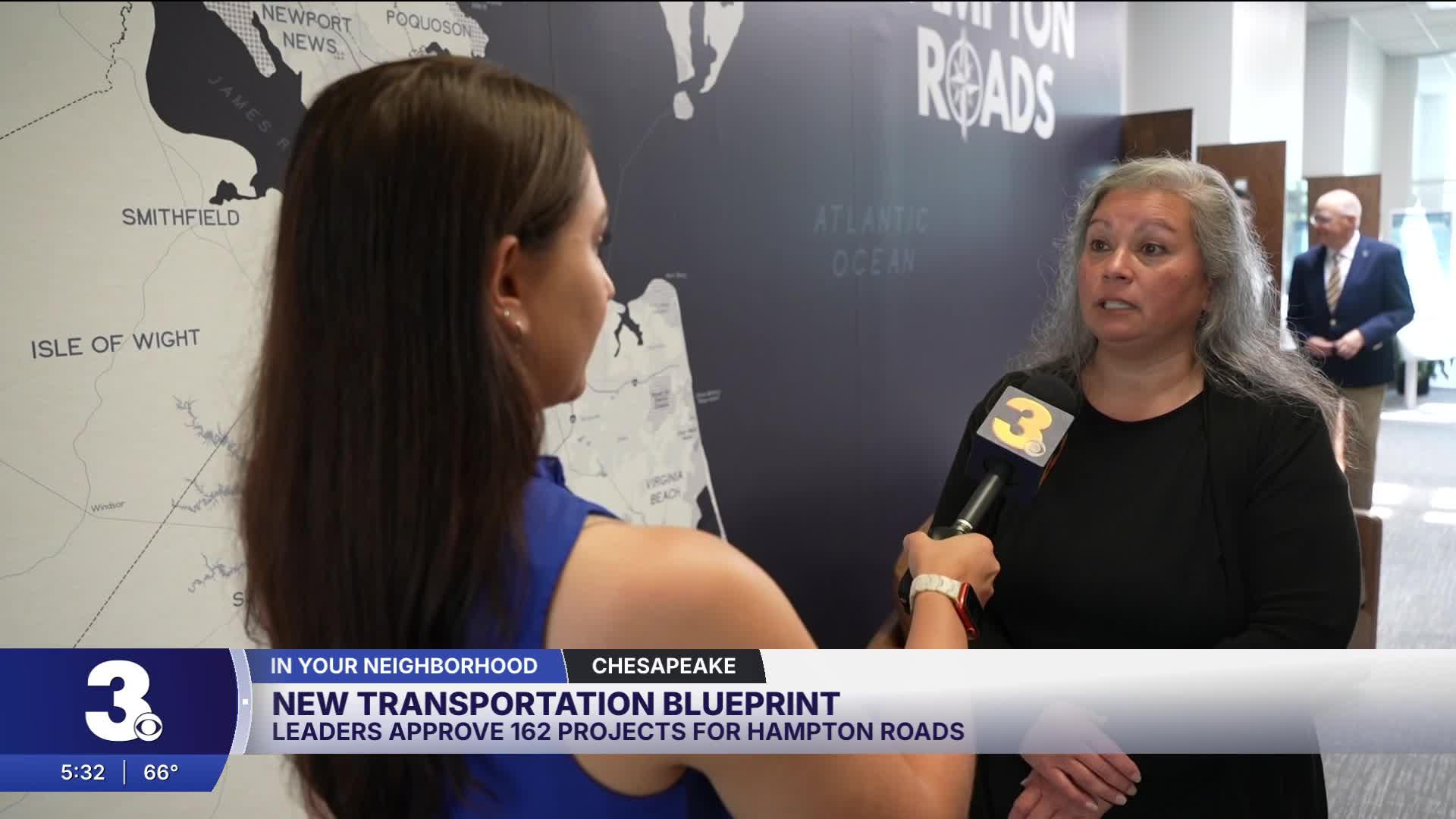


CHESAPEAKE, Va. — Transportation leaders gathered in Greenbrier Thursday to chart the course for Hampton Roads mobility over the next 25 years. The Hampton Roads Transportation Planning Organization (HRTPO) approved a plan that promises to reshape how residents move around the region. But for one Newport News man who addressed the HRPTO, he says the current reality of getting around without a car remains fraught with danger and frustration.
Eph Ragasa made the journey from Newport News to Thursday's meeting using a combination of bus and bicycle—a trip he described as "atrocious" and one that emphasized "how disconnected our community is." The Newport News neighbor who identifies as a transit rider, bike rider, and car owner, used his three minutes of public comment time to challenge transportation officials to consider alternatives beyond expanding roadways.
"I'm forced to go through incredibly busy roads, you know, cars zipping by 45 MPH, and there's no room for me to ride my bike," Ragasa told WTKR after the meeting. "Sometimes there's no sidewalk, so I'm forced to ride my little folding bicycle on the road while cars are zipping by 45 miles, 50 MPH."
His commute contrasted the day's focus on major infrastructure projects, particularly updates on the Hampton Roads Express Lanes Network (HRELN). Mike Davis from the Virginia Department of Transportation reported that the HRELN aims to provide traffic relief across Newport News, Hampton, Norfolk, and Chesapeake. The Chesapeake section is already operational as a 14-mile stretch running from the Bowers Hill Interchange across the High Rise Bridge.
Davis says peninsula construction is scheduled to wrap up by the end of this year, with the entire network set for completion by late 2027. Once finished, the HRELN will offer drivers additional travel choices and improved travel time reliability along I-64. Solo drivers will pay tolls to use the express lanes while general purpose lanes remain free. Carpoolers with E-ZPass Flex responders can use the express lanes at no charge.
The express lanes represent just one component of the newly approved 2050 Long Range Transportation Plan, a comprehensive blueprint encompassing 162 projects across the region. Dale Stith, Principal Transportation Planner for HRTPO, emphasized the cyclical nature of regional planning.
"Every five years, we're going back out to the community to see, what are our new priorities, and we just want to make sure that we're positioning our region and these transportation projects properly, so that we're queueing them up and that the projects that need to get built, can get built," Stith said.
The plan spans everything from major Hampton Roads Bridge-Tunnel work to bike trails and transit expansions. According to Stith, the long-range plan represents a "transportation for all" vision addressing congestion and safety concerns for drivers, cyclists, and pedestrians alike.
We’re not just reducing congestion, but we’re also trying to improve connectivity, and improving safety, which was that public comment that we received today. And again, not just for drivers, we want to make sure that those who have more limited choices and rely on transit or need to bike and walk–that we’re thinking about that," Stith said.
For Ragasa, the promise of future bike infrastructure feels distant compared to his current reality. He cited economic factors driving his transportation choices, noting gas prices around $4.50 per gallon and the stress of driving in congested areas.
"I think many residents here feel that they're stuck, that there's no options for them to efficiently go to work, do their grocery store, do their errands," Ragasa said. "The solution of widening lanes, adding more lanes, prioritizing more car traffic... it's a short term solution. We need to have more alternatives."
Ragasa said his decision to use alternative transportation despite the challenges reflected his commitment to experiencing firsthand the gaps in the regional transportation network.
"I just want to kind of let them know, hey, this is actually what's going on on the ground right here," he said of his message to board members. "I'm just a single resident here. I'm not part of any group or anything like that. So, but I'm just hoping that, you know, just my little 3 minutes there kind of make them at least think about it."
As Hampton Roads prepares for population growth and changing mobility needs over the next quarter-century, officials say they will balance investments in traditional infrastructure with emerging demands for sustainable, multimodal transportation options.
The 2050 Long Range Transportation Plan now moves forward with implementation, while residents like Ragasa continue to navigate the current system one commute at a time.
This story was reported on-air by a journalist and has been converted to this platform with the assistance of AI. Our editorial team verifies all reporting on all platforms for fairness and accuracy.
Click here to see how we use AI at WTKR News 3.
