

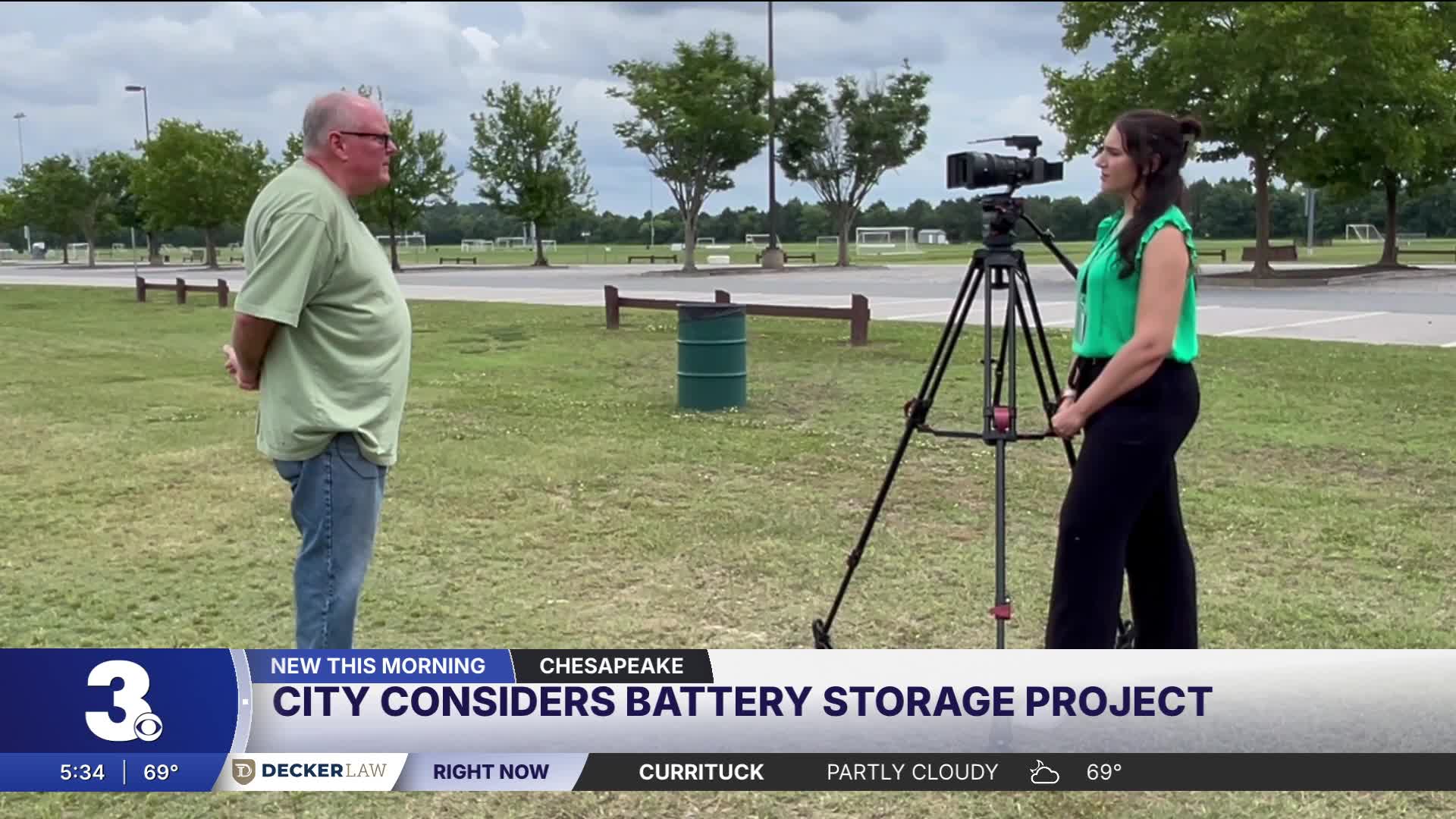


CHESAPEAKE, Va. — East Point Energy is proposing to build a battery energy storage system facility in Chesapeake's Hickory area, and the project is nearing a critical vote from city leaders. The proposed Mill Stone Energy Center, located at 1912 Centerville Turnpike South — about 2 miles north of Hickory High School — has been in development for roughly 2 years and could begin construction as early as 2030 if approved.
A battery energy storage system works by pulling power off the grid during off-peak hours, typically at night, and pushing it back onto the grid when demand is highest — during heat waves, winter storms, or other high-usage periods.
"When a peaker plant or something would normally come on, we push the energy back onto the grid and that helps stabilize the grid, provide power, and also, over the course of time, bring down prices," Elisha Kiser, the Mill Stone Senior Project Developer at East Point Energy, said.
Kiser described the technology as functioning like a pacemaker for the power grid — capable of dispatching energy within seconds to stabilize supply. The facility would be interconnected with PJM, the regional transmission grid covering 13 states including Virginia, and would respond to signals from that grid when power is needed.
Cat Chapman, East Point Energy's Manager of Community Engagement, pointed to last summer's heat wave as an example of why the region needs this kind of infrastructure.
"Last summer, if you remember the heat wave, I believe it was back in July, Virginia almost ran out of power. The grid was utilizing at 97%, so energy storage is really a solution to making sure we don't have blackouts and brownouts during high usage, during extreme weather and other emergency services," Chapman said.
The facility would be built on 112 acres of land, with only 30 acres disturbed for the project — including 2 access roads. East Point Energy plans to purchase the full parcel and has committed, as a condition of the permit, to preserving the remaining land and prohibiting any data center development on the property.
Jeff Staples, a Chesapeake neighbor with 30 years of environmental work experience, supports the project and has been working with a coalition of groups — including the Sierra Club, Chesapeake Climate Action Network, and his own organization, Save the Dismal — to help inform neighbors about battery energy storage systems.
"There's actually no emissions whatsoever that would come from this project. So, that's a huge plus right there. It won't be an eye sore. It won't be hurting our ears. And it'll actually be providing electricity for us," Staples said.
Staples says he also noted the facility's relatively small footprint.
"The battery facility is only gonna take up less than 10% of the area, so it's gonna be a preserved green space, and I think that's very important, especially in this area where overdevelopment is occurring, so we'll still have a place for wildlife in this area," Staples said.
One of the most common points of confusion surrounding the project is the difference between a battery energy storage center and a data center — a distinction developers say is critical.
"We store energy, and we feed it back to the grid when it's needed most. Data centers use energy, so, complete opposites," Chapman said.
Staples said some of the confusion stems from disinformation, as well as the fact that a data center was previously proposed for a nearby location — a project that was ultimately not approved. East Point Energy has also committed, as a condition of the permit, that no data center will be built on the Mill Stone property.
One neighbor contacted News 3 with concerns about the risk of battery fires and the facility's proximity to Hickory High School and Hickory Middle School. Developers say the project site is more than 3,000 feet from the high school, and the closest residence is nearly 1,500 feet away. Chapman addressed the fire concern directly.
"Battery energy storage facility fires account for 1 to 2% of the facilities worldwide, and the actual incidence has dropped 97%," Chapman said.
Kiser added that as a condition of the permit, East Point Energy has proposed that if an incident were to occur, air, ground, and water testing would be conducted immediately. She noted that in past high-profile battery storage fire incidents, monitoring by other companies found no lasting environmental impact.
Chapman said the company has also had extensive dialogue with the Chesapeake Fire Department to ensure crews are prepared in the rare event of a fire, and has spoken with local schools to address their concerns.
On the environmental front, Kiser said the project has already cleared several regulatory hurdles, including reviews by the Department of Environmental Quality, the Department of Wildlife and Fisheries, and SHPO. Groundwater and stormwater design concerns have also been addressed in the facility's plans. Additional permitting — including DEQ permits, a site plan, and a permit by rule from the State Corporation Commission — will be required further along in the process.
Staples said the facility's energy source adds another layer of environmental benefit.
"The energy that will be stored in there is coming from the offshore wind project. So all in all it's a very clean resource for us," Staples said.
East Point Energy held its third and final community meeting at Hickory High School Wednesday night ahead of the upcoming planning commission vote. The interactive session featured stations covering topics including fire safety, the permitting process, the site plan, and the company's background. Residents were also able to submit written questions and comments.
"It's really important that we listen to the community, hear those concerns, and address them in the development of our project," Chapman said.
The Mill Stone Energy Center is scheduled to appear on the Chesapeake Planning Commission agenda on June 10. If the planning commission recommends approval, the project would move to the Chesapeake City Council for a vote on July 21. Both meetings are open to the public for comment.
If approved by both bodies, the project would enter an interconnection study process — during which the project is analyzed in relation to the PJM grid — that is expected to take about 2 to 2.5 years. Additional permitting would follow, with construction estimated to begin around 2030 and operations potentially starting in 2031.
Chesapeake residents with questions about the Mill Stone Energy Center can click here or email millstone@eastpointenergy.com.
This story was reported on-air by a journalist and has been converted to this platform with the assistance of AI. Our editorial team verifies all reporting on all platforms for fairness and accuracy.
Click here to see how we use AI at WTKR News 3.
