

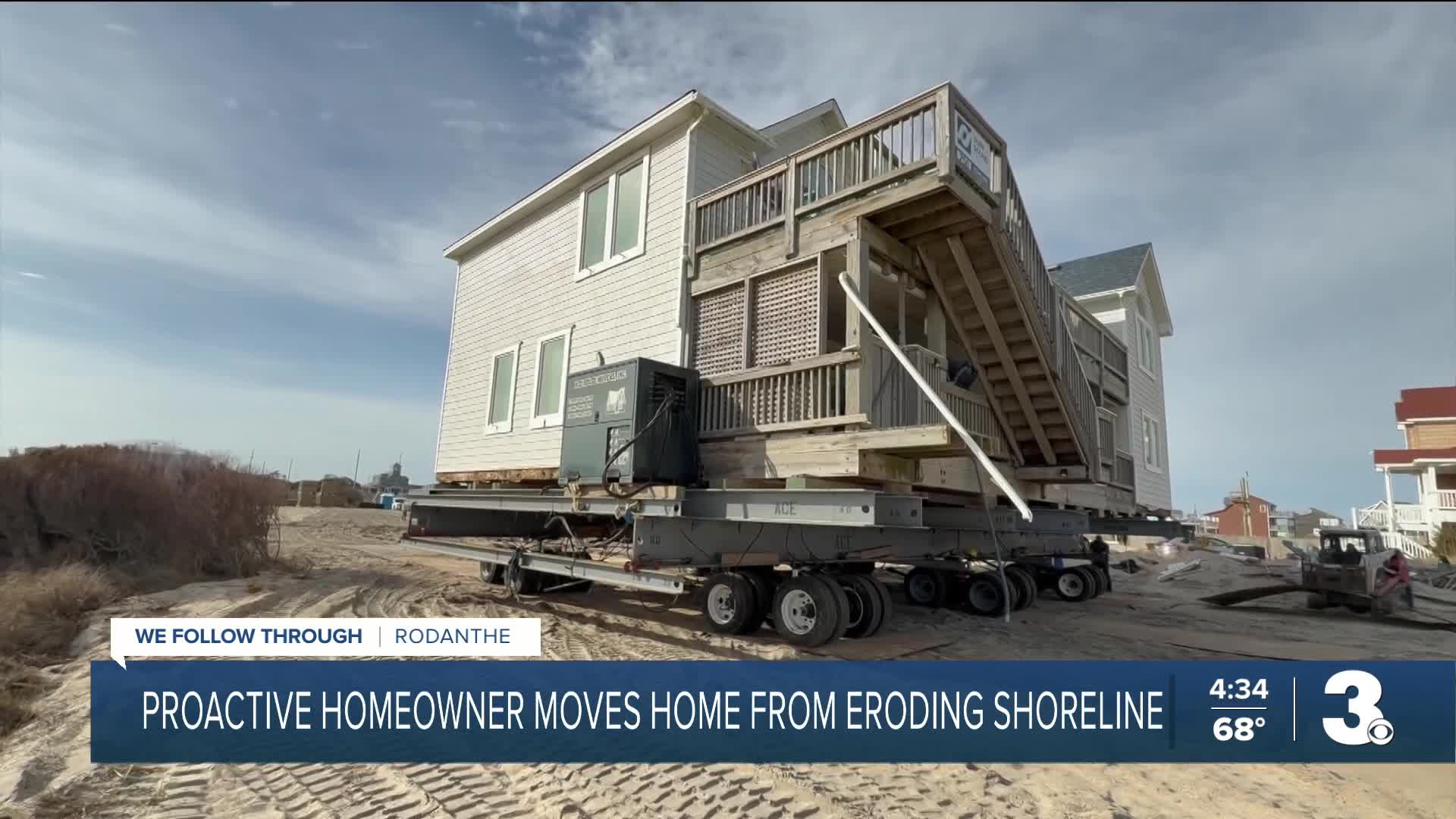


RODANTHE, N.C. — The wait will soon be over for Rodanthe homeowner Betty Jane Saylor, whose home made the 250-foot move inland from the dangers of the Atlantic Ocean on Wednesday.
"I feel like screaming at the top of my lungs. It's finally happening," said Saylor.
News 3 introduced our audience to Saylor in September 2024, after Hurricane Erin destroyed the pool on her oceanfront home. Saylor was especially upset because she had started the process to obtain permits to move her home in October 2024.
watch related: Man heartbroken to learn longtime vacation home collapsed
The Division of Coastal Management told News 3 in September that the area where Saylor wanted to move her home triggered a CAMA major permit process because of the need to fill in wetlands in that location. DCM marked the application complete on May 7, which then went to the U.S. Army Corps of Engineers and was approved entirely on Aug. 25 of last year.
But with the Atlantic Ocean continuing to encroach on her property, Saylor says the last 16 months have been stressful.
"It still was a lot of stress. When we lived 400 miles away, you wonder, are you going to have a house? Are you not going to have a house? And that's what we had to deal with the whole time," said Saylor.
But that's all in the rearview now, and besides it being her second home and rented out, Betty shares some of the ways she and her husband like to give back with it.
"We let people use it that's got cancer, we give it to them for free. That's our payback. Anyone that's going through a hard time, if we find out, for some reason, we give them a vacation. That's our way of saying thank you," said Saylor.
The contractor for the house move, Clark Olsen with Hurricane Construction, shared that moving a house of this size is a unique process.
watch related: Another Buxton house claimed by the ocean
"We had to move about 1500 tons of sand on over to the new area. Once everything is prepped, then the house gets cut loose from the piles and jacked up. There's a bunch of wheels underneath it. We have over 90 tons of steel underneath this house, and the house gets raised. It's takes a lot to hold it up and it will be moved down to its new location 250 feet away," said Olsen.
Though there will still be more work to do before Saylor's home is back up and running, she's thankful that this is a reality now.
"It's gonna be peace of mind, and we can go back to the way we used to be," said Saylor.
She's also hoping that in the future, homeowners having to go through this kind of house move will not have the same experience.
"I just wish CAMA (Coastal Area Management Act) and the Army Engineers would get together and not make the homeowners go through this. We're going through enough stress alone without all the red tape that you're making us go through," said Saylor.
Watch: Rodanthe homeowners moving houses frustrated by lengthy process
DCM shared this statement with News 3 back in September 2025 when we asked about Saylor's permitting process for her home:
"The Rodanthe homeowner initially proposed relocating the house in 2024. At that time, the homeowner was advised that relocation to a site that did not require wetland fill could proceed under a CAMA minor permit, which would have been issued within the standard 25-day review period. The homeowner declined this option, requesting instead that the house be moved as far landward as possible, which required filling USACE Section 404 wetlands. This triggered the CAMA major permit process and through the DCM umbrella process, was circulated to the United States Army Corps of Engineers ("USACE") and other state agencies and local government. For the USACE, the Regional General Permit 291 is a special regional general permit in North Carolina that streamlines the application review process for projects in coastal areas. Rather than requiring a separate application to the USACE, the Regional General Permit 291 coordinates the review by the USACE with North Carolina's Coastal Area Management Act (CAMA) program.
The Division of Coastal Management deemed the application complete on May 7, 2025, and circulated it for review on May 16. Through the applicant's agent, the permit review was placed on hold pending a final agency decision by the USACE.
On August 25, 2025, DCM received USACE's decision. The Division then issued a CAMA major permit on August 25, 2025, authorizing relocation with wetland fill."
DCM confirmed that they marked the application as complete by their agency in mid-May 2025 and then sent it to USACE for final approval. The final approval didn't come until Aug. 25. USACE said a typical review process takes about 60 days, but there can be delays. The three-month wait for this approval isn't uncommon, according to USACE officials.
