

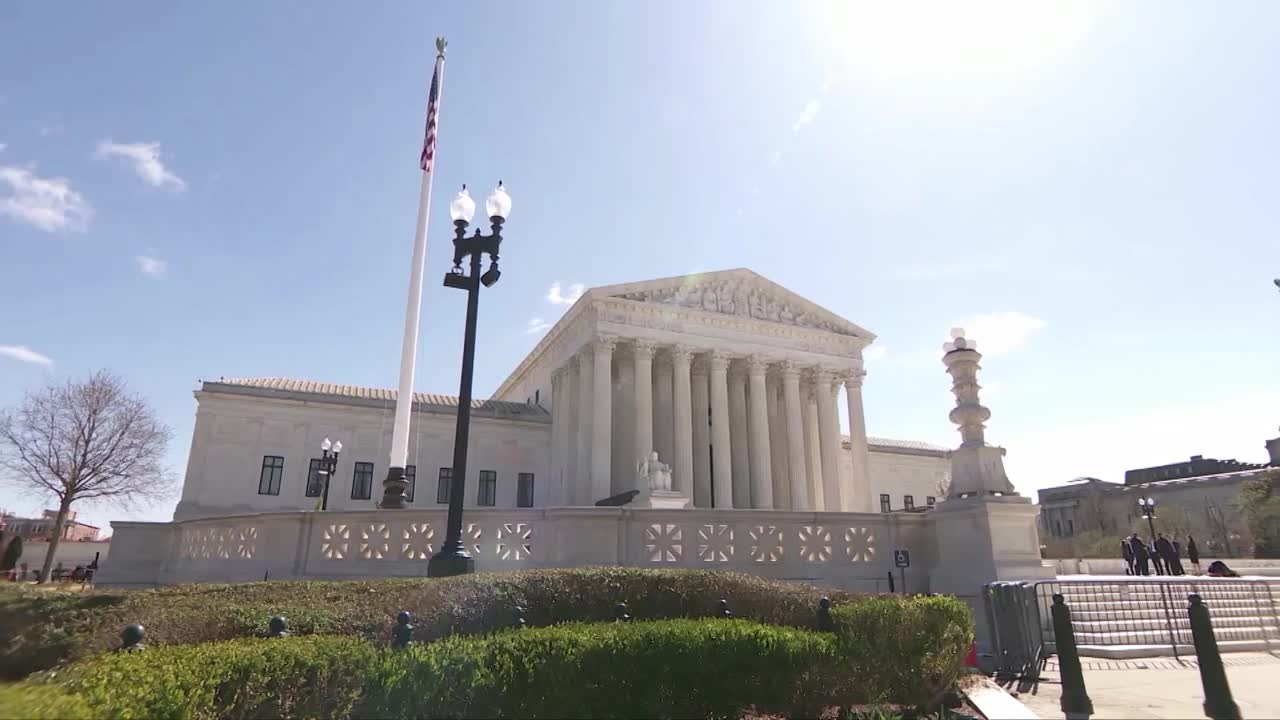


RICHMOND, Va. — The U.S. Supreme Court issued a ruling Wednesday that weakens a Civil Rights-era law and will have major implications on how states can draw their political maps.
In a 6-3 ruling, the conservative majority said Louisiana relied too much on race to make a second majority-Black congressional district.

National Politics
Supreme Court backs GOP in redistricting case, limiting Black voters’ influence
The decision deals a blow to a key provision of the Voting Rights Act, which required political maps to include districts where minority populations’ preferred candidates can win elections.
Political experts do not think it will lead to changes in Virginia's maps, but could in other states.
Justice Samuel Alito called the map an unconstitutional gerrymander.
"Because the Voting Rights Act did not require Louisiana to create an additional majority-minority district, no compelling interest justified the State’s use of race in creating SB8," Alito wrote in the court's majority opinion.
In her dissent, Justice Elena Kagan wrote that states can now systematically dilute minority citizens’ voting power without legal consequence.
"The consequences are likely to be far-reaching and grave. Today’s decision renders Section 2 all but a dead letter," Kagan said.
Republican National Committee Chairman Joe Gruters praised the decision.
"This decision is a win for fairness, the rule of law, and anyone who opposes racial gerrymandering. The American people don’t want to see Americans segregated by race in their congressional maps, which is exactly what was happening in Louisiana." Gruters said in a statement. "Today, the Supreme Court reaffirmed a basic constitutional principle: the government cannot discriminate on the basis of race when drawing congressional maps.”
Virginia Rep. Jennifer McClellan called the ruling a "devastating blow."
"While the 6-3 decision in Louisiana v. Callais upholds the constitutionality of Section 2, the conservative majority of the Supreme Court leaves it powerless to address racial discrimination in our electoral system and opens the door for a new wave of unbridled racial gerrymandering," McClellan wrote. "Today’s ruling makes it nearly impossible to ensure minority voters have a fair opportunity to elect the candidate of their choice and threatens Black representation across the country. These ongoing attacks pull us farther away from the ideals upon which our nation was founded and undermine generations of progress to achieve fair participation and representation in a government by, of and for the people."
Political analysis of the ruling
CBS 6 Political Analyst Dr. Bob Holsworth weighed in on the court's reasoning.
"They said, 'Here was this district that was drawn primarily on the basis of race,' and that's not okay," Holsworth said. "Interestingly enough, if you draw it on the basis of partisanship, that's okay. No matter how partisan a map is, the Supreme Court says that's okay. But it is unconstitutional, they say, to draw a district in which race is the primary factor that is underlying the district."
Virginia Commonwealth University political science professor Dr. John Aughenbaugh shared a similar assessment of the ruling's impact.
"I have to agree with the critics, okay, the court basically gutted the impact of Section Two," Aughenbaugh said. "It would make it extremely difficult for challengers using Section Two of the Voting Rights Act to claim that a state in redistricting was impermissibly using race."
Aughenbaugh points to the level of Kagan's dissatisfaction with the majority opinion because she read some of her dissent from the bench and did not include "respectfully" in her conclusion.
"She concluded her dissent with not the phrase 'I respectfully dissent', she uses 'I dissent'. These are both indicators that a justice who is writing in dissent is upset," he added.
Holsworth and Aughenbaugh both expect the ruling will lead to Republican-led states in the South attempting to get rid of some of their majority-minority districts. But, they said the main question is how many will get it done in time for the 2026 midterms, or will have to wait for 2028.
"In some of these states, you have primary elections going on right now, so it's very difficult to go back and redraw a district after you have an election going on," Holsworth said.
"I saw an analysis last year that was done by the New York Times that I thought was pretty accurate," Aughenbaugh said. "You're looking at potentially up to a dozen, but more than likely eight-to-10 congressional seats that were drawn in Deep South states as majority-minority to comply with the Voting Rights Act that those states might then decide 'Well, if we don't have to do that, we're going to go ahead and redraw.'"
Neither expects to see immediate changes in Virginia's congressional maps because of the ruling.
"In Virginia right now, there's no majority-minority district. We have a couple of districts that are significantly African-American, but we don't have any that was drawn over 50% right now," said Holsworth.
However, the fate of Virginia's current congressional maps are still in limbo nonetheless as its already-ongoing redistricting efforts remain hung up in the courts.
Earlier this month, voters had approved a change to the state constitution to allow the current map that favors Democrats to 6-5 to be replaced by one that favors that party 10-1 until the 2030 census.
This was an effort being led by state Democrats in response to Republican-controlled states taking similar efforts after being asked to do so by President Donald Trump.
But a lawsuit filed by the Republican National Committee against the referendum led to a Tazewell Circuit Court judge ordering the vote was unconstitutional and could not be certified.
The case is before the Supreme Court of Virginia, which denied a motion Tuesday to lift that order. But it has not had a hearing scheduled on the merits of the case.
On Monday, the court heard arguments in another lawsuit against the case, but has yet to issue a ruling.
"This is something that we've really never seen before," said Holsworth. "That in the middle of a House election in a non-census year, you might say, we are seeing these redistricting battles going on with state after state in order to give a partisan advantage to one of the other parties."
This story was initially reported by a journalist and has been converted to this platform with the assistance of AI. Our editorial team verifies all reporting on all platforms for fairness and accuracy. To learn more about how we use AI in our newsroom, click here.
