

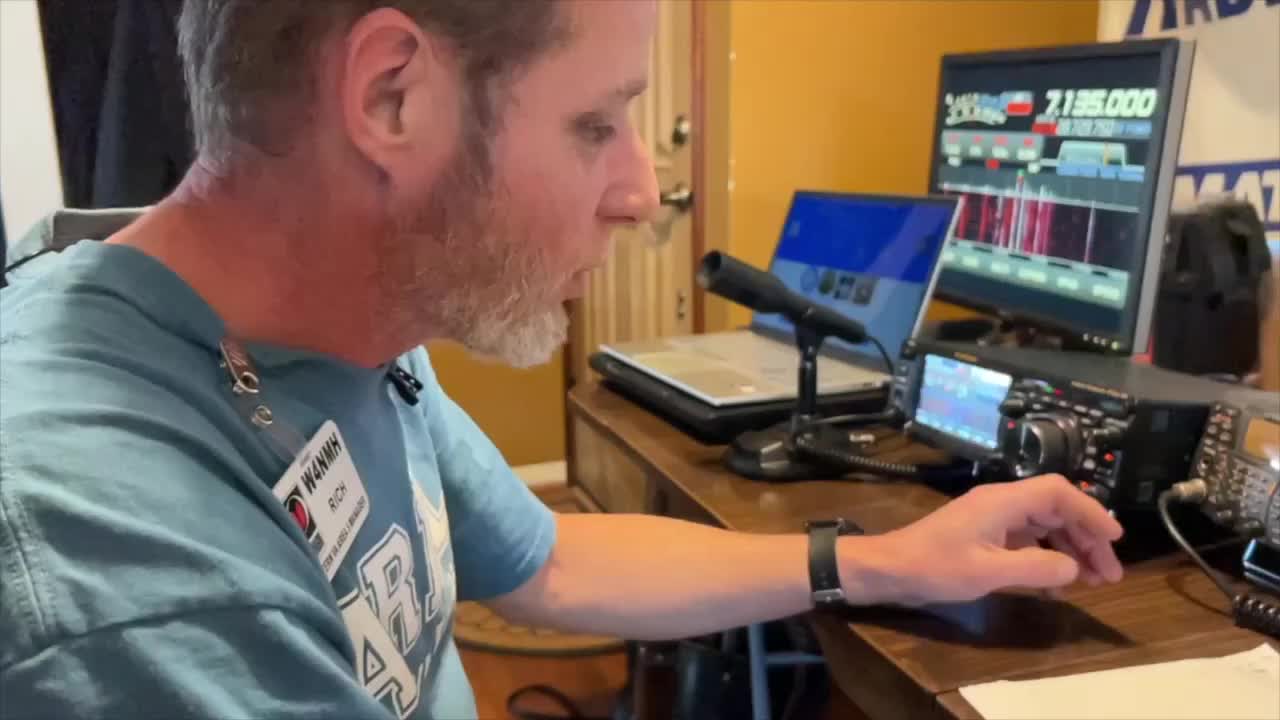


NORFOLK, Va. — Many know ham radio as a hobby — and it is — but when disaster strikes, it quickly becomes essential.
“When I got the funnel cloud report, I called Wakefield directly because that’s immediate life danger,” said Rich Davis, an amateur radio operator.
In March 2017, a tornado swept through Chesapeake and crossed over into Virginia Beach’s Salem neighborhood.
“I called my counterpart in Virginia Beach and said, ‘Hey, there’s a tornado in your city. Get your guys ready," Davis said.
Amateur radio operators — or “hams” — are often the eyes and ears on the ground during a storm, relaying real-time observations to the National Weather Service.
And you don’t need the internet or a cell phone to get the word out.
Corey McCook, one of about 30 members in the Norfolk ham operators club, remembers how important ham radio became when Hurricane Maria hit Puerto Rico.
“A lot of the infrastructure failed, and that happened coincidentally with a major solar flare that took out satellite communications,” he said.
While storm chasing is a big part of what ham operators do, it’s also a hobby where enthusiasts can talk to each other all over the world.
“It doesn’t matter whether you’re 12 or 70 — you can be just as smart with radios at any age," said Jeff Swain, another member of the Norfolk ham operators club.
You do need a license to operate, and you don’t get paid — but that’s not why these Norfolk hams do it.
“When you have a purpose like that and you can fill a void where there’s a need — when they couldn’t have done it without you — that makes you feel special. It’s very fulfilling," said McCook.
Your local ham operators can turn from hobbyists to heroes in the blink of an eye. And they are positively Hampton Roads.
