

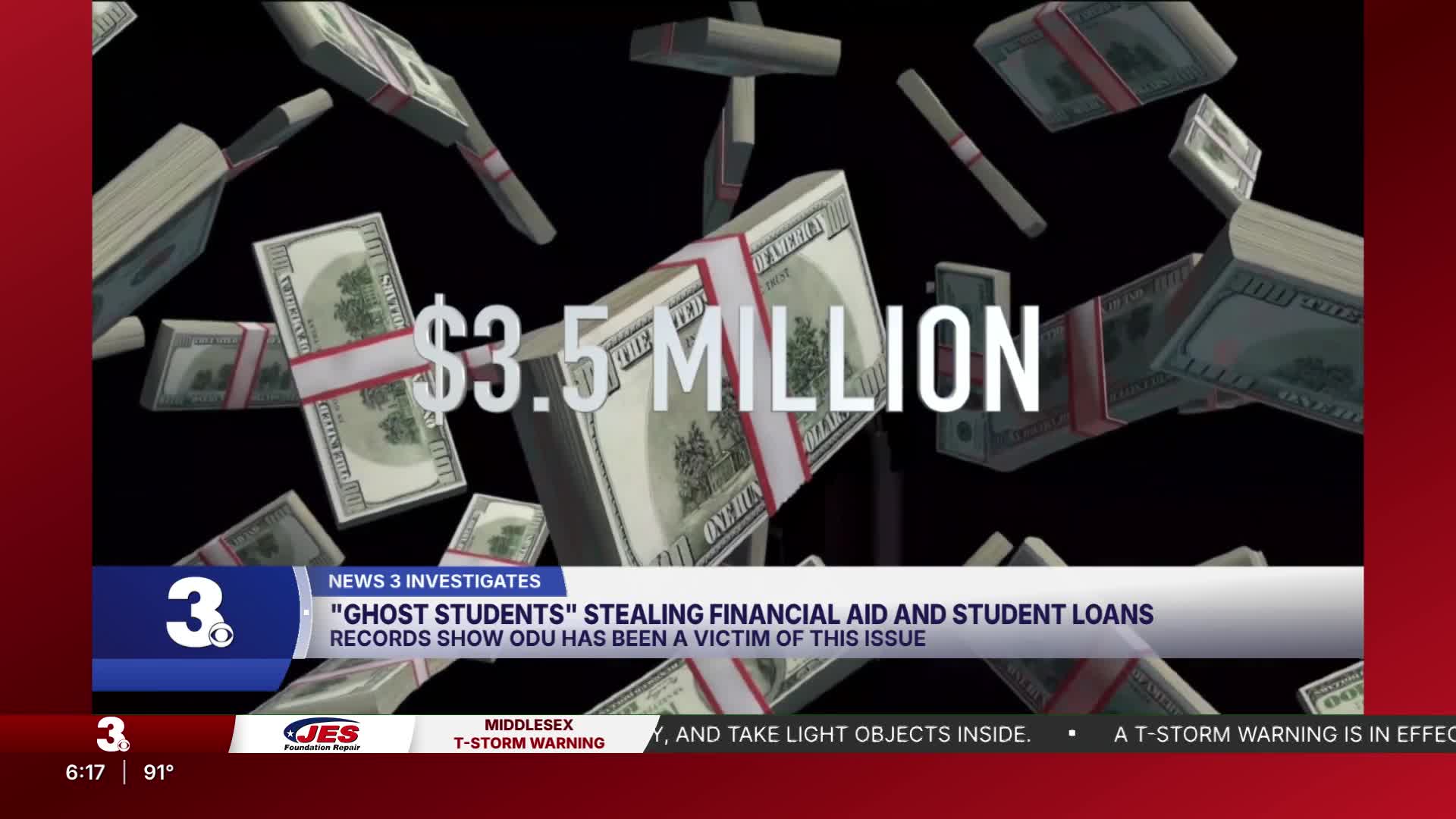


Stealing financial aid and student loans through "ghost students" is an increasing problem, and federal authorities recently put out a warning about the scheme being seen around the country.
Now, court records show that Old Dominion University has been a victim.
A suspect applied to be a student at ODU in October 2025 and was given about $4,000 in financial aid, according to court records. However, records state that the application was fake and the suspect applied using another person’s information.
In February 2026, the Undergraduate Admissions Office realized the scheme after contacting the person whose name was on the application. That person told authorities he never applied to ODU and never applied for financial assistance.
It’s a problem called "ghost students," where online thieves, sometimes using AI, steal federal financial aid.
ODU Police Chief Garrett Shelton said this is the only case they’ve had. They’re still investigating it, no one has been arrested, and overall fraud is a constant, ongoing problem.
Old Dominion University issued the following statement to News 3:
“Old Dominion University takes this matter very seriously. The University follows all federal requirements regarding financial aid administration and fraud reporting. Once we became aware, we took immediate steps to report the matter to the appropriate authorities and offices. Due to our commitment and responsibility to personal privacy, we will not comment on details regarding this specific case.
Please note that financial aid fraud is a nationwide issue and one the U.S. Department of Education is taking active steps to address. In February 2026, the Department’s Office of Inspector General reported identifying more than 12,000 student identities associated with FAFSA submissions that had a high likelihood of being fraudulent, representing a potential loss of nearly $3.5 million in federal student aid. The Department has since expanded fraud detection and identity verification efforts nationwide.”
James E. Lee is the president of the Identity Theft Resource Center.
“All of these things begin with data breaches. Educational institutions over the last couple of years have become huge targets for data breaches, and we've seen massive numbers of students and institutions impacted,” Lee said.
Federal authorities issued an alert in July about this increasing problem of fraud schemes targeting student aid programs. They say fraud rings use stolen and fake identities to enroll in colleges and illegally get federal student aid.
“We're going to see more impersonation attacks, and we're going to see more attacks against these institutions,” Lee said.
Last year, the Department of Education found potential fraud with over 12,000 federal student financial aid applications, representing a possible loss of more than $3.5 million.
Experts say you should never share your personal information, monitor your accounts, and freeze your credit.
“I try to tell people all the time, do everything you can not to make it easy," Shelton said. "Lock your bank accounts. Lock your credit cards.”
