

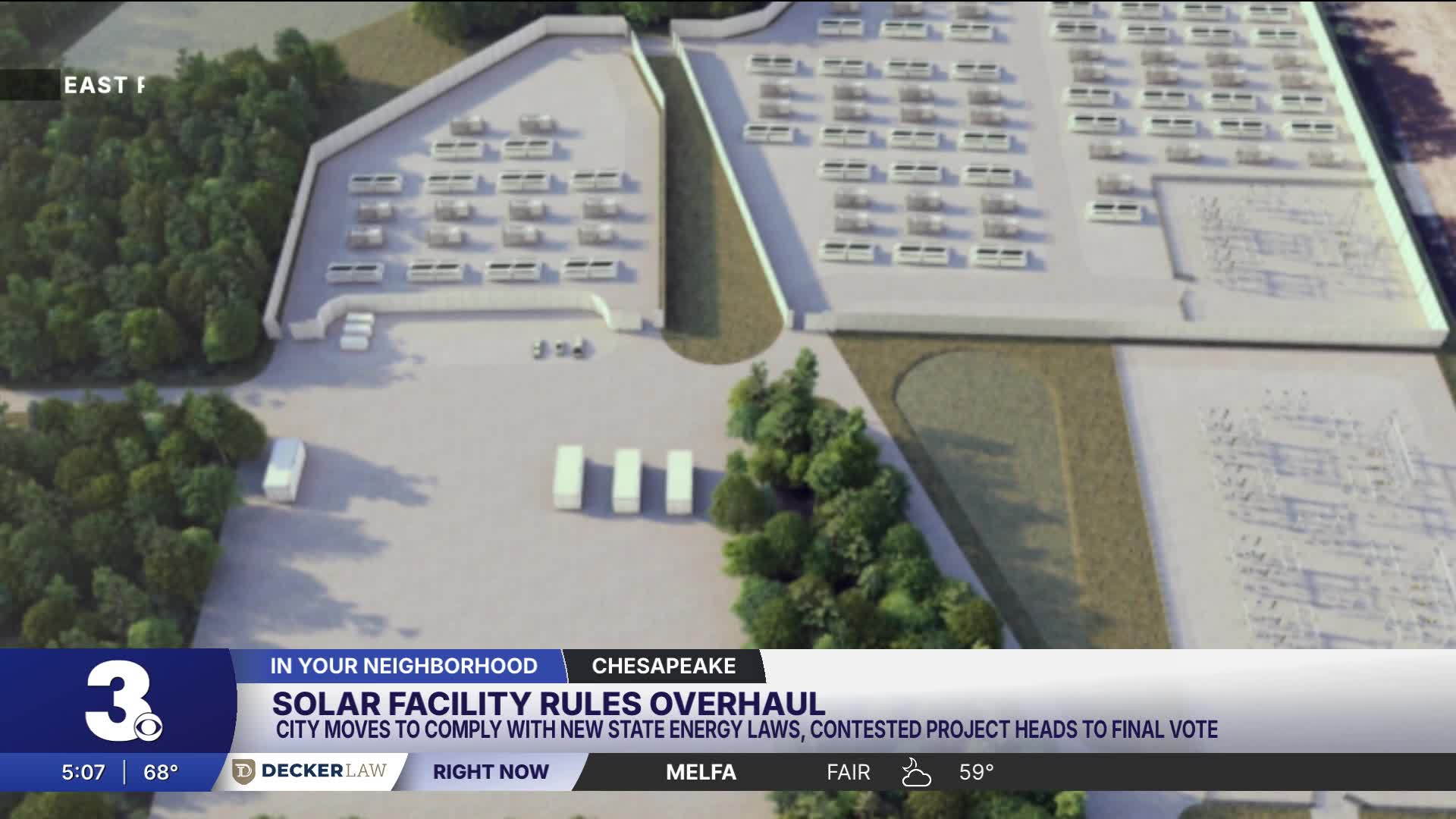


CHESAPEAKE, Va. — Chesapeake City Council voted 8-0 Tuesday to begin updating the city's rules for solar and battery energy storage facilities. This unanimous vote could affect the proposed Mill Stone Energy Center Battery Energy Storage System (BESS) in the Hickory area.
The council approved two initiating resolutions on June 23, 2026, directing the Chesapeake Planning Commission to consider and make recommendations on proposed amendments to both the city's 2045 Comprehensive Plan and Article 13 of the Chesapeake Zoning Ordinance. The changes are required to bring local regulations in line with new state laws passed during the 2026 session of the Virginia General Assembly.
Two sets of bills passed by the General Assembly are driving the changes.
HB711 and SB347 add new requirements for solar facilities, including a use permit for solar farms, specific setback and design requirements, and a mandate that owners, lessees, or operators hire a professional engineer to review and update decommissioning plan cost estimates and related financial assurances at least every 5 years. The legislation also requires the city to provide the State Corporation Commission with a record of each decision on a solar farm or energy storage project within 60 days of the decision.
HB891 and SB443 establish that battery energy storage projects are a permitted accessory use on any parcel of land that has an approved use permit for a solar facility. The bills also preserve the city's authority to require safe operation and negotiate a siting agreement for battery use.
The initiating resolutions direct the Planning Commission to hold a public hearing and make its recommendations within 60 days, or a longer timeframe as specified by City Council. A full analysis of the necessary zoning and comprehensive plan changes will be provided in a staff report to City Council when the request is formally considered.
The new regulations could affect how projects like Mill Stone Energy Center are reviewed going forward, including new requirements for use permits and safety protocols.
The proposed Mill Stone Energy Center would be built on an approximately 31-acre portion of a larger property at 1912 Centerville Turnpike South.
A battery energy storage system works by pulling power off the grid during off-peak hours, typically at night, and pushing it back onto the grid when demand is highest — during heat waves, winter storms, or other high-usage periods. The project has been in development for roughly 2 years. If ultimately approved by City Council, construction could begin as early as 2030, with operations potentially starting in 2031.
East Point Energy, the developer behind the project, has said the facility would be interconnected with PJM, the regional transmission grid covering 13 states including Virginia. The company has committed, as a condition of the permit, to preserving the remaining land on the property and prohibiting any data center development there.
On June 10, the Chesapeake Planning Commission voted 7-1 to recommend denial of a conditional use permit for the Mill Stone Energy Center. Residents spoke on both sides of the issue at the meeting.
Developers have previously said the project site is more than 3,000 feet from Hickory High School and that the closest residence is nearly 1,500 feet away. East Point Energy has also said it has had extensive dialogue with the Chesapeake Fire Department to ensure crews are prepared in the rare event of a fire.
Chesapeake City Council is scheduled to make the final decision on the Mill Stone Energy Center project at its July 21 council meeting. That meeting is open to the public for comment.
This story was reported on-air by a journalist and has been converted to this platform with the assistance of AI. Our editorial team verifies all reporting on all platforms for fairness and accuracy.
Click here to see how we use AI at WTKR News 3.
