

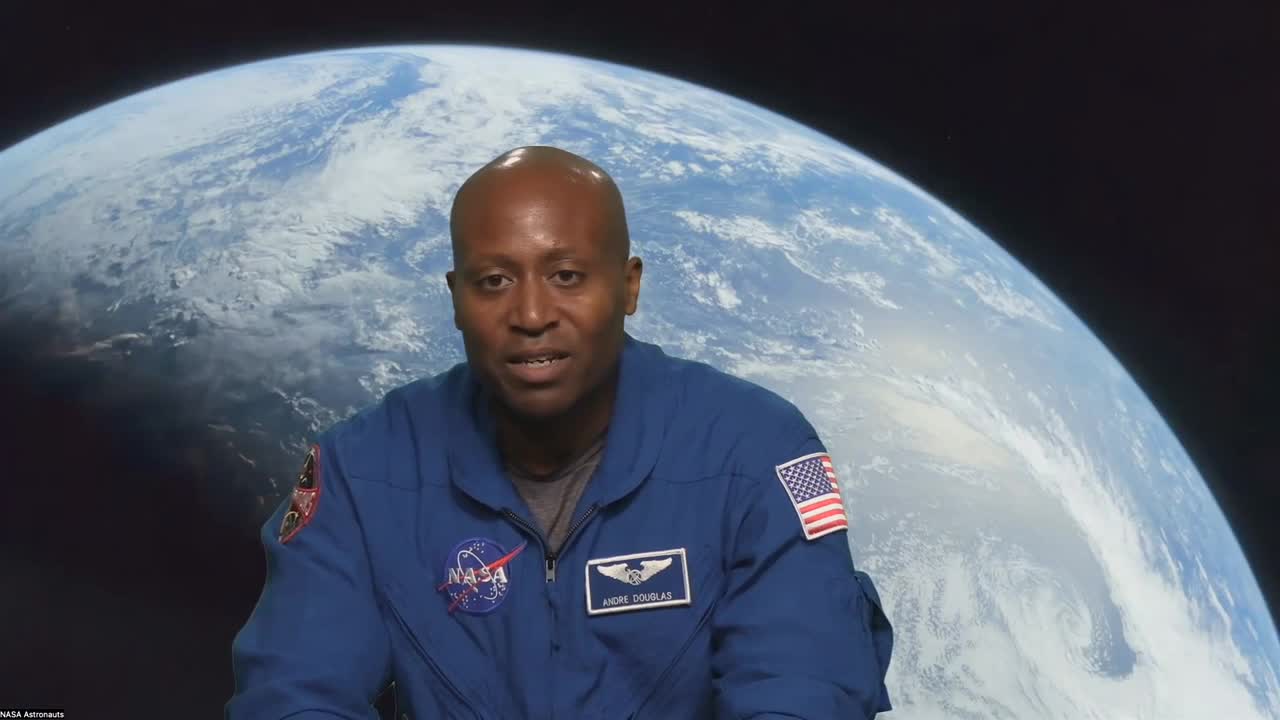


CHESAPEAKE, Va. — With less than a year until launch, Western Branch High School graduate Dr. Andre Douglas is deep in training for what will be his first journey to space as part of NASA's Artemis III mission. He's reflecting on the path that took him from Chesapeake classrooms to NASA training facilities.
Douglas, selected in June as mission specialist alongside NASA veterans Randy Bresnik and Frank Rubio plus European Space Agency astronaut Luca Parmitano, is preparing for the critical test mission targeted for mid-2027. He says the announcement earlier this year marked the culmination of a dream he's pursued since he was young.
"Yeah, it was very, very exhilarating because I've been trying to do this since I was 7 years old," Douglas said. "So when I got the call from Reid Wiseman and I was with my family, it was like one of the best moments of my life. And so I was on cloud nine."
The Artemis III mission will not fly to the moon or land on its surface. Instead, the crew will orbit Earth while practicing the complex docking procedures between their Orion capsule and two different lunar landers developed by SpaceX and Blue Origin. This two-week demonstration mission serves as crucial preparation for future moon landings, allowing astronauts to perfect the docking systems in Earth orbit where they can return home quickly if problems arise.
"We need to launch that up first, and then the providers have to launch their landers after us," Douglas explained. "So we're going to dock in space to make sure we can get people from the Orion vehicle to the Blue lander while in space, just like when the Dragon docks to the ISS, the International Space Station."
The mission is designed to buy down risk for Artemis IV and beyond, when astronauts will perform these same docking maneuvers in lunar orbit before two crew members descend to the moon's surface. For Artemis III, the crew will practice with Blue Origin's lunar lander by actually transferring between vehicles, while they'll test SpaceX's Starship by ensuring the docking systems can connect and secure properly.
As launch approaches, Douglas's training intensity has ramped up.
"My biggest thing is repetition, repetition, repetition," he said. "The more chances you get to exercise the task, the more comfortable you are with it."
Having previously trained for Artemis II as backup crew, Douglas finds some familiarity in the process while adapting to new mission-specific requirements.
"I'm really excited because this is my first space mission," he said. "I remember talking to my chief before. I thought they weren't going to let any rookies onto Artemis, and here I am, right? I want to know what it feels like to be in zero gravity and really help out with the mission too."
Douglas's journey began at Western Branch High School, where he graduated in 2004.
"A lot of the AP calculus and AP physics classes were the core of my technical background," Douglas said.
Academics weren't his only focus. Douglas participated in basketball, soccer, marching band, percussion ensemble, and concert band. He says these experiences taught him crucial teamwork and leadership skills. As drumline captain, he learned to both follow direction and lead others.
After high school, Douglas earned a bachelor's degree in mechanical engineering from the U.S. Coast Guard Academy. He continued his studies to earn master's degrees in mechanical engineering, naval architecture, marine engineering, and electrical and computer engineering, plus a doctorate in systems engineering.
His Coast Guard service provided diverse experience as a naval architect, damage control assistant, salvage engineer, and officer of the deck. Before joining NASA's astronaut corps, Douglas held a senior position at Johns Hopkins University Applied Physics Laboratory, where he supported planetary defense, space exploration, maritime robotics, and ocean system missions. He contributed to NASA's DART planetary defense mission and served as backup crew for the Artemis II test flight.
The mission comes at a pivotal time for NASA's Artemis program, which aims to return astronauts to the moon's surface for the first time since the 1970s. Program changes announced by NASA administrator Jared Isaacman earlier this year aim to fast-track the timeline similarly to the Apollo era, with lunar landings now targeted for 2028.
For young people in Chesapeake watching Douglas's journey, he offers encouraging advice rooted in his own experience.
"Be willing to try just about anything that comes up as an opportunity," he said. "I think the biggest thing, especially when you're young, is having an opportunistic mindset."
He emphasizes seeing challenges as opportunities rather than obstacles, noting that this perspective can shape one's destiny.
"There are so many opportunities in the 757 out there in Chesapeake," Douglas said. "Be blessed that you're there because there are certain areas that don't have the opportunities that you do have."
Douglas remains grateful to his Western Branch community. He looks forward to returning and reconnecting with the community that helped launch his journey from high school hallways all the way to the stars.
"Just big thanks to everybody that's there and if they're not there, who were there in the past, because I think that community really develops people that are successful and also well balanced, and I'm very grateful to be from there and to have those experiences," Douglas said.
As the mid-2027 launch window approaches, Douglas represents not just personal achievement but the potential that exists within Hampton Roads communities.
The Artemis III mission will serve as a crucial stepping stone toward NASA's ultimate goal of returning humans to the lunar surface, with Douglas and his crewmates playing a vital role in ensuring future missions can safely navigate the complex journey from Earth to moon and back again.
This story was reported on-air by a journalist and has been converted to this platform with the assistance of AI. Our editorial team verifies all reporting on all platforms for fairness and accuracy.
Click here to see how we use AI at WTKR News 3.
