

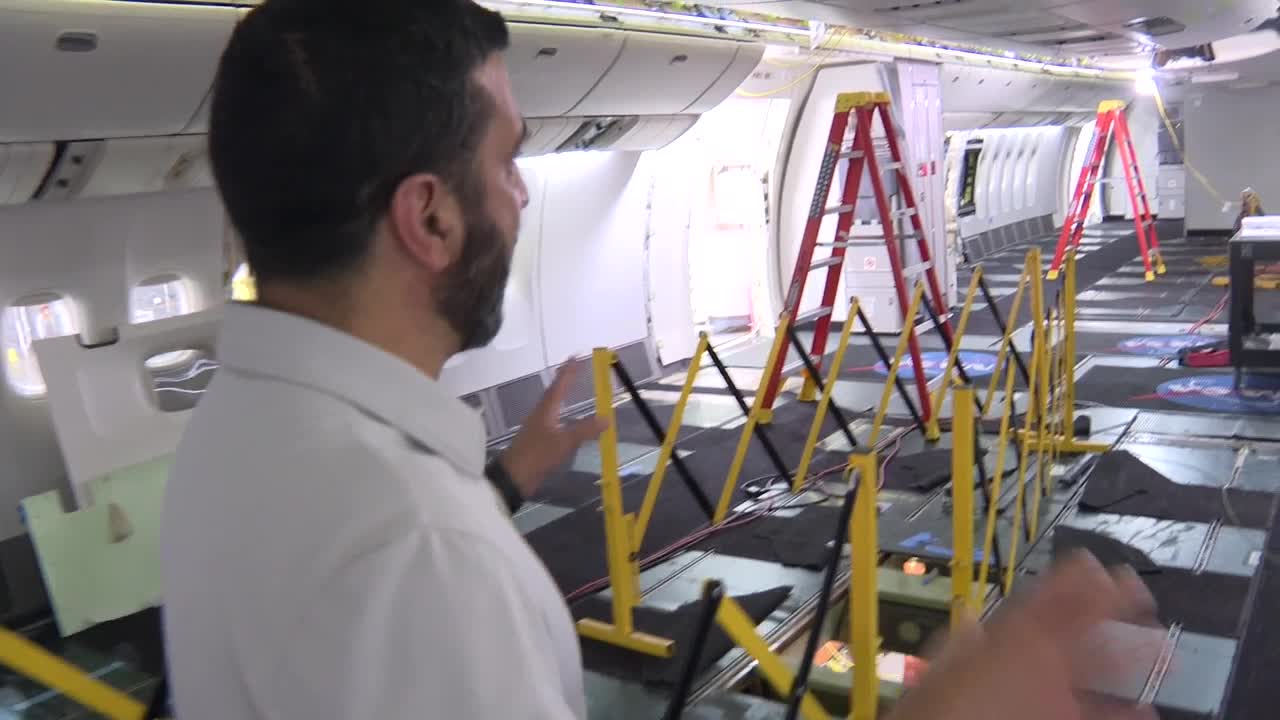


HAMPTON, Va. — NASA Langley Research Center in Hampton offered a look Thursday at the agency's newest airborne science lab as the first mission was about three months away.
The lab is a Boeing 777 bought from Japan in 2022.
Amin Nehrir is one of the scientists who will be on board when it takes off in January 2027 to collect data on winter weather.
Watch: NASA Langley opens gates to developers for first time in its 109-year history
“We’re going out to deploy cutting-edge technology that allows us to better measure the really dry polar environment that the satellites just can’t see," Nehrir explained.
The data could lead to better weather forecasts in the future.
Back in 2024, News 3 talked with Nehrir about the plane as NASA was in year two of converting it.
Watch: NASA Langley Research Center converts Boeing 777 into flying research lab
“It allows us to access parts of the world that are really difficult with smaller aircraft," he told News 3 at the time.
Winter weather isn’t all the plane will be used for.
On Thursday, News 3 talked with Laura Judd. She’s a scientist who will be on the plane’s second mission in 2028. That mission will measure air pollution in multiple cities.
Watch: NASA Langley Research Center opens first new wind tunnel in more than 40 years
“We’re going to be able to put more instruments, remote sensing instruments specifically, together than have ever been able to fly together before," said Judd.
That option is one reason NASA picked the plane for the airborne lab.
“On the predecessor plane, the previous largest science aircraft that we had, it was about 40 instrument team members. For this one, first campaign, we have about 100," NASA Boeing 777 Program Manager Kirsten Boogaard said.
Watch: NASA Langley conducts first-of-its-kind drone test with human organ
NASA Langley Center Director Trina Dyal said this is a needed upgrade.
“We’ve know for a while that we really needed to expand our ability to do airborne science and airborne campaigns and we had an aircraft that was 40 years old. So it was time for a little face lift and to be able to push the boundaries of what we wanted to do in airborne campaigns," said Dyal.
Boogaard said as of Thursday requests to use the plane for missions as far out as 2033 were already coming in.
Watch for Colter Anstaett's reporting on News 3 and WTKR.com. Have a story idea or tip for Colter? Email him.

Click here to see how we use AI at WTKR News 3.
