

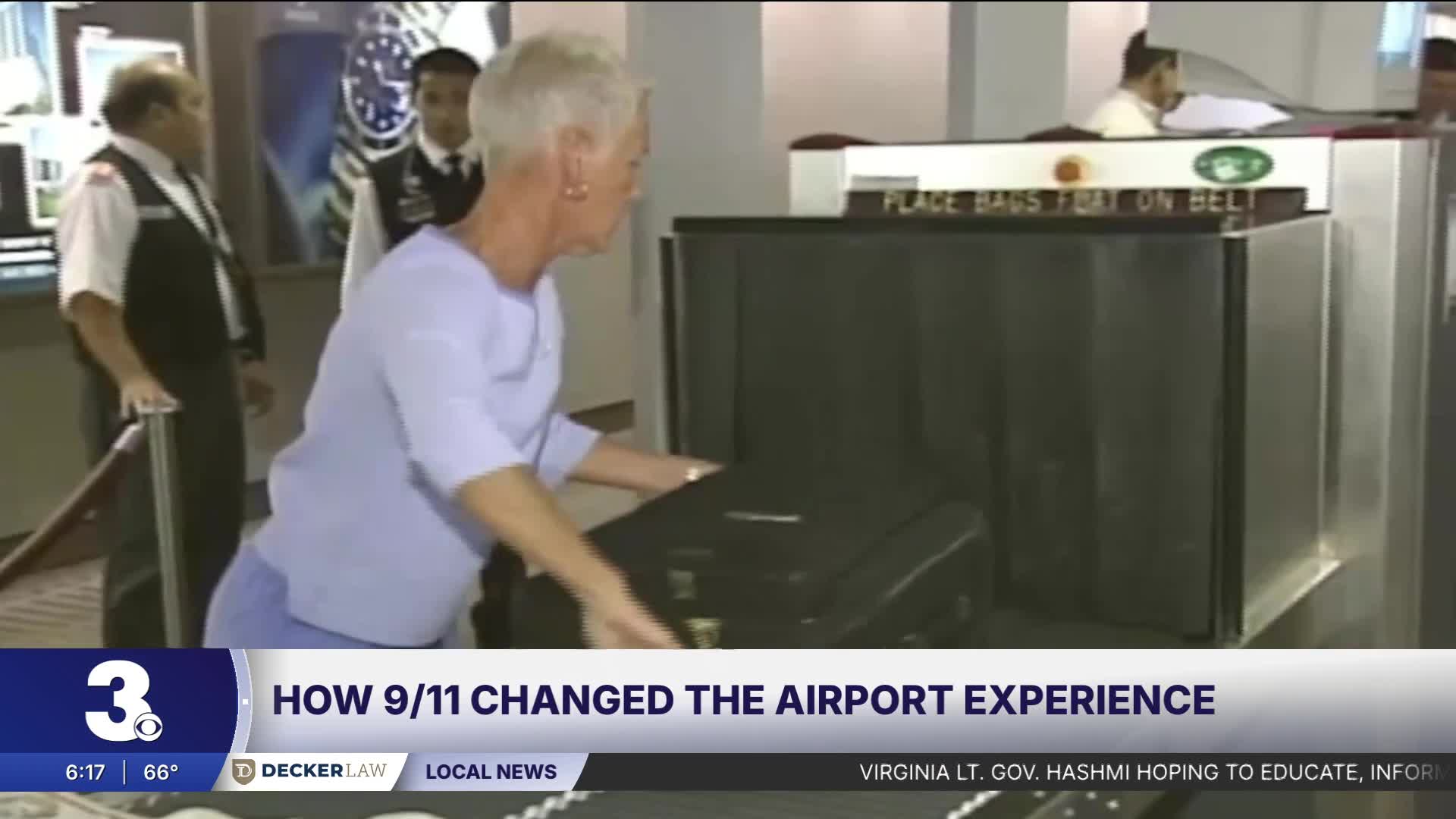


NORFOLK, Va. — For millions of Americans, the memory of Sept. 11, 2001, is inseparable from the way they experience airports today. For those who spend the most time in and around them, those reminders come more often than most.
The frequent flyer
Diane Raihle has flown thousands of times. In the 1980s and '90s, she traveled to every major city in the United States organizing job fairs for a company called Brass Ring.
"Flying was just another life," Raihle said. "You'd get your tickets beforehand, obviously, and then just wait at the gate, and then, you know, it was just calm."
Family members could wait with passengers at the gate. Security was minimal.
That changed on Sept. 11, 2001. Raihle, now Senior manager of Member Development at the Hampton Roads Chamber, remembers the chaos of that day.
"We had some employees out at different states at the events, so that was kind of scary watching everything on the TV and then trying to get everybody home safe," Raihle said.
Today, she still thinks differently about flying.
"When I do fly now, it is in the back of my mind," Raihle said, adding that she feels the heightened security of current times helps her feel safe.
As fate would have it, she now works in Norfolk's World Trade Center.
"Every once in a while I'll think about that (coincidence)," Raihle said. "You know we have to live our life. My motto is 'day by day' and you have to, you know, put everything aside and move forward."
The airport executive
Charlie Braden was heading back to the office at Norfolk International Airport on the morning of Sept. 11 when his administrative assistant called with the news.
"Did you see what had happened at the World Trade Center?" Braden recalled being asked.
Planes had been flown into the World Trade Center towers and the Pentagon. Jetliners still in the sky were grounded in what Braden described as the first nationwide ground stop ever called by the FAA.
His marketing team was immediately tasked with communicating to passengers from grounded flights and those who could no longer take off.
"That first day was probably the most hectic," said Braden, now associate vice president of Market Development at Norfolk International Airport, a position he has held through a nearly 40-year career at the airport. "September 12 was like a ghost town. There were no flights leaving."
When service resumed on Sept. 13, passengers were given a form detailing a "heightened state of security." The National Guard was deployed at airports across the country.
The previous security setup — contracted through the airlines — was suddenly outdated.
"The Aviation and Transportation Security Act was signed that changed everything because at that point that's when the TSA took over everything," Braden said. "There was some confusion, but also there was an understanding by the traveling public that there had to be some new procedures."
The head of security
Jeff Horowitz joined the Transportation Security Administration in March 2002, in just the second class of officers to come on board. Over a 25-year career, he has risen to Assistant Federal Security Director covering Norfolk and Newport News and has watched airport screening evolve dramatically.
"We used to look at a boarding pass, physically look at a boarding pass and ID match the face with the ID. Now we have computer technology," Horowitz said. "The machines behind us, we used to just go through a metal detector. Now we have advanced imaging technology which looks at organics, any anomaly on the body. TSA right now has 20 layers of security."
Some of those layers are visible to passengers. Others are not.
"From the time you buy a ticket up until the time you fly, we're vetting your name," Horowitz said. "You go to one airport, you might not get the exact same experience. That's also part of what we want."
For Horowitz, the work is personal. He joined the NYPD in 1984 and also served as a paramedic.
"9/11, being a cop and a paramedic, I lost a lot of friends," Horowitz said.
Hardened cockpit doors are now standard. Advanced imaging technology has replaced metal detectors. And the security infrastructure passengers move through today bears little resemblance to what existed before the attacks.
Click here to see how we use AI at WTKR News 3.
