

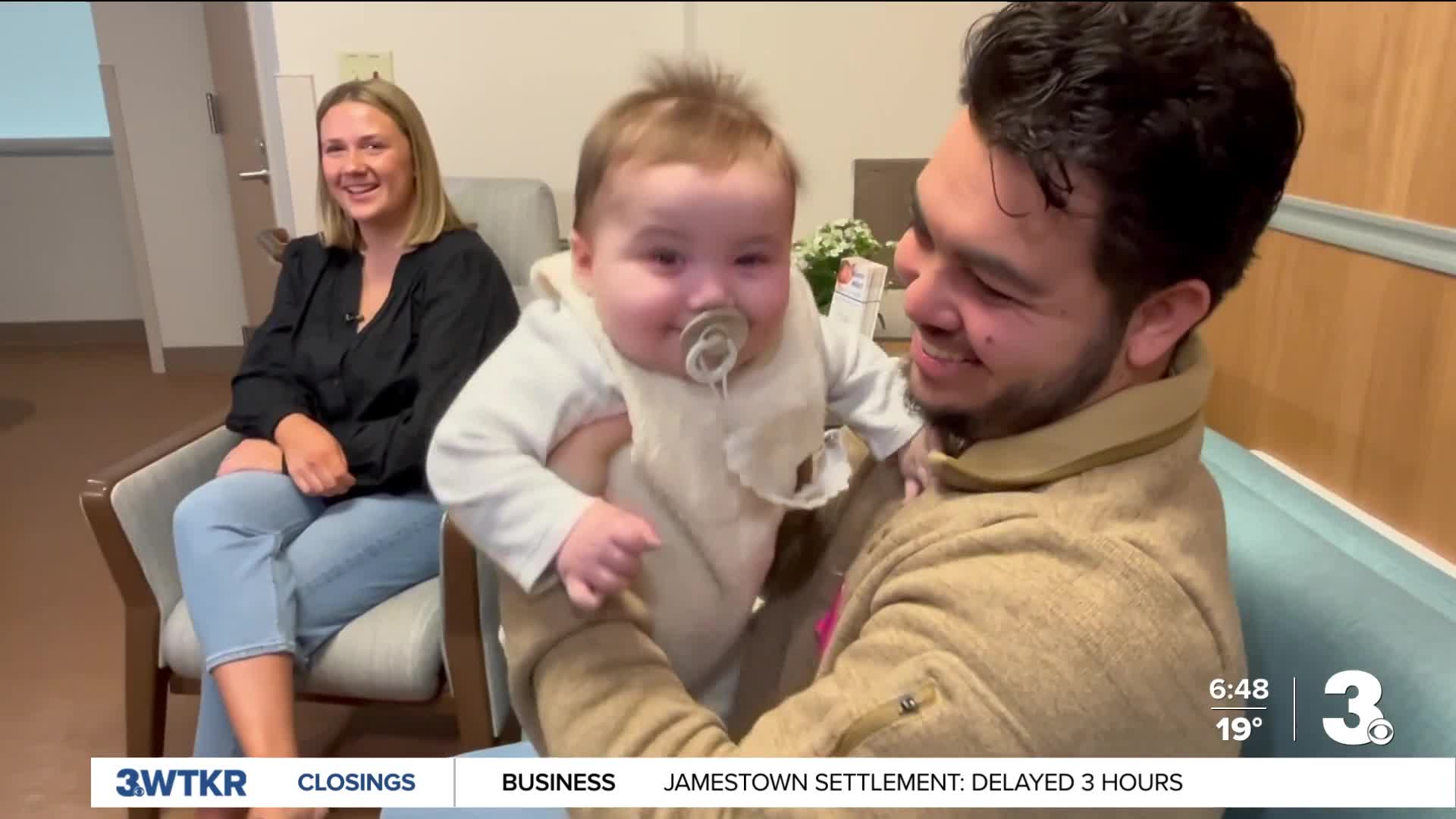


NORFOLK, Va. — When Lillie Martinez had her son Jesse Joe seven months ago, she expected to feel overwhelming joy. Instead, she found herself struggling with postpartum depression and anxiety.
"I remember telling my friends and family this is supposed to be the happiest moment of my life and I'm so depressed and I'm so scared and this isn't right," Martinez said. "I was very shameful of that."
Martinez isn't alone. According to the National Institute of Mental Health, at least one in seven mothers experiences perinatal depression. Perinatal depression is a mood disorder that occurs during pregnancy and after childbirth.
Martinez and her husband Jaron are high school sweethearts who met 10 years ago on a bus in Virginia Beach. After school dances, two dogs and a wedding, they welcomed their son Jesse Joe in June.
But the early days of motherhood were darker than Martinez anticipated.
"I experienced postpartum depression, postpartum anxiety, pretty early on after I had my son," Martinez said.
During a lactation consultation at Sentara Leigh Hospital with Jessica Schafer, a family nurse practitioner, Martinez broke down.
"We were sitting right here [and I] did not care about the lactation. I just started bawling. I was like, I, I feel crazy. I need help. What's happening to me?" Martinez asked Schafer.
Schafer said this interaction was similar to ones she had in the past. She noticed a pattern during her lactation consultations.
"The lactation program was really, really successful, but I was also noticing there were quite a few moms opening up to me about their postpartum depression [and] anxiety," Schafer said.
This led Schafer to advocate for expanding her role beyond lactation support.
“[My leadership team at Sentara] created this position for me and it was magical and it was everything I wanted to do. So, we started treating moms for lactation, but also now I can help them with the postpartum anxiety, depression [or] whatever they're going through,” Schafer said.
The medical understanding of postpartum challenges is evolving. Schafer says Healthcare providers now use the term PMADs - perinatal mood and anxiety disorders - because the condition encompasses more than just depression.
"Research has shown that our hormones don't even balance out until about 2 years," Schafer said.
"Now we're shifting to what's called PMADs, perinatal mood and anxiety disorder, because it's not just depression. I think that's where it gets a lot of moms because they're like, ‘well, I'm not depressed, but I'm anxious, I have rage, I have intrusive thoughts, I'm not bonding with my baby,'" Schafer said.
Schafer identifies several red flags that indicate when mothers should seek help, including crying over “minor” issues like not having the right bottle tops, extreme fear of walking downstairs with the baby, sudden intense anger toward family members, and obsessive behaviors like constantly checking if the baby is breathing.
Schafer said another one is getting really angry at your husband or your family or even at your baby for no particular reason.
“Generally speaking, the first and second weeks you're going to be really sensitive [and] weepy [because] your hormones [are] shifting significantly. But if it's like that after about two weeks or if it's really severe and it's impacting your daily life, then that is not ‘baby blues’ anymore, that is a mental condition,” Schafer said.
For Martinez, the honest conversation with Schafer was life-changing.
"She said ‘I promise you will get through this.’ Without those words I just don't know if we would be in this situation [and] where we are today, if it wasn't for her," Martinez said.
Martinez wishes there were more awareness about postpartum mental health challenges.
"I wish that there was more awareness about it because I feel like if there were women wouldn't feel so crazy," Martinez said.
"Moms should be studied because I swear they're superheroes."
Schafer emphasizes that help is available.
"We're here to validate you and guide you, and you do not have to live like this. There is a better way to live," Schafer said.
Today, Martinez, Jaron and Jesse Joe are thriving.
"My son is the best thing that's ever happened to me, and I feel like we're finally getting into our routine and we're flourishing," Martinez said.
Martinez says some days she still has to take it one second at a time.
Schafer offers one-on-one meetings, mommy and me classes that are always full of often military moms and kids, and postpartum support groups.
Resources for new mom's:
- Perinatal Mood & Anxiety Disorder Support Group
- Postpartum Support Group Williamsburg
- Mommy & Me at Sentara Leigh
- Postpartum Support Virginia
- Postpartum Support International
"This story was reported on-air by a journalist and has been converted to this platform with the assistance of AI. Our editorial team verifies all reporting on all platforms for fairness and accuracy."
