

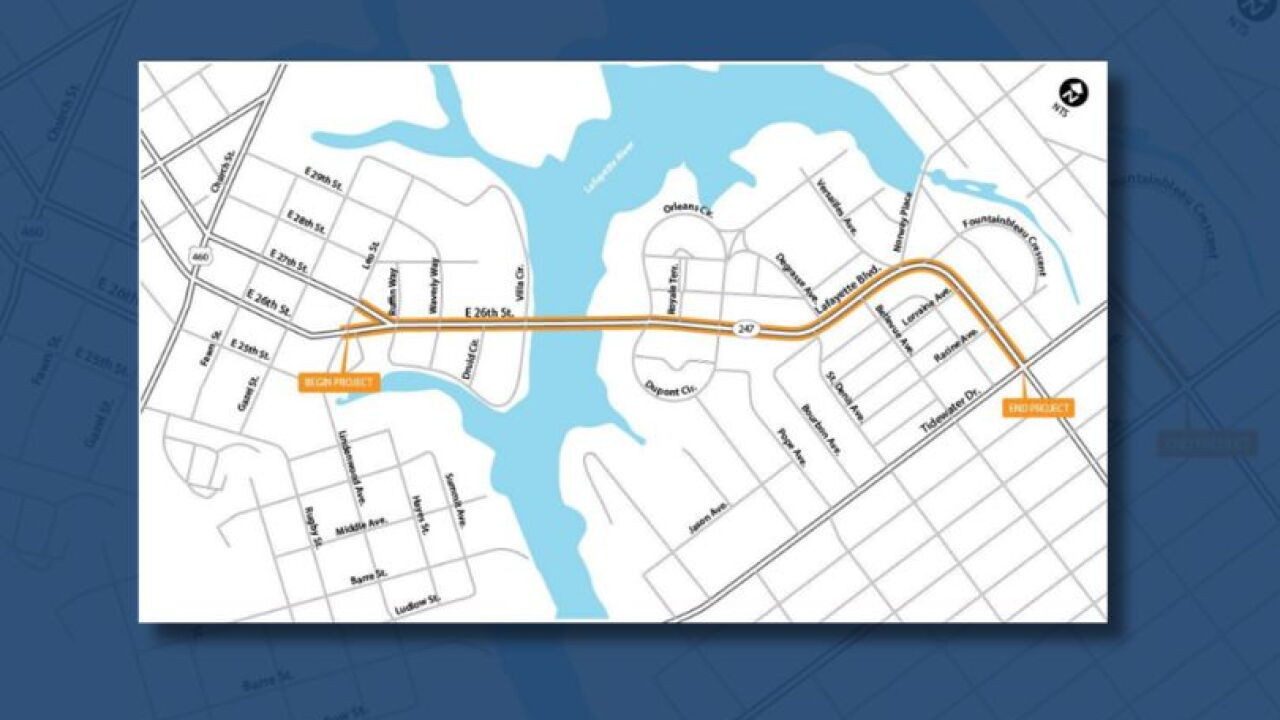

NORFOLK, Va. — Changes could eventually be coming to Lafayette Boulevard as Norfolk transportation officials consider ways to slow drivers, improve pedestrian and bicycle safety and address a corridor with hundreds of crashes reported over the past decade.
The Norfolk Department of Transportation presented an update on its Lafayette Boulevard Comprehensive Study to the Lafayette-Winona Civic League on Sept. 1. City officials emphasized the presentation was not a final construction decision, but another step toward developing a phased approach to improving safety along the corridor.
The study focuses on a corridor that connects neighborhoods, parks, schools and other destinations. According to the city, measured vehicle speeds are above the posted speed limits, while residents have repeatedly raised concerns about walking, biking and crossing Lafayette Boulevard.
Traffic data presented by the city illustrates the speeding concerns.
On portions of East 26th and East 27th streets with a posted speed limit of 25 mph, 85th-percentile speeds were measured at roughly 36 mph. Along Lafayette Boulevard, where the posted speed limit is 30 mph, 85th-percentile speeds were more than 38 mph in both directions. Daily traffic volumes at the locations studied ranged from about 8,600 to more than 10,000 vehicles.
Crash data is also driving the discussion.
The city identified 268 crashes along the study corridor between 2017 and 2026, including three fatal-injury crashes and 12 severe-injury crashes. Twenty-eight crashes were classified as speed-related, while 13 involved cyclists or pedestrians.
The city has been gathering feedback on Lafayette Boulevard since early 2025. That process has included community meetings, two online surveys and other outreach. Norfolk estimates its total outreach and engagement has exceeded 4,600 interactions, including meeting attendance, mailers, survey responses, emails, phone calls and social media.
Speeding stood out in the first survey. Of 105 responses collected in 2025, 95 identified speeding as a transportation or safety concern. Distracted drivers received 56 responses, while 45 cited difficulty crossing Lafayette Boulevard. Traffic-calming measures were the most commonly suggested improvement, followed closely by pedestrian and bicycle improvements.
A larger 2026 survey reinforced those concerns. Of the 245 respondents included in the city's presentation, 94% said they use Lafayette Boulevard weekly or daily. Eighty-three percent use it to enter their neighborhood and 75% use it when leaving.
When asked about priorities, 201 respondents selected speed management and traffic calming, making it the top response. Bicycle and pedestrian improvements followed with 188 responses, while 129 selected intersection improvements and 97 chose lighting and visibility improvements.
The survey also found significant differences in how safe people feel depending on how they travel. Seventy-nine percent of respondents biking or using a scooter described conditions as "somewhat unsafe" or "very unsafe," compared with 66% of those walking or riding transit and 36% of drivers.
Among the potential changes being studied are left-turn lanes at some median openings, closing certain median openings, pedestrian and bicycle improvements and additional lighting. Concept drawings presented Sept. 1 also showed potential changes to the layout of Lafayette Boulevard and possible pedestrian improvements near DeGrasse and Bellevue avenues.
However, city officials made clear those concepts should not be interpreted as approved projects.
The city said no final construction package, lane configuration, median closure or funding commitment has been approved. Instead, the study and surveys have confirmed a need to continue working on safety, speed management and traffic operations along the corridor.
Some changes could come sooner than others.
The city's proposed implementation path calls for near-term improvements over the next 12 months that could include speed-feedback signs, coordination on enforcement, refreshed pavement markings and signs, tree trimming and a review of visibility and lighting. The city also plans to look at sidewalk and curb-ramp fixes where feasible and evaluate pedestrian crossings at key intersections.
Over the next one to three years, Norfolk could review signal timing, analyze specific medians and access points, examine traffic during peak periods and refine intersection and turn-lane concepts.
Longer-term changes, potentially three to five years out, could include permanent traffic-calming designs, bicycle and scooter connections and turn-lane or vehicle-storage improvements. Those projects would depend on funding and available resources.
The city says its next steps include finalizing community feedback and the study report, refining recommended options, identifying a potential "quick-build" project and seeking funding before returning with more detailed implementation plans.
Click here to see how we use AI at WTKR News 3.
