

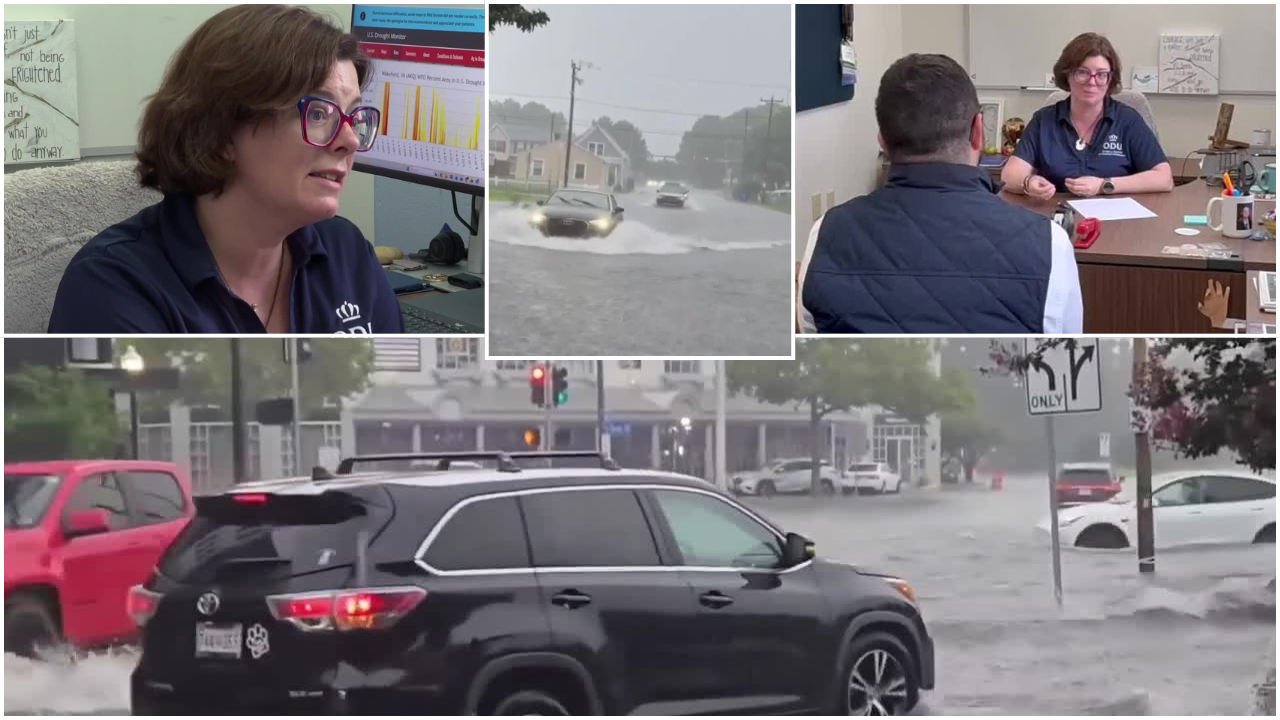


NORFOLK, Va. — Remember all that heavy rain and flooding Hampton Roads experienced earlier this summer? You might think it would have been enough to pull the region out of a drought.
But despite those intense summer storms, much of Hampton Roads and northeastern North Carolina continue to deal with drought conditions. And with more rain in the forecast, an Old Dominion University expert says it's not just about how much rain falls — it's about how that rain falls.
Dr. Jessica Whitehead, the Joan P. Brock Endowed Executive Director of the Institute for Coastal Adaptation and Resilience at Old Dominion University, says the region has been dealing with unusually dry conditions for more than a year.
"The Tidewater region has been flirting with drought since last December," Whitehead told News 3's Jay Greene. "Regionally, drought has been creeping up on us."
Whitehead explained that signs of regional dryness first began appearing in September 2025. By early December, Norfolk had reached the U.S. Drought Monitor's D0 classification, meaning conditions were abnormally dry.
Drought conditions continued to worsen through the spring, reaching their peak severity in May.
While several powerful storms brought heavy rainfall and flooding to Hampton Roads over the summer, Whitehead says those downpours didn't provide the kind of sustained moisture needed to reverse months of dry conditions.
"The events in August, in particular those big rain bombs, all they do is they run right off," Whitehead said.
Instead of intense downpours that overwhelm drainage systems, Whitehead says the region needs rainfall that has time to soak into the ground.
"We want to see it over several hours, possibly even over several days. Give it really enough time to soak in and have our ecosystems use it, and then have some of it run off into our reservoirs," she explained.
WATCH: Despite summer flooding, Virginia, North Carolina remain in drought
Whitehead said much of the rain from those summer storms quickly flowed into the Chesapeake Bay rather than providing lasting relief.
Since mid-August, drought severity has once again been increasing across Hampton Roads.
According to the National Weather Service in Wakefield, approximately 46% of its forecast area was experiencing some level of drought, ranging from moderate to extreme, as of its Oct. 29 drought information statement.
The agency also reported that drought conditions had worsened by one or two categories across portions of southeastern Virginia and northeastern North Carolina over the previous four weeks.
New drought maps released Thursday, Nov. 5, continue to show significant dryness across the region.
And the rainfall numbers help explain why.
Whitehead said Norfolk International Airport, the region's official weather observation station, had recorded just 30.48 inches of precipitation since the beginning of the year as of Thursday.
That's 12.78 inches below normal — a deficit of more than a foot of rain.
"So right now, this time of year, going all the way back to January, we're about 12.78 inches below normal at the Norfolk Airport, which is our official observing station," Whitehead said.
She noted that rainfall has been uneven across Hampton Roads, with some communities receiving significant downpours while neighboring cities received little or nothing.
Whitehead also pointed to the period between Oct. 5 and Nov. 5, when Norfolk International Airport recorded 2.96 inches of rainfall. According to her analysis, that tied for the seventh-driest such period on record.
The airport had also gone roughly two weeks without measurable rainfall.
But the effects of drought aren't limited to rainfall measurements and weather maps.
Whitehead says residents may already be noticing changes in their neighborhoods, including drier lawns, increased watering needs and changes in fall foliage.
"You might be noticing that dryness coming in earlier, or even if you're driving around, the leaves this year got a little bit drier. Colors are a little bit muted, and all of them happening, you know, about a week before we usually see that," Whitehead said. "So all of these are fingerprints of drought in our region."
The impacts also extend into northeastern North Carolina, where communities have experienced similarly dry conditions.
Whitehead says lower stream flows can change the balance of freshwater and saltwater in coastal waterways, potentially allowing saltwater species to move farther inland than usual.
"I think people think, oh, we're at the coast; we always have plenty of water," Whitehead said. "The challenge is that when it's drier than normal, when you have lower stream flows, that water is saltier than it usually is."
She explained that species typically associated with saltier water, including blue crabs, may move farther inland as those conditions change.
However, one of the biggest concerns associated with prolonged drought is the region's water supply.
Much of Hampton Roads and northeastern North Carolina relies on surface water, including rivers and reservoirs, for drinking water.
Norfolk has eight reservoirs as part of its water supply system, along with deep wells. Portsmouth also operates reservoirs, while Virginia Beach receives water from Lake Gaston near the Virginia-North Carolina border.
As drought conditions persist, communities across the region have continued asking residents to voluntarily conserve water.
"Obviously we're not in you know danger kind of situation, but anything you can do to help is something that's for the good of the region right now," Whitehead said.
She recommends checking sprinkler timers, avoiding unnecessary lawn watering and inspecting homes for leaks.
Even small leaks, particularly around toilets, can waste water without homeowners realizing it.
Whitehead says residents can also use collected rainwater from rain barrels for outdoor watering rather than relying entirely on municipal water supplies.
Those conservation measures can also help reduce household expenses.
"All of these things conserving water, also conserving your wallet," Whitehead said.
With more rain expected in the coming days, some residents may wonder whether the incoming precipitation could finally bring an end to the drought.
During News 3's interview, reporter Jay Greene raised that very question, joking that viewers might say, "Well, dang, Jay, you just did a story on drought, and we're getting rain."
Whitehead explained that one rainy day isn't necessarily enough to reverse a prolonged drought.
"The quality, the the kind of the rain that we get matters. We need it to soak in. We need it to not all come at once," she said.
"If we get a day of gentle rainfall that lasts for an entire day. That's the kind of drought-busting rainfall that we're looking for."
Even then, Whitehead says the region would need repeated periods of steady precipitation to make up for its significant rainfall deficit.
"But you know, a close to 13-inch deficit on the year, we need to not just get one of those. We need to get it again, and we need to get it again," she said.
There is some encouraging news in the longer-range forecast.
NOAA's Climate Prediction Center indicated in its Oct. 29 outlook that southeastern Virginia and northeastern North Carolina had a 40% to 60% chance of experiencing above-normal precipitation through the end of January 2027.
The agency's seasonal drought outlook also indicated that drought conditions could improve or potentially end across parts of the region by late January.
However, that outlook depends heavily on whether near- or above-normal rainfall actually develops.
Whitehead says past droughts in the region have sometimes been followed by wetter winters associated with changes in large-scale climate patterns, including El Niño.
While those patterns don't guarantee a wet winter, they can influence the amount of precipitation the region receives.
For now, Whitehead says the key is getting consistent rainfall rather than another round of intense storms.
"Nice, gentle, soaking rainfall. Good day to stay inside with a book or or Netflix," she said. "That kind, that kind of rainfall is what we're hoping for, and then getting a pattern of it to get us out of this drought."
And as Hampton Roads prepares for more rain, Whitehead says it's important to remember that a single storm doesn't define a drought.
"One event doesn't get us out of a drought. One dry spell doesn't get us in a drought," she said. "But we've had a lot of dry of dry spells punctuated by some of these small events that helped a little bit, but just didn't quite do it."
Watch for Jay Greene's reporting on News 3 and WTKR.com. Have a story idea or tip for Jay? Email him.

Click here to see how we use AI at WTKR News 3.
