

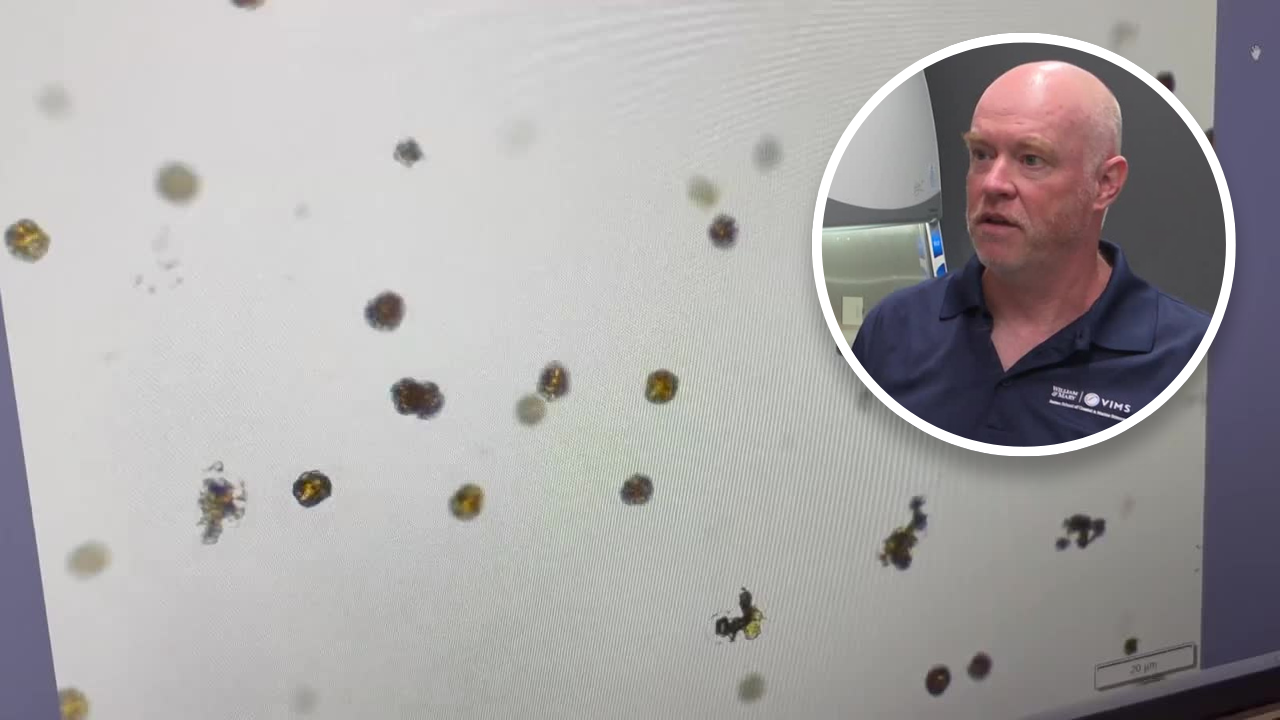


EASTERN SHORE, Va. — A harmful algal bloom in the Chesapeake Bay devastated marine wildlife and caused significant losses for some oyster farmers along Virginia’s Eastern Shore. Now, scientists are working to better track these blooms and provide coastal communities with earlier warnings if another outbreak occurs.
The species of algae, identified as Alexandrium monilatum and referred to by scientists as “Alex,” rapidly grew into what is called a harmful algal bloom in the Chesapeake Bay in September. It quickly blew over toward the Eastern Shore just days later.
According to Hamish Small with William & Mary’s Virginia Institute of Marine Science (VIMS) and Batten School, the bloom developed and moved with unusual speed.
“This obviously happened very rapidly. Within five days, we had an incredibly large bloom of this species in the middle of the bay, and then rapidly, within one day, it was pushed onto the Eastern Shore,” Small said. “That’s where we heard of impacts to fish mortality and impacts to oyster aquaculturists as well.”
The sudden shift left little time for farmers to respond. Some oyster growers report losing nearly their entire crop for the season, with losses estimated in the millions.
Small and his research team were among the first to collect samples of the bloom. Now, they are working to understand its potential long-term effects and whether similar events could become more common.
“There is a likelihood that we may see more blooms in the future,” Small said. “It's a phenomenon countrywide where, with increasing temperatures and water temperatures, we're seeing more blooms of species.”
To prepare for future outbreaks, researchers are collaborating with Old Dominion University and the National Oceanic and Atmospheric Administration (NOAA) to develop improved monitoring and forecasting methods.
The effort includes using satellite technology to identify potential blooms and distributing additional water-testing kits to coastal communities.
Researchers are also working to forecast when and where harmful algal blooms may develop by analyzing environmental conditions.
The monitoring process begins by identifying unusual concentrations of chlorophyll in the water, which can indicate a potential bloom. Once researchers determine whether the bloom is harmful, they can use additional modeling systems to predict where it may travel.
Testing kits are now distributed to several schools and volunteers throughout the region. Researchers train these community members to collect water samples and submit their findings, expanding the network of people who help monitor local waterways.
The goal is to increase community participation and create a more comprehensive monitoring network throughout the region.
Small says the long-term hope is to develop a system capable of providing real-time notifications to people who could be affected.
Researchers hope the technology will eventually alert residents, fishermen and aquaculture businesses when a harmful algal bloom is developing nearby, giving them more time to prepare.
For oyster farmers and coastal communities still dealing with the effects of the outbreak, earlier detection could make a significant difference if another bloom develops in the Chesapeake Bay.
Click here to see how we use AI at WTKR News 3.
