

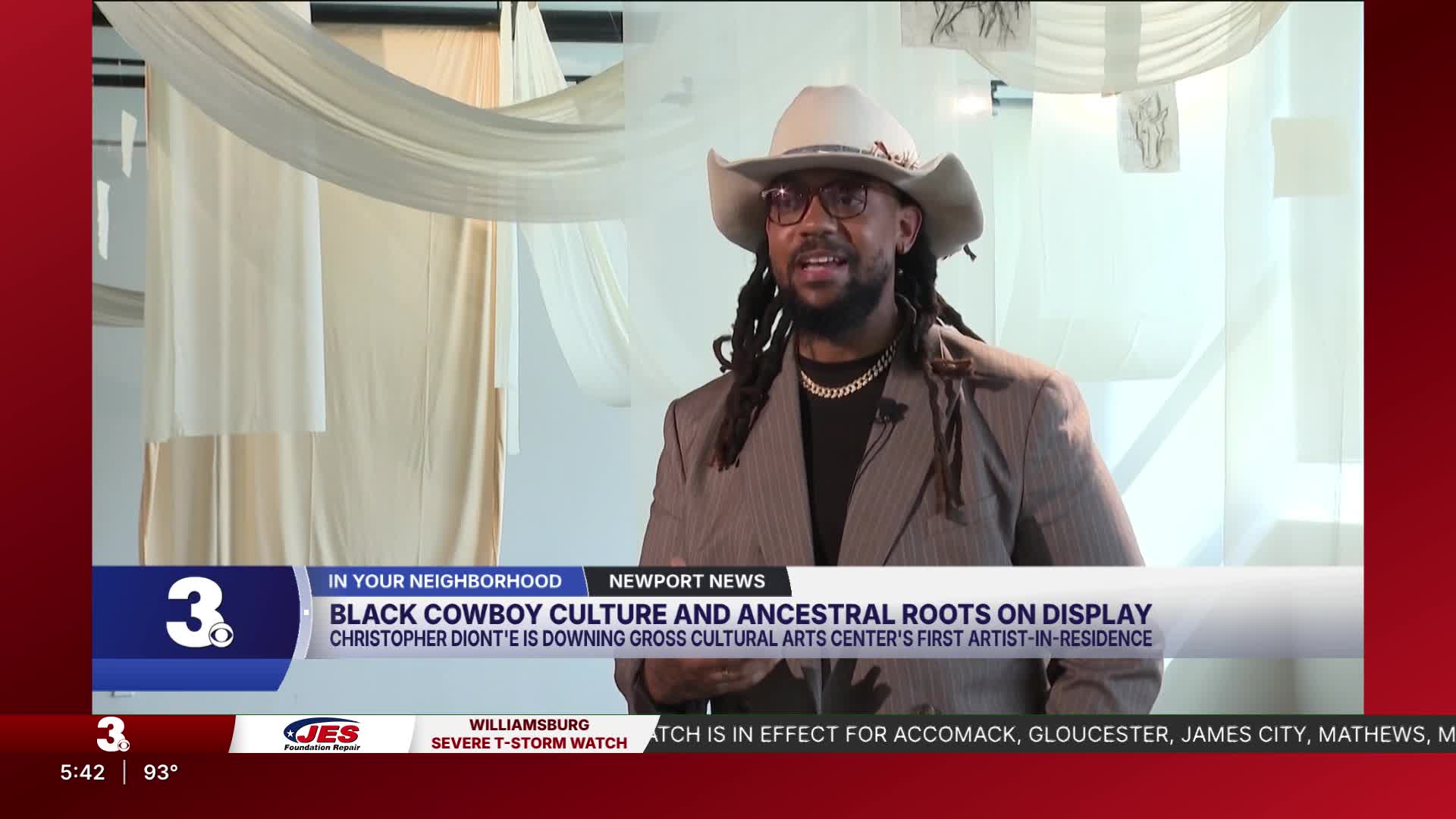


NEWPORT NEWS, Va. — Black cowboy culture, ancestral roots in Virginia and a gleaming hope for the next generation shine through in a local artist’s new exhibition.
Hampton Roads-based artist Christopher Diont’e is Downing Gross Cultural Arts Center’s inaugural artist-in-residence, a new position formed to help everyone involved.
Diont’e returned home to Hampton Roads after a stint in Richmond and was looking for a studio space, as Downing-Gross Cultural Arts Center was looking to revive their fiber arts program.
“It just so happened that he’s an amazing disciplinary artist. And so we sort of crafted this program with him, so that it can be beneficial to us as an institution, the city and our residents, and also to him as an artist,” Newport News Parks and Rec Program Supervisor Cindy Johnson said.
His time at Downing-Gross has become what Diont’e calls a full circle moment from when he was a kid dreaming of having his own gallery at the art center down the street from his grandmother’s home.
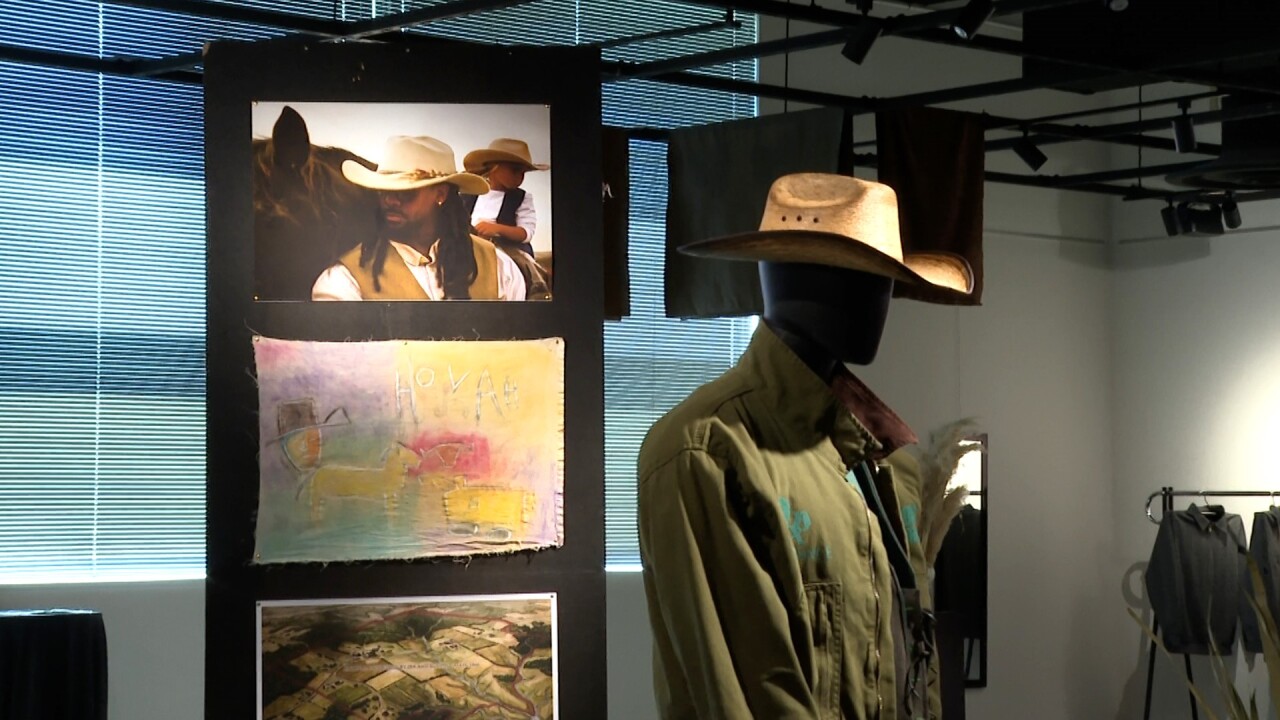
“In those conversations I was having with my grandmother who stays still down the street, saw me down there on the billboard down there, where my face was as the first artist-in-residence, took a picture of that, was like, ‘these are the conversations we used to have,’” Diont’e recalled.
Another full circle moment came in the form of learning his roots. Always having felt an inexplicable pull to the countryside, training horses, and working with cattle, a discovery made it all fall into place.
“Honestly, I was just really trying to figure out who were the first African Americans or men of color in Virginia who were cowboys. And going down that rabbit hole led me to the last name Callis, which is my family's last name,” Diont’e said.
Ira Callis was Diont’e’s third great grandfather. Ira, and his brother Ruffin, were enslaved in Louisiana for nearly three decades. Their enslaver was killed during the Civil War and the brothers were promised an inheritance. They then marched for ten days from Louisiana to Virginia and bought 1,500 acres of land that they named Freeman, Virginia.

That land stayed with the family – which Diont’e owns a portion of. He says visiting the land was both emotional and spiritual.
“I felt like they were with me and I felt like they were guiding me and telling me the whole time, ‘we’re waiting for you’. A lot of the things that I've done prior to them, just that walk through the property, made sense,” Diont’e said.
As Diont’e keeps the legacy alive through caring for the land and telling stories through art, his son, Hovah, eagerly joins him every step of the way, at the studio, rodeos, and in daily chores.
“He's not tripping about being out there knowing that we got to cut grass and mow hay, he's like, excited to wake up at 4-5 in the morning to get out there in the field and go work,” Diont’e said.
Diont’e says this exhibition comes largely from a place of joy, which seems to be a common thread in his residency. He says his favorite part has been connecting with his local community during open studio sessions and classes.

“I've just been honored to be here, honored to share with the community, honored to talk about who I am and what I do,” Diont’e said.
Ancestral Soil: 1865 – The Foundation of Freeman, Virginia is on display through August 15. For more information on the Artist Residency Program, visit Downing-Gross Cultural Arts Center’s website here.
