

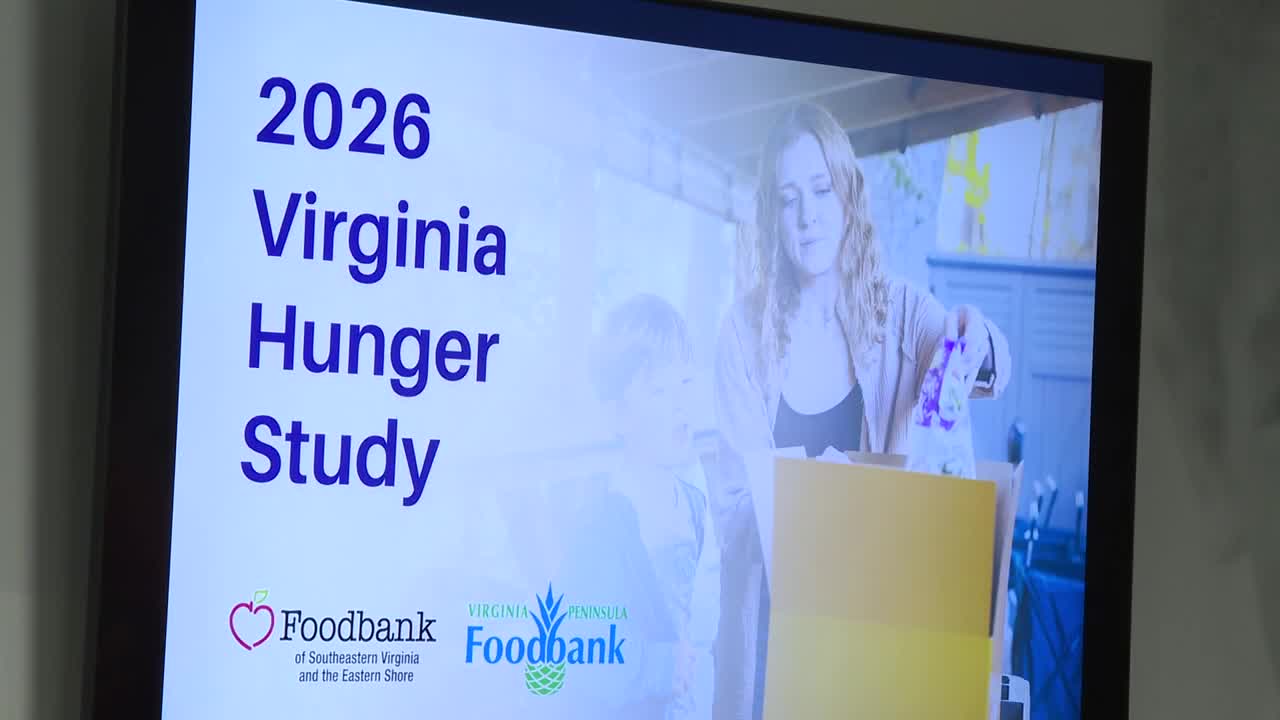


NORFOLK, Va. — A new statewide study is revealing just how many families across Hampton Roads are struggling to put food on the table, with local food bank leaders saying the findings reflect a growing need they have been witnessing firsthand.
The inaugural Virginia Hunger Study found that 43% of households across Southeastern Virginia and the Eastern Shore experienced food insecurity during the past year. On the Virginia Peninsula, that number climbed to 50%.
The findings were released Wednesday during a joint briefing in Norfolk, where leaders from the Foodbank of Southeastern Virginia and the Eastern Shore and the Virginia Peninsula Foodbank joined representatives from community organizations to discuss the challenges facing local families.
For Chris Tan, president and CEO of the Foodbank of Southeastern Virginia and the Eastern Shore, the findings put numbers behind a problem that extends beyond the people many might traditionally associate with hunger.
"These are not families in some distant place; these are our neighbors, the people who bag our groceries, who teach our children, who serve alongside us at church, who work full time and cannot make ends meet," Tan said.
The study included interviews with more than 5,600 Virginians and was commissioned through a partnership between the Federation of Virginia Food Banks, the Virginia Department of Social Services and No Kid Hungry Virginia. The survey was conducted by NORC at the University of Chicago with support from researchers at Virginia Tech.
It is the first statewide, Virginia-only survey to measure food insecurity using the U.S. Department of Agriculture's standard 18-question Household Food Security Survey Module.
Statewide, 42% of households experienced food insecurity, according to the study.
The numbers were even higher among households with children.
In Southeastern Virginia and the Eastern Shore, 56% of households with children experienced food insecurity. On the Peninsula, that number reached 62%.
Bob Latvis with the Virginia Peninsula Foodbank said those numbers are especially concerning because children and seniors are among the most vulnerable populations his organization serves.
"For food insecurity, in its simplest terms, it's you don't know when your — where your next meal is coming from," Latvis said.
He said families are increasingly having to make difficult decisions about which household expenses to prioritize, including prescriptions, gasoline, health care costs and groceries.
The growing need is also reflected in the number of people turning to local organizations for assistance.
During its 2025-2026 fiscal year, the Virginia Peninsula Foodbank recorded 100,000 additional visits to its partner agencies and mobile pantries.
"We've seen on the Peninsula the numbers spike drastically year over year," Latvis said.
Latvis said the organization had been seeing increasing demand at pantries, mobile distributions and other locations even before the new study was released.
The Foodbank of Southeastern Virginia and the Eastern Shore has experienced a similar increase.
Tan said the organization handled about 1.4 million transactions annually when he first arrived. Last year, that number reached 2.6 million.
But one of the study's findings also challenges the assumption that food insecurity primarily affects people who are unemployed.
In Southeastern Virginia and the Eastern Shore, approximately 60% of both food-insecure and food-secure neighbors were employed.
Dr. Matisha Dentu, who helps operate a food pantry through Living Faith Christian Center on the Peninsula, said that reality is evident among the families her organization serves.
"These are people who get up every morning. They go to work. They care for their children and their families. They pay rent. They pay a mortgage. They pay utility bills. They put gas in their cars to go to work," Dentu said. "And after doing all of that, there simply is not enough money left to purchase the food that their households need."
Dentu said the pantry is not necessarily the only source of food for the people it serves. For some families, it provides the additional groceries they need to make their household budget work.
The study found that 87% of food-insecure households statewide said higher-than-usual grocery prices had a major impact on their finances.
Dentu said families can find themselves struggling because of an accumulation of expenses rather than one major financial emergency.
Groceries may become more expensive at the same time as utilities or housing costs rise. A family could face an unexpected car repair, illness or loss of income that puts additional pressure on an already tight budget.
Dentu described one neighbor who had been using her organization's pantry to supplement his grocery budget while waiting for disability benefits. As his physical condition worsened and he was no longer able to travel to the pantry, the organization began taking food to him.
"That is what these statistics look like in real life and in real time," Dentu said.
She said food assistance can help families preserve money for other necessities, including medicine, utilities and transportation.
"Making sure a child doesn't go hungry matters," Dentu said. "So when we talk about food or hunger, we're not just talking about food. We're talking about the stability of families. We're talking about health, and we're talking about the ability of hardworking people to remain stable when their household budgets simply cannot absorb another increase."
For some Hampton Roads residents, finding available food is only part of the challenge. Getting to it can be another obstacle.
Sabrina Davis, founder and executive director of RESET INC., said her organization operates a 24-hour community walk-up pantry in Chesapeake along with a weekly food and diaper distribution.
Davis said the walk-up pantry alone can serve approximately 50 to 75 people each day. During one recent Thursday distribution, Davis said the organization served 246 people in less than two hours. In one week, the organization also received 12 calls for food assistance, delivered food to 10 households and received 14 requests for diapers.
"Having food available does not necessarily mean you have accessibility," Davis said.
She said some of the people her organization serves do not have reliable transportation. Others are elderly, have young children or are trying to coordinate food pantry hours around their work schedules.
Davis said families are also weighing food costs against rent, electricity, medication, child care, gasoline and other household expenses.
Despite being a relatively young, grassroots organization, Davis said RESET INC. serves more than 500 people during an average week.
She said meeting that need requires collaboration among food banks, local pantries, churches, businesses, farmers, volunteers and community leaders.
"Food insecurity cannot be addressed by one food bank, one nonprofit, one church, or by one government agency or community partner," Davis said. "It takes all of us."
The study also identified differences in health outcomes between food-insecure and food-secure households.
In Southeastern Virginia and the Eastern Shore, 76% of adults in food-insecure households reported having been diagnosed with a chronic disease, compared with 67% of food-secure adults.
Sixty percent of food-insecure adults reported visiting an emergency room or urgent care facility, compared with 46% of food-secure adults.
Tan said those findings reinforce his organization's emphasis on distributing nutritious food.
During its most recent fiscal year, the Foodbank of Southeastern Virginia and the Eastern Shore distributed a record 26.6 million pounds of food. For the first time, fresh produce and lean protein accounted for more than half of that distribution.
The Virginia Peninsula Foodbank has also increased its focus on fresh produce, lean proteins and other nutritious options. The study found 27% of food-insecure neighbors on the Peninsula reported difficulty accessing healthy food.
Food bank leaders say the new study can also help them identify communities where people may have difficulty finding charitable food resources.
Tan said one of the findings that concerns him is the number of people experiencing food insecurity who are not accessing the charitable food network.
He said his food bank has grown from 110 partners to 241 in three years, but there are still geographic gaps.
In some communities, Tan said, there may be several food pantries within a mile. In more rural areas, people may have far fewer options.
"There are pockets of our communities where ... there are not enough resources for those neighbors," Tan said.
The Foodbank of Southeastern Virginia and the Eastern Shore has also made changes to its Food Finder tool to help people find distributions that are open near them in real time.
Tan said the organization plans to continue using data to determine where people are accessing food and where additional resources may be needed.
For the food bank leaders and community organizations who gathered Wednesday, the study provides new data to describe a need they say they have already been seeing at pantry doors and distribution sites.
"The study certainly gives us the data. Our pantries and other partner agencies give us the faces behind the data, and both are telling us the same thing," Dentu said. "More of our neighbors are finding it difficult to put enough food on the table, and the charitable food network is an increasingly important part of how families maintain and remain stable from one month to the next."
Click here to see how we use AI at WTKR News 3.
