



NORFOLK, Va. — Carolyn Savage remembers celebrating her birthday. She remembers getting dressed up, going out and learning a line dance at PBR in Norfolk.
Then, nothing.
The next thing Savage remembers is waking up in the hospital, where she learned that her night out had turned into a fight for her life.
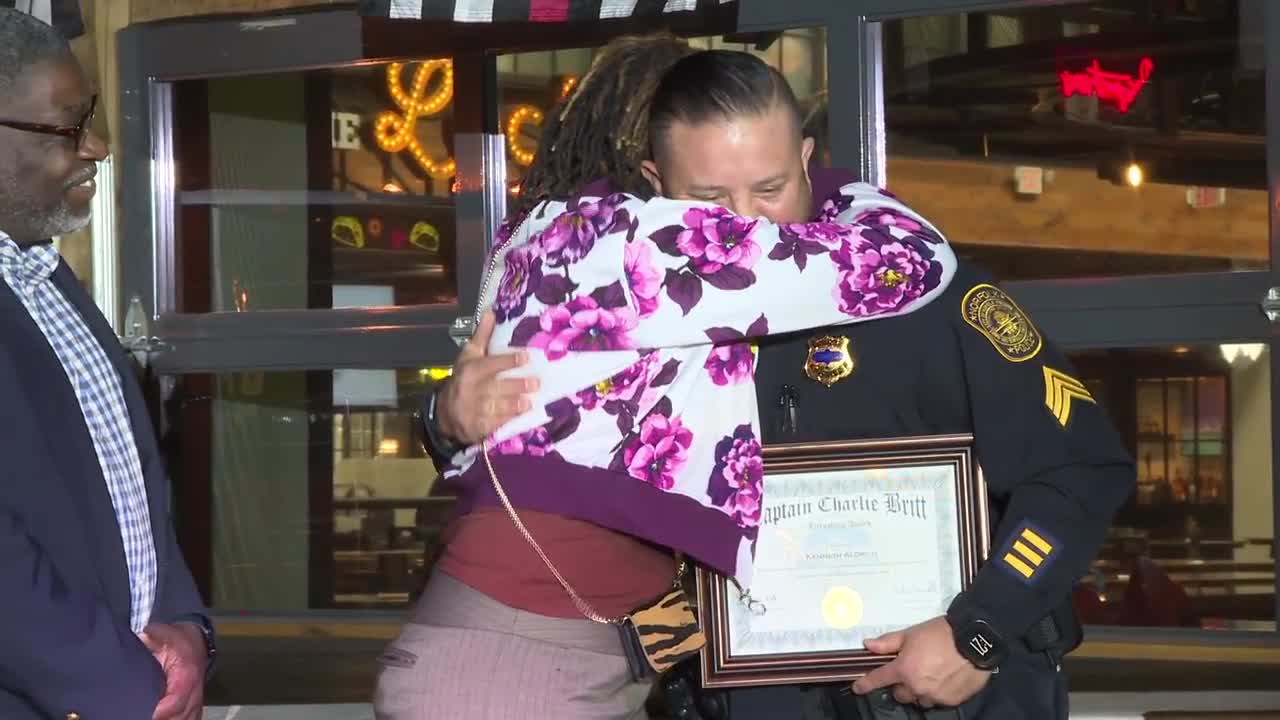
Months later, Savage returned to PBR to meet and thank some of the people responsible for making sure her story did not end there.
Norfolk Fire-Rescue invited News 3 to the reunion. WTKR News 3's Jay Greene was there as Savage came face-to-face with some of the people who helped save her life.
"I really appreciate everybody that just rushed in," Savage said. "It saved my life, and I wouldn't be here today."
Savage was celebrating her birthday on July 24. She said she had spent the day with her boyfriend and eventually made her way to PBR.
"I remember I was learning the line dance, and that was it," Savage said. "Then I ended up in the hospital."
Around 12:30 a.m., Savage collapsed.
Norfolk Police Sgt. Kenny Aldrich was working private security at PBR when he saw Savage on the ground. He went to her, realized she did not have a pulse and immediately started chest compressions.
PBR staff worked to clear the building while someone went to get the facility's automated external defibrillator, or AED.
Norfolk Fire-Rescue's Medic One arrived shortly after 12:35 a.m., followed by Engine One. By the time crews reached Savage, the chest compressions had helped produce a faint pulse.
But she soon lost that pulse again.
Crews immediately resumed CPR and used a defibrillator. Her pulse was restored around 12:43 a.m., according to Norfolk Fire-Rescue.
Savage was taken to the hospital, where doctors determined she was having a heart attack. She was taken to a cardiac catheterization lab and received a stent to help keep an artery open.
Savage said she had never experienced anything like it before. She considered herself active and said she regularly worked out and walked. She recalled feeling slightly tired in the days leading up to the cardiac arrest but did not think it was a sign of what was about to happen.
Her family history also included heart attacks. Savage said her mother and grandmother both died after suffering heart attacks.
Hearing afterward just how close she came to dying was difficult to comprehend.
"Sometimes it overwhelms me when I'm just doing normal things, and I'm like, 'Oh my God! I literally was out, and I actually died, and I came back to life,'" Savage said. "So I feel like I have a second chance."
Part of that second chance meant getting an opportunity to meet the people who acted during those critical first moments.
Savage said she had spent months thinking about the officer who rushed to help her, even though she did not know what he looked like.
"I know it's somebody's job, but it's just, it's everything to me that he would rush up and help me," Savage said.
During the reunion, she was finally able to hug Aldrich and thank him herself as well as member of Norfolk Fire-Rescue who were there.
"I gave him a card and just said, you know what? Thank you for rushing in. Thank you for just seeing something and you did it. You acted fast," Savage said. "I just gave him a big hug, and it just makes me cry."
For Norfolk Fire-Rescue, the reunion was also a chance to see an outcome first responders do not always get to witness.
Capt. Darlene Braun leads Norfolk Fire-Rescue's EMS division. She said seeing Savage return to her normal activities after what happened was worth celebrating.
"We work really hard in the city to deliver the best patient care, and to see somebody be able to walk out of the hospital after such a short amount of time and go back to their daily activities is a big deal for us," Braun said.
Braun said Savage's survival also demonstrates why the actions taken before paramedics arrive can be critical.
"Early compressions, bystander CPR. That is the message that we're trying to push," Braun said.
In Savage's case, Braun said the people inside PBR had several pieces of that response already in motion. Aldrich was performing compressions, and staff knew where the AED was located and went to retrieve it.
"They had all of the steps in place," Braun said. "Early compressions were already being given, and somebody went to get the AED."
Braun said simply knowing where an AED is located can make a difference during an emergency.
"To know where your AEDs are is very important. Early defibrillation is very important," Braun said. "It's a very simple skill."
Norfolk Fire-Rescue offers free courses to people in the city to teach hands-only CPR and how to use an AED. Braun said people should not hesitate to ask where an AED is located when they are at a business or other facility because an emergency can happen without warning.
The department is also looking for more people interested in making emergency response their career.
Braun said Norfolk Fire-Rescue is in the hiring process for both fire-rescue and paramedic-only opportunities. She encouraged people interested in the work to follow the department's website and social media for information about those opportunities.
"If saving lives is something that you are drawn to, we would love to have you part of our team," Braun said.
For Savage, the experience has also changed how she thinks about her own health and the time she has.
She said she now gets regular checkups, takes medication and has made changes to her diet and lifestyle. She also hopes what happened to her reminds other people not to assume a serious medical emergency cannot happen to them.
But her biggest takeaway is simpler.
"Life is way too short," Savage said. "Just be in the moment. Enjoy your life, love your life."
Click here to see how we use AI at WTKR News 3.
