



PORTSMOUTH, Va. — Portsmouth city leaders got their first look at a proposed $360.7 million general fund budget for fiscal year 2027. A spending plan that holds the property tax rate steady but includes higher utility costs and leaves Portsmouth Public Schools millions of dollars short of what district leaders say they need.
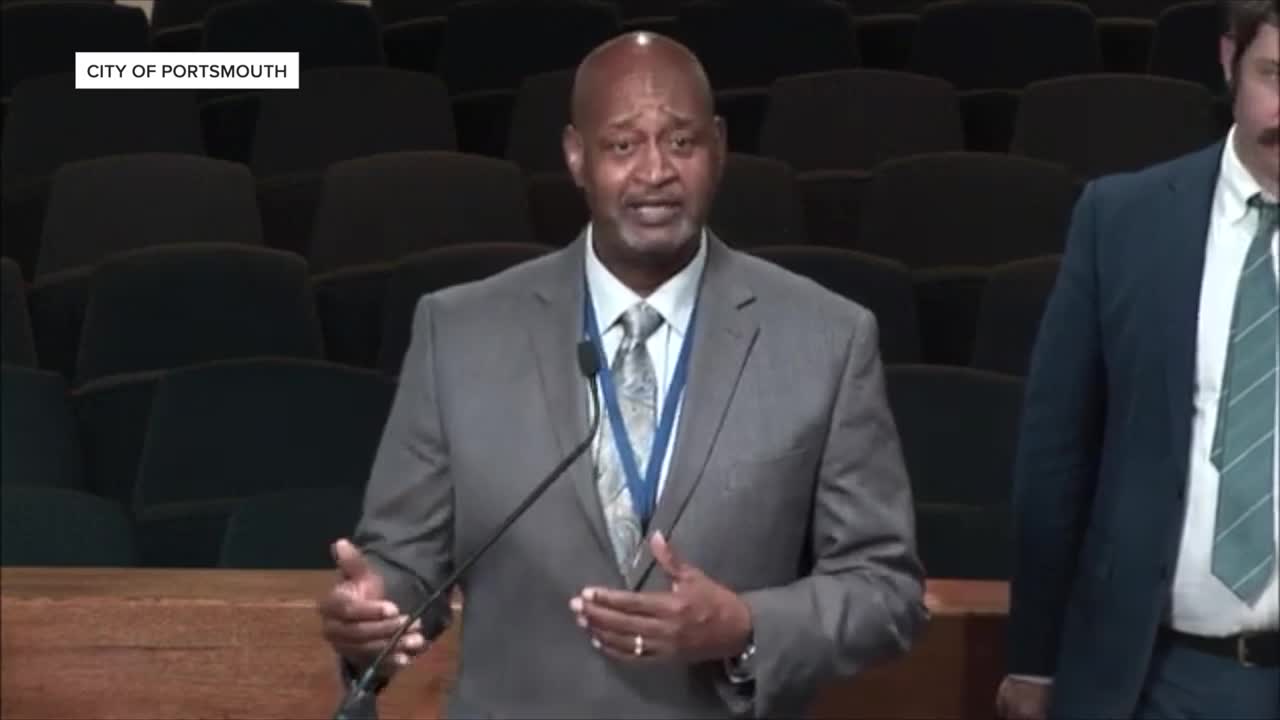
City Manager Steven Carter presented the budget at a special city council meeting, calling it "a plan for action" built around improving core services, investing in city employees, and advancing major capital projects, all without raising taxes.
"I'm proud to say without increasing taxes," Carter said.
The real property tax rate will remain at $1.24 per 100 of assessed value. However, water and sewer rates will increase by 5% to fund system maintenance, and stormwater fees will be adjusted to .75 cents per equivalent residential unit. That's about a $17.00 annual rate.
The proposed budget represents a 6.3% increase over the fiscal year 2026 budget. But budget officer Trey Burke cautioned council against treating that figure as a sign of broad revenue growth.
Burke said two factors drove most of the increase: a one-time jump in real property tax values and a larger draw from the city's fund balance, which is essentially money saved from prior years. Strip those two items out, he said, and the underlying revenue growth is closer to 2.9%.
"That 2.9% is the number I'd encourage council to focus on as the measure of our natural fiscal trajectory," Burke said.
Burke described the spike in property values as likely tied to a shortage of available land in the city, calling it more of a one-time adjustment than a trend that can be counted on going forward.
The proposed budget includes funding for several significant capital investments:
- Relocation of City Hall
- A new K–8 school for Portsmouth Public Schools
- A combined public safety facility
- Relocation of Cradock Fire Station
- Completion of the PACE Center for the school system
Carter said the City Hall relocation is about more than moving offices. He described it as an opportunity to create a more modern and accessible space for residents and employees, while also opening the current waterfront property to future development.
One of the most contentious elements of the proposed budget is the allocation for Portsmouth Public Schools.
The school system initially requested $14.3 million in new funding. After negotiations, that number was reduced to $12.8 million. The proposed budget allocates just $7 million in new funding, bringing the total school system allocation to approximately $89.9 million, still nearly $6 million short of what school leaders said they needed.
Carter acknowledged the gap and said he and school superintendent Dr. Elie Bracy, III, are continuing to negotiate.
"The promise we've made each other is that I will continue to work on the city side to see if there's some room that we can make some modifications," Carter said. "And that he will continue to work on the school system side to see if he can find a way to help us meet somewhere in the middle."
Carter told council the school funding number in the current proposed budget is not necessarily the final figure.
The budget also includes the creation of a new public safety director position, a single leader who would oversee all of Portsmouth's public safety operations, including police and fire.
"That director will be in charge of all things public safety," Carter said. "And be able to coordinate all of those entities into a cohesive, functioning, responsive unit."
Burke told council that the city will commit more than $21.1 million in fiscal year 2027 to pension and retirement obligations covering 942 retirees. That figure includes $10.1 million for legacy pension obligations, $8 million for the police retirement system, $2.1 million for the Portsmouth Supplemental Retirement System, a $1.4 million one-time payment of $1,500 per participant directed by council, and $11 million in pension obligation bond payments.
As of June 30, 2025, the city's combined net pension liability stood at $63.8 million, with a funded status of 75.4%.
"This is a substantial obligation, and it is critical that our decisions ensure that the long-range viability of these systems so that every retiree receives what they're entitled to," Burke said.
The city is also continuing to build a trust fund for other post-employment benefits, contributing $1.5 million this fiscal year. Since 2018, the city has contributed a total of $8.5 million to that fund.
Carter said the city plans to launch a financial transparency dashboard that will allow residents to more easily track how public funds are being spent.
Residents will have three opportunities to speak at public hearings before the budget is adopted:
- April 14 — Regular city council meeting, 7 p.m.
- April 28 — Regular city council meeting, 7 p.m.
- May 12 — Regular city council meeting, 7 p.m. (rates and fees only)
The budget is scheduled for adoption on May 12.
You can find the budget presentation here and watch the presentation here.
This story was reported on-air by a journalist and has been converted to this platform with the assistance of AI. Our editorial team verifies all reporting on all platforms for fairness and accuracy.
