

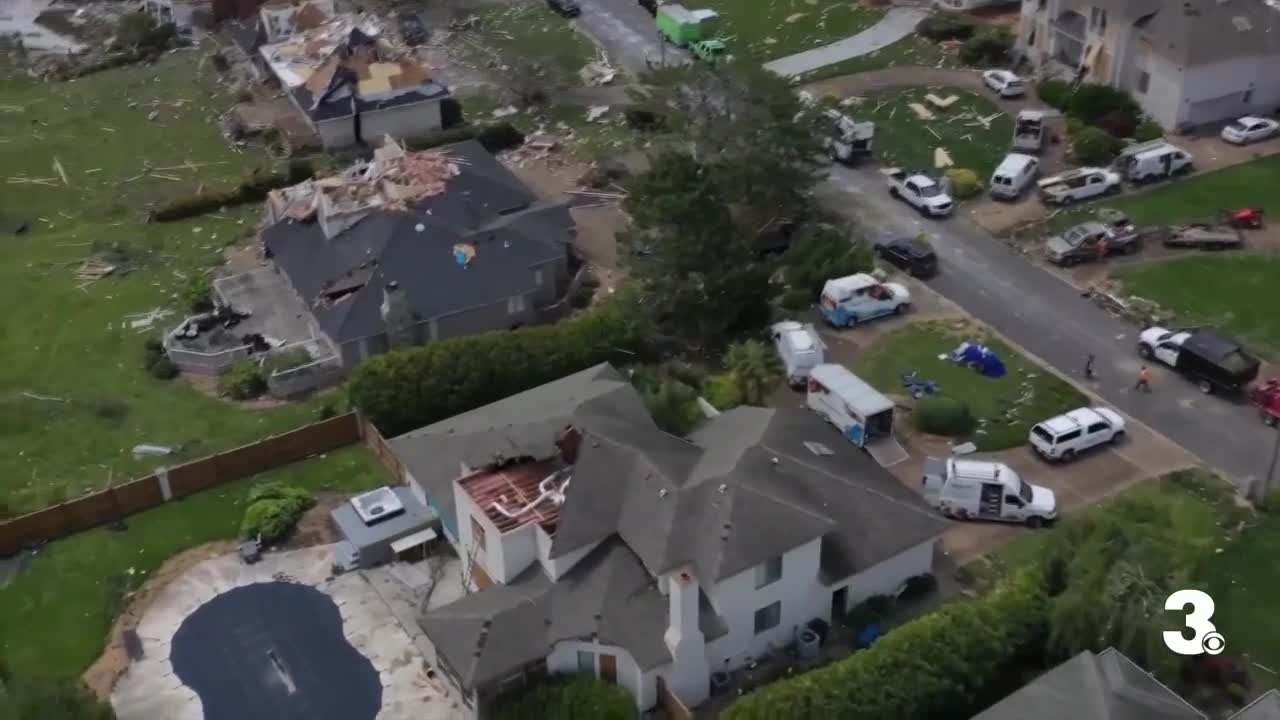


VIRGINIA BEACH, Va. — On the morning of April 30, 2023, showers and non-severe storms passed through Hampton Roads, but nothing like what Great Neck neighbors would experience later that afternoon.
Soon, conditions changed, creating the recipe for a final, more intense round of storms. One of those storms formed into a rotating supercell over Virginia Beach, producing an EF3 tornado that was on the ground for about five minutes, moving almost 60 mph from the Lynnhaven River through the Great Neck neighborhood before dissipating over Fort Story.
Watch: Drone video shows destruction from EF-3 tornado in Great Neck area
Carrie Triepel, a Great Neck resident, said, “It was like, you're in a horror film, right? You hear that [beep noise] and lights went out.”
Triepel’s daughters were home as large trees fell onto their property.
“They felt like their eardrums were going to, you know, get in, let be sucked into their into their head. And it was very, very, very scary,” Triepel said.
The tornado damaged over 100 homes, with millions in losses, but miraculously caused no injuries or deaths.
Watch previous coverage: Virginia Beach leaders hold news conference to address tornado that struck Great Neck area
“It was just the devastation, and couldn't believe the roof was all caved in,” Sandra Johnson said.
“Bricks were everywhere,” Bert Johnson said. "Part of the house was just blown up inside. Glass everywhere."
The Johnsons are Great Neck homeowners.
Damage from a tornado with estimated peak winds of 145 mph is unavoidable, but a quick emergency response helps reduce the cost of severe weather.
Watch previous coverage: Couple whose home was damaged by tree in Virginia Beach EF-3 tornado reflects on a very close call
Tornadoes most commonly form within powerful thunderstorms called supercells. Think of supercells as nature's most dangerous storms. They are very rare in our neighborhoods, but when the right conditions — warm, moist air, strong winds that change with height, and atmospheric instability — come together, supercells can form. From there, the rotating updraft within the supercell can descend toward the ground, forming a wall cloud.
The downdraft then helps feed into the rotating updraft of the supercell, creating a strong vortex and funnel cloud. Once the funnel cloud reaches the ground, you have a tornado. That’s what happened when the powerful EF3 tornado touched down in the Great Neck neighborhood.
“We started pulling back resources ahead of that weather, make sure we didn't have, police officers, or teams out on bikes, you know, public safety patrolling and ambulances or, you know, foot patrols, getting them back in,” said David Topczynski, Virginia Beach director of emergency management.
Watch previous coverage: VB fire crews recount tornado response
Topczynski has handled emergency responses for weather events across the country. He was working with two NWS Wakefield meteorologists on the day of the tornado, monitoring severe weather for the Something in the Water festival. The response began as soon as the tornado began to form, but the preparations began well before the tornado was on the ground.
“Because we had tested so much and rehearsed so much beforehand. It was like clockwork,” Topczynski said.
The first step is addressing the hazards left in the wake of the destruction. Energy and gas companies, along with emergency services, need to know where to go and how to help. Plus, crews are needed to remove debris. It's a lot of moving parts, and that's where emergency managers step in.
Topczynski helped coordinate a disaster rehearsal in coordination with Something in the Water festival. That rehearsal was put into action as the tornado unfolded.
Watch previous coverage: VB officials estimate EF-3 tornado caused $16M in damage to Great Neck homes
“We're tracking where we are, so the help and the resources are going to where it needs to go. And then we're problem solving,” Topczynski said.
Above all else, preventing injuries and loss of life is the top priority for emergency managers, with no deaths or injuries reported.
The Great Neck tornado is an example of successful emergency response, but some neighbors are still feeling the cost of the tornado and the fallout afterward. Bert and Sandra Johnson's home was destroyed by the Great Neck tornado. They say the road to recovery has been anything but easy.
Watch previous coverage: Homeowners continue to clean up from VB EF-3 tornado
“You get stuck in this nightmare,” Bert Johnson said.
The cost of severe weather is more than just dollars. Sandra has spent years talking to insurance, the public adjuster, the mortgage company, the architect, the contractor — the list goes on. And yet her house is still not finished.
“They'll release 10,000 here, 20,000 here. And every time she has to just keep calling them to keep coming out, like, every few weeks or every month,” Bert Johnson said, adding that this process has been going on for the past three years.
The Cost of Severe Weather: News 3 team explores storm impacts in Hampton Roads
Through their fight to rebuild, Bert and Sandra have provided valuable insight into how homeowners can manage disaster recovery.
“I’d definitely get a public adjuster first — we spent too much of our own time, like trying to fight the insurance, and they knew how to do it and they knew how to get the max amount of money,” Bert Johnson said.
They also recommended hiring contractors to seal off any holes in the roof, rather than using tarps, and doing as much as you can to soak up water from leaks. Make sure you're not being charged for taxes and electric on an unlivable house with no electricity. The Great Neck tornado's devastating cost cannot be calculated solely in dollars, but in countless lives it reshaped forever.
“Pray it never happens to you,” Bert Johnson said.
Click here to see how we use AI at WTKR News 3.
