

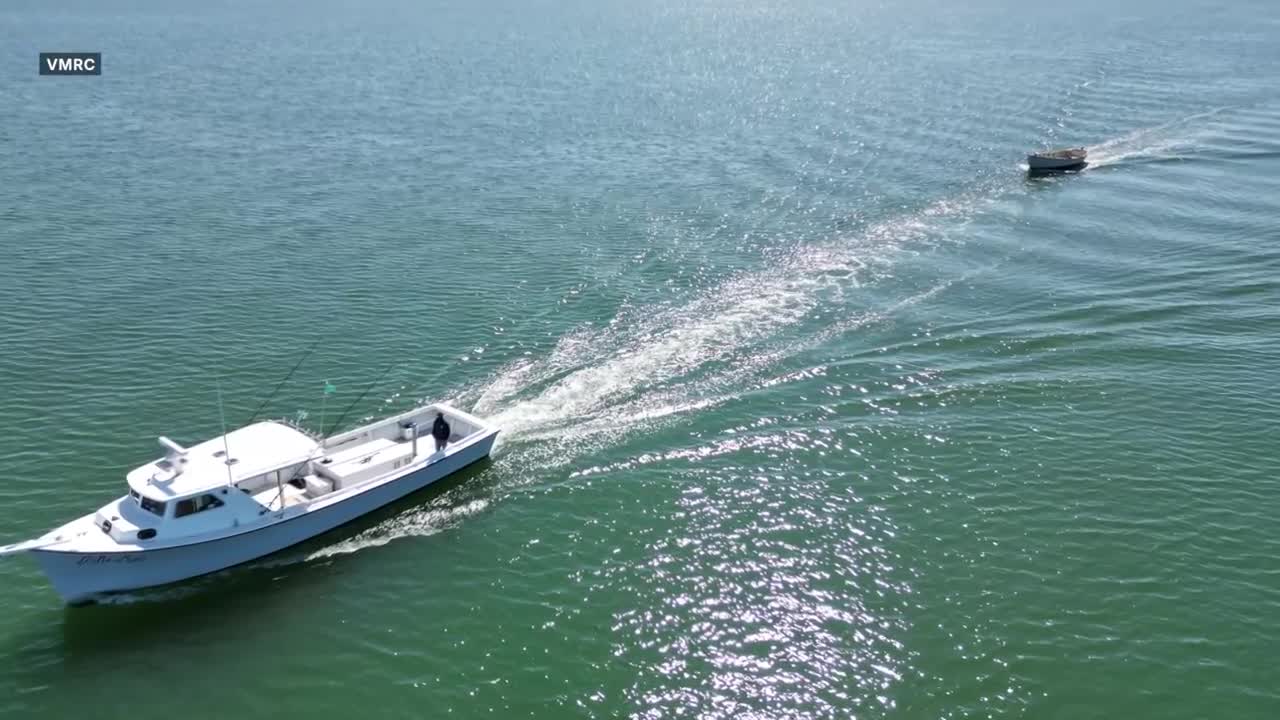


HAMPTON, Va. — A vessel once used to study the Chesapeake Bay is now helping preserve it. Freya, a boat built by renowned Chesapeake Bay naturalist Gilbert Klingel, was recently and intentionally sunk off Windmill Point in Mathews County to serve as an artificial reef. The vessel now rests on the bottom of the Chesapeake Bay, where it is expected to provide habitat for marine life and contribute to the health of the region’s ecosystem.
Klingel used Freya in the 1950s to study marine life in the bay, often working with a diving chamber he designed called the Aquascope. After his death in 1983, the vessel remained a piece of local maritime history. Now, more than four decades later, it has taken on a new purpose beneath the water’s surface.
“They anchored the boat and they opened the valves that they had installed through a hole and allowed her to fill up with water from the inside and sink naturally,” said Hunter Smith, a Virginia Marine Resources Commission artificial reef specialist.
Artificial reefs are typically placed on relatively flat sections of the seafloor, where they provide a stable structure for algae, bacteria and other organisms to attach and grow. Over time, these structures attract increasingly complex marine communities.
“Small attaching organisms come first, then your bait fish, then your larger fish, and then you're all the way up to your largest predatory fish, crabs, shellfish, everything benefits from it,” Smith said. “It gives them almost an oasis in the wide-open places for things to hide, seek shelter and find food.”
Freya is not the only piece of Hampton Roads history being repurposed for conservation efforts.
Materials from the Hampton Roads Bridge-Tunnel (HRBT) expansion project are also being used to create artificial reef habitat in the bay. As portions of the original bridge-tunnel structure are demolished to make way for the expanded crossing, the resulting concrete is being recycled into reef-building material.
“The actual concrete demolition material is wonderful for reefing,” a Smith told News 3. “As they're taking down the old structure and putting up the new structure, we are using that material on reef sites.”
Tons of demolished concrete from the HRBT expansion project are being placed at artificial reef locations throughout the Chesapeake Bay. The material is currently being used at two sites: Bluefish Rock Reef off the coast of Hampton and Back River Reef near Poquoson.
Officials say the projects provide a dual benefit by recycling construction materials while creating habitat that supports fish, shellfish and other marine species.
As traffic continues to flow through one of the region’s busiest transportation corridors, pieces of the old bridge-tunnel will now help support life beneath the waters of the Chesapeake Bay.
Click here to see how we use AI at WTKR News 3.
