



NORFOLK — As many as 4,000 people gathered in Norfolk, Virginia, on January 1, 1863, for what historians believe was the first Emancipation Day parade in the United States.
Much of what is known about the parade's history comes from The New Journal and Guide, a historic Hampton Roads Black newspaper founded in 1900 that is still in publication.
In 1926, a local citizen shared an original record of the 1863 celebration with the paper. An 1863 article from The New York Times confirmed the parade took place the same day the Emancipation Proclamation went into effect.
Watch related coverage: Historians say Harborfest isn't about slave trade — but Norfolk's waterfront played a role
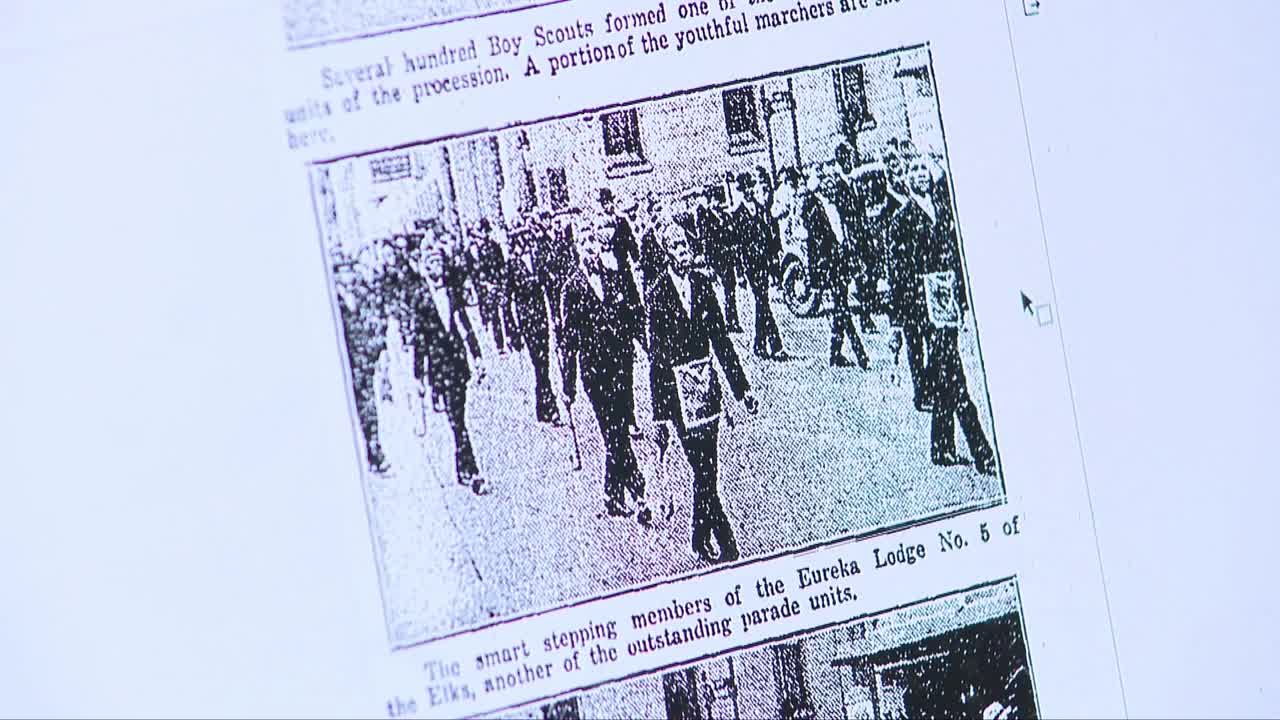
The New Journal and Guide Publisher Brenda Andrews has spent time reviewing the paper's digital archives, which include photographs and reporting from the parade's 1937 coverage — images that show Norfolk's famous Excelsior Band and crowds that drew thousands.
"As the article says, thousands of people would show up," Andrews said.
Andrews said the paper's documentation of the parade is part of a larger mission.
"Black reporters and photographers and photojournalists have been a part of keeping this important documentation of Black history," said Andrews. "That's what The Journal and Guide has done for 126 years."
Watch related coverage: Tuskegee Airman buried in Suffolk helped lay groundwork for Red Tails
According to reports, the parade began near First Baptist Church Bute Street in downtown Norfolk and stretched more than a mile to East Princess Anne Road, ending at Elmwood Cemetery — where participants burned Confederate President Jefferson Davis in effigy.
"What you might say a caricature of Jefferson Davis, a uniform with perhaps silver straw in the hat. [It] symbolized Jefferson Davis, and they burned [it], set it on fire," said historian and author Dr. Tommy Bogger.
Bogger, a retired archivist from Norfolk State University, said the 1863 crowd included thousands of free and enslaved Black people, many of whom had sought refuge in a Union-controlled Norfolk.
The celebration marked the day Abraham Lincoln's Emancipation Proclamation went into effect — predating Juneteenth, the day in 1865 when enslaved African Americans in Galveston, Texas, became free.
Watch related coverage: The remarkable story of a Black Revolutionary War hero from Portsmouth
When asked whether Norfolk was the site of the first Emancipation Day parade in the country, Bogger was direct.
"As far as I've been able to determine, yes, especially because this was the one area that was under control of the Union Army," Bogger said.
Organizers of the parade were deliberate in how they approached the event, Bogger said. They obtained a parade permit from the local military governor and requested a military escort.
Watch related coverage: 100 quilts honor Black History and Underground Railroad stories in Chesapeake
The parade became a major annual tradition for several decades.
"This was a big holiday among Blacks in Virginia and it didn't begin to peter out until around about World War II," Bogger said.
While the parade faded from public memory over the decades, Andrews said revisiting it in the context of Juneteenth celebrations carries meaning.
"It kinda connects all of us together," Andrews said.
"When we are able to document the Emancipation Day and how important it was to Black people here in Norfolk," Andrews said.
Watch related coverage: Cannonball from Revolutionary Era still embedded in this Norfolk church's wall
Andrews said the lesson extends beyond any single event.
"You have to tell your own story or it gets told for you," Andrews said.
Bogger said the history uncovered in Norfolk deserves wider recognition.
"This is a very significant part of our history that we are very, very proud of what our forefathers did in this area, and we want to make sure they received their rightful place in history," Bogger said.
This story was reported on-air by a journalist and has been converted to this platform with the assistance of AI. Our editorial team verifies all reporting on all platforms for fairness and accuracy.
