

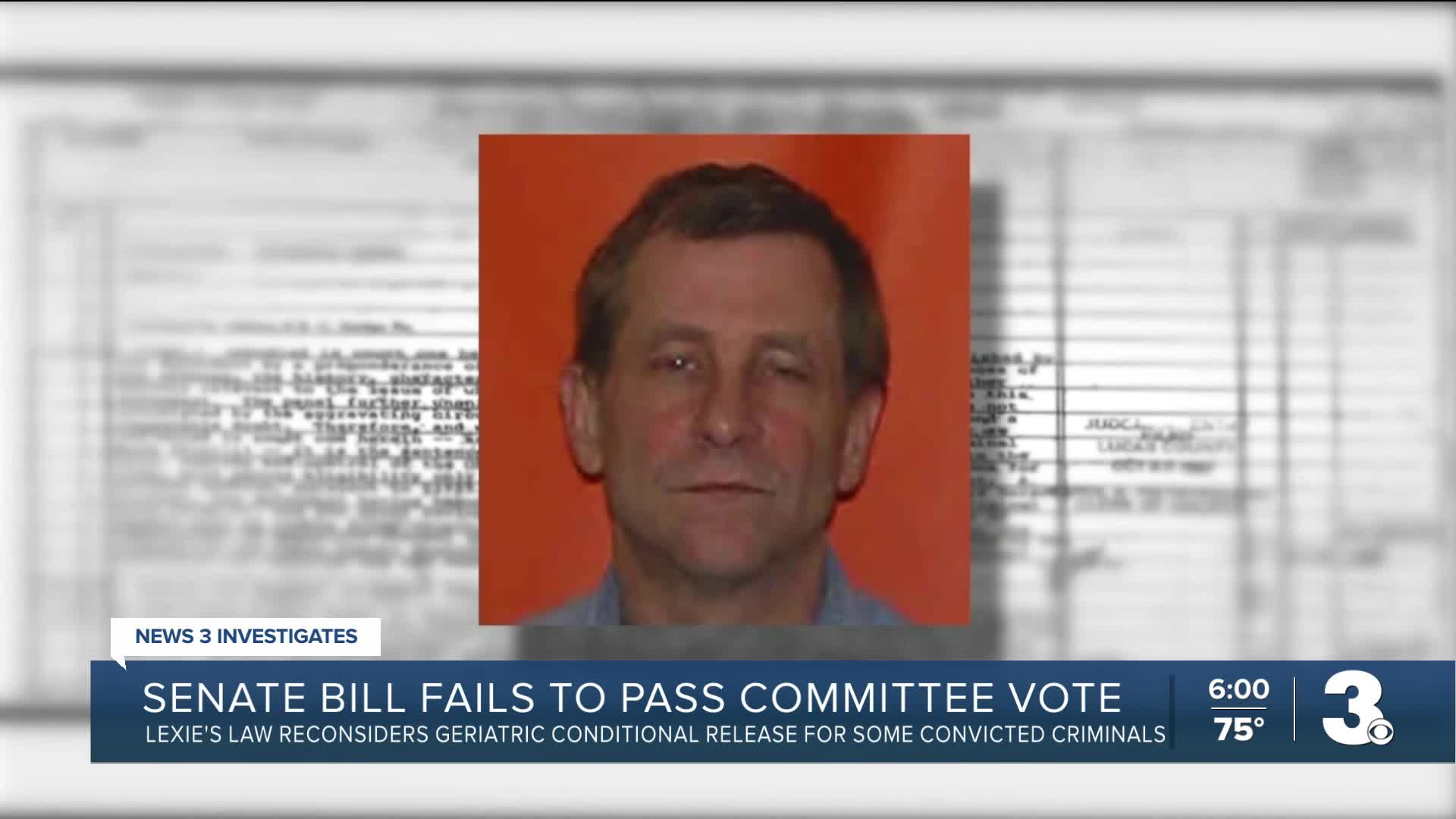


RICHMOND — Efforts to make it harder for older violent offenders to qualify for annual parole hearings under Virginia's geriatric conditional release law have failed in both chambers of the Virginia General Assembly, leaving victims' families disappointed but determined to keep fighting.
Marie Jones had hoped lawmakers would change the law after James King, the man who killed her sister, Lexie Walters, was given a parole consideration just five months after receiving two life sentences from a judge in Virginia Beach.
"I had pretty much zero knowledge of politics and walking into this, I learned a lot, very quickly and it's overwhelming," Jones said.
Watch previous coverage: Virginia Senate considers 'Lexie's Law' to restrict geriatric parole for violent offenders
James King murdered a woman in Ohio in the 1980s, served 20 years, was released and moved to Virginia Beach, where he sexually assaulted another woman and then murdered Jones' sister, Lexie Walters.
King was 67-years-old when he murdered Walters.
King was eligible for a parole hearing under a Virginia law known as geriatric conditional release.
Watch related: James King served 20 years for a brutal murder. Then he killed again.
Under current Virginia law, an inmate who is 65 years old with five years served — or 60 years old with 10 years served — is eligible for geriatric conditional release annually, for most committed crimes.
The parole board can defer consideration for three years.
Jones and others want the law changed to make it more difficult for people convicted of crimes like murder, rape and other violent offenses to qualify for this type of release.
The new law was called "Lexie's Law."
State Sen. Bill DeSteph and Delegate Anne Ferrell Tata introduced bills in both the House and Senate to change Virginia law. The Senate bill died in the Finance and Appropriations Committee. The House bill died in the Committee on Public Safety.
Watch previous coverage: Victim's family aims to keep daughter's murderer, eligible for geriatric compassion law, behind bars
DeSteph was appalled when he learned about King’s crimes and his access to a parole hearing.
"It should never have happened. He should never have been let out of jail and this wasn't his first time, this was his third time doing it," DeSteph said.
The parole board denied King's parole and deferred it for three years.
DeSteph said he was caught off guard by the Senate bill's failure, given the level of support it had received.
"I was surprised that, having bipartisan support, that we got this out of committee with one no vote. It had passed, the first time with only one no vote, than all of a sudden there's a financial impact and we're killing it," DeSteph said.
Watch previous coverage: Some want change to VA law to prevent violent criminals from getting parole hearings
On February 17, Senator Mamie Locke indicated during session the change created a $360,000 impact, but DeSteph said there was no financial impact according to the parole board.
They voted 20 to 19 to send the bill back to the Finance and Appropriations Committee which is where it died.
Jones said the process has made her feel as though the rights of inmates are being prioritized over the rights of victims.
"They do not show any concern for what we're going through. Instead, they're showing more concern over the criminals that commit the most heinous of crimes," Jones said.
DeSteph said he plans to bring the legislation back next session.
"The next steps are we'll bring it back next year, and we'll build more advocacy, and we'll have to get more people across the state to say, this is wrong," DeSteph said.
Jones said she is not giving up.
"I believe for me the cause that I'm fighting for, it supersedes what I'm up against with politics itself. I know that I'm fighting not just for my sister anymore. I'm fighting for all the victims and their families," Jones said.
WTKR will continue to follow this story and report on any developments.
We reached Senator Locke for clarification regarding the amount of money she cited but have not heard back yet.
