

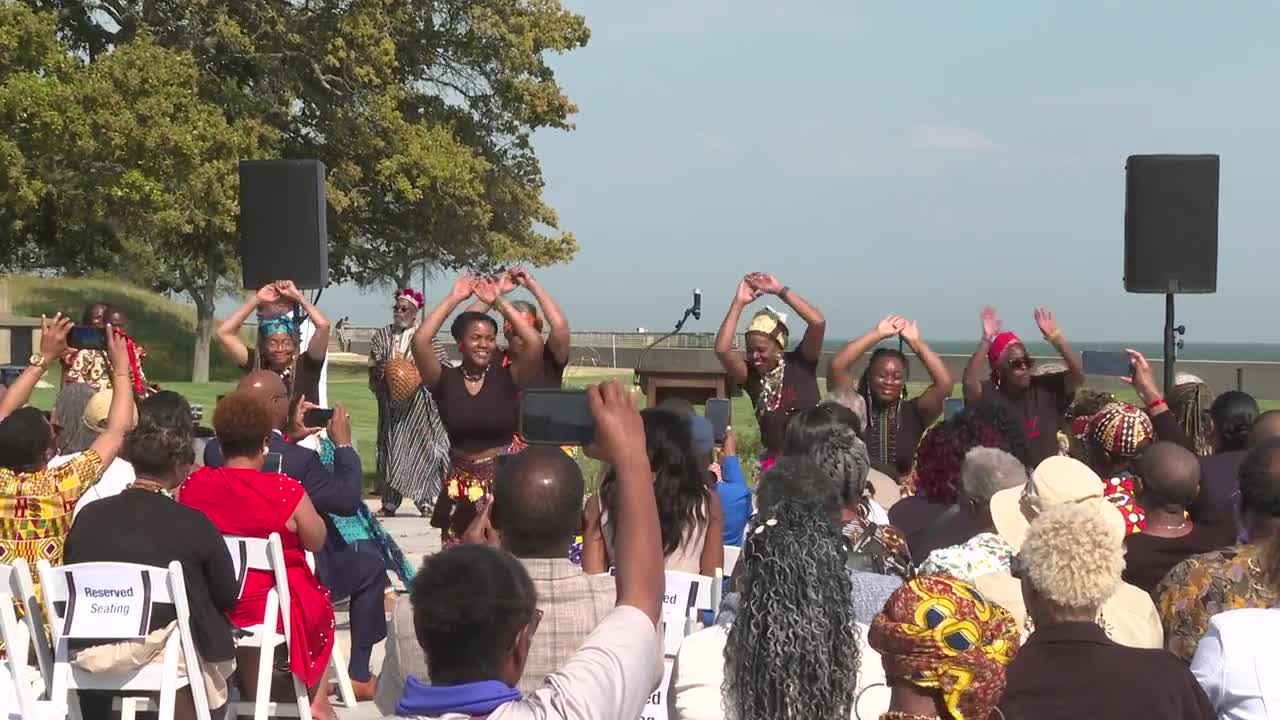


HAMPTON, Va. — The first Africans — who were forcibly brought to Virginia in the early 17th century — were kidnapped from the region of West Central Africa. Their arrival in 1619 marked an early chapter in what would become the Transatlantic Slave Trade.
A memorial at modern-day Fort Monroe, where the enslaved Africans arrived, was dedicated April 24.
"The African Landing Memorial at Fort Monroe seeks to interpret this historical event beginning with the origins of the people—what their life might have been like prior to their abduction, the journey across thousands of miles of ocean– to their landing at Point Comfort and the lives they made for themselves," the 1619 Landing website reads.
Watch the dedication live:
“Very rarely am I speechless, but this one feels so deep," said Wanda Tucker, a descendant of of two of the enslaved Africans in that 1619 group.
The enslaved Africans came from Angola. At the memorial, tiles on the ground point in the direction of Angola. Granite from Angola was also used to build the memorial.
“There’s history here as to how Angolans first arrived and all of the 400-plus years of history, construction of America’s history, that we have brought since the beginning. I don;t want that to be missed in any way," said Tucker.
News 3 has been covering this for years. In 2024, Tucker told News 3 the land the memorial is on represents the beginning of a great tragedy, loss, trauma, and resiliency.
“The resilience of a people. The hope, the future, their perseverance in the midst of all of that trauma and horror," Tucker said in 2024.
Watch: African Landing Memorial at Fort Monroe honors enslaved Africans and descendants
Tucker and her family have partnered with the Fort Monroe Authority and the Fort Monroe National Monument to offer input and perspective on the development of the memorial.
Virginia Gov. Abigail Spanberger was among the dignitaries who spoke at Friday’s dedication ceremony.
“The Commonwealth of Virginia will protect and steward this memorial, and we will make sure it is here for the generations who will stand on this ground and learn its stories. It is up to us, all of us, to tell these stories with the honesty and grace they deserve," Spanberger said.
Watch: Fort Monroe marks 'African Landing Day' with ceremony at future monument site
The dedication isn’t the end, though.
“It’s almost like a book of essays with this memorial, much like the African experience in America over 400 years," said Fort Monroe Authority Executive Director Scott Martin.
Sculptures and a relief wall will eventually be installed.
Watch: Projects underway at Fort Monroe helping shape future of the historic site
“We really see it as our contribution to what it means to be an American and how we sustain this remarkable experiment of democracy," Martin explained.
It is also not the end for the story of enslaved Africans.
“This is a place in the story where I believe that people can come here and just know how America’s black history started," Tucker said.
