

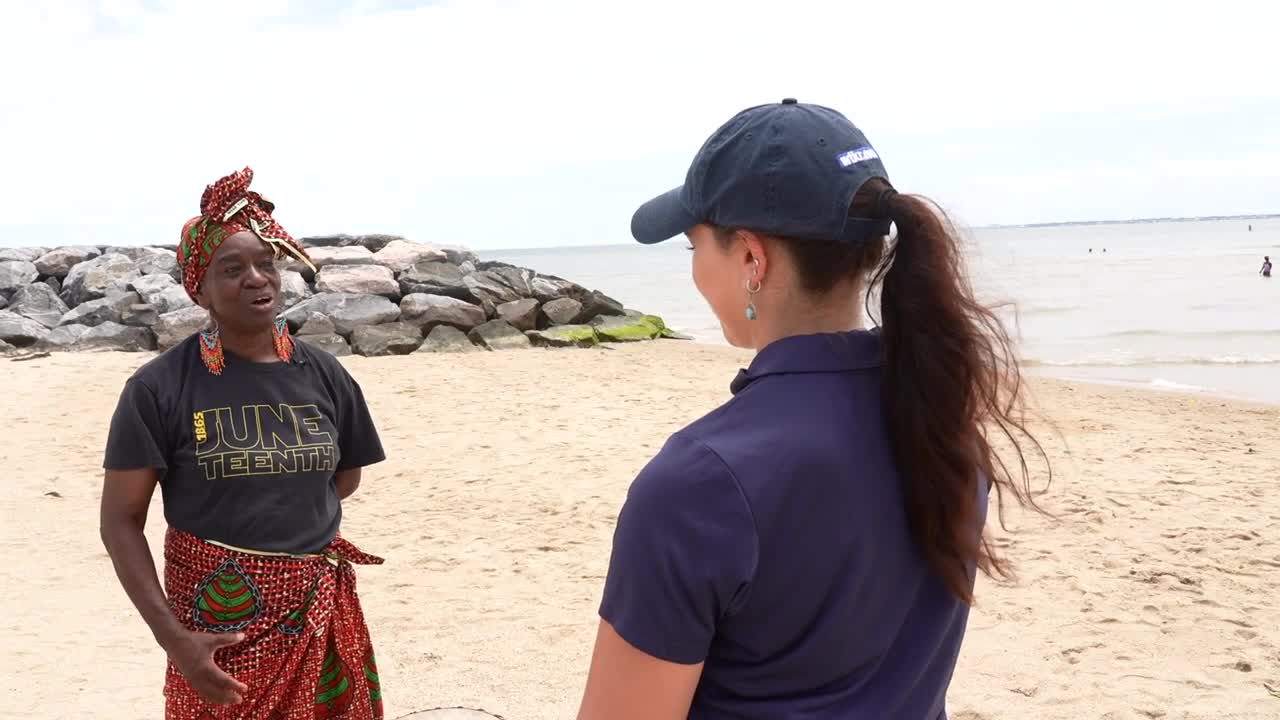


HAMPTON, Va. — Flowers lined the shoreline at Outlook Beach at Fort Monroe National Monument Saturday as the Sankofa Projects hosted its 15th Annual International Day of Remembrance. It was a spiritual ceremony honoring the millions of African men, women, and children who died during the Middle Passage of the Transatlantic Slave Trade.
The United Nations has described the Transatlantic Slave Trade as the largest forced migration in history and one of the most inhumane acts ever committed. The U.N. recently acknowledged it as the gravest crime against humanity, though the United States voted against that designation.
Chadra Pittman, founder and executive director of the Sankofa Projects, brought the Remembrance ceremony to Hampton in 2012, following a tradition initiated by activist and scholar Toni Cade Bambara in 1989. Pittman said the flowers placed along the water's edge carry deep meaning.
"If you see the water's edge, it's beautiful with flowers going all the way around. The flowers are to honor those ancestors. They never got a proper burial," Pittman said.
The ceremony took place at Fort Monroe, a site Pittman described as central to understanding the origins of slavery in America.
"Fort Monroe is where it all began, right. When we talk about 1619, this is the place where slavery began in British North America," Pittman said.
Hampton, known as the landing place of the first 20 and odd Africans in 1619, holds particular significance for the event. Pittman emphasized that the history being honored extends beyond African Americans.
"This history is American history and international history. When you look at the people that were involved in the trade from Europe to all across the world, people have benefited from the enslavement trade of Africans, so we're here to honor them. We're here to say never forget this history," Pittman said.
Pittman also addressed what she sees as a growing effort to erase diverse histories.
"To erase parts of the history or say some parts are not important doesn't help any of us. If this happens to us, it can happen to anyone," Pittman said.
The day's events included a ceremonial remembrance walk around the Tree of Remembrance, a procession to the water, poetry, drumming, traditional songs, and performances.
Hampton neighbor Tasha Okonkwo-Bongiorno attended the event with a personal connection to its history.
"I'm remembering my mother who came here in the 70s with her sister Opal to do this and we had a handful of people. They called them witches, burned crosses in their yards, and they said don't bring that African stuff here. So I'm here today to say how grateful that they came here," Okonkwo-Bongiorno said.
Hampton neighbor David Riddick shared what the ceremony meant to him.
"Freedom. For you to know where you are going, you must know where you come from," Riddick said.
Okonkwo-Bongiorno echoed a message of togetherness.
"Unity and love for one another, because we all belong, too," Okonkwo-Bongiorno said.
The Remembrance ceremony is held annually on the second Saturday in June and is distinct from Juneteenth, which is observed on June 19. Pittman said the date is intentional and consistent.
"Whatever 2nd Saturday that is, is when we celebrate these ancestors," Pittman said.
The Sankofa Projects conducts educational, cultural, and social justice work year-round, highlighting untold chapters of history.
Pittman said the organization's name reflects its core mission.
"Sankofa means 'reach back and fetch it.' It is important to reach back and touch your ancestors, touch your history," Pittman said.
Event partners included the Hampton History Museum, Fort Monroe National Monument, Fort Monroe at Old Point Comfort, Visit Hampton Virginia!, Fort Monroe's Casemate Museum, and the Unity Commission.
This story was reported on-air by a journalist and has been converted to this platform with the assistance of AI. Our editorial team verifies all reporting on all platforms for fairness and accuracy.
Click here to see how we use AI at WTKR News 3.
