

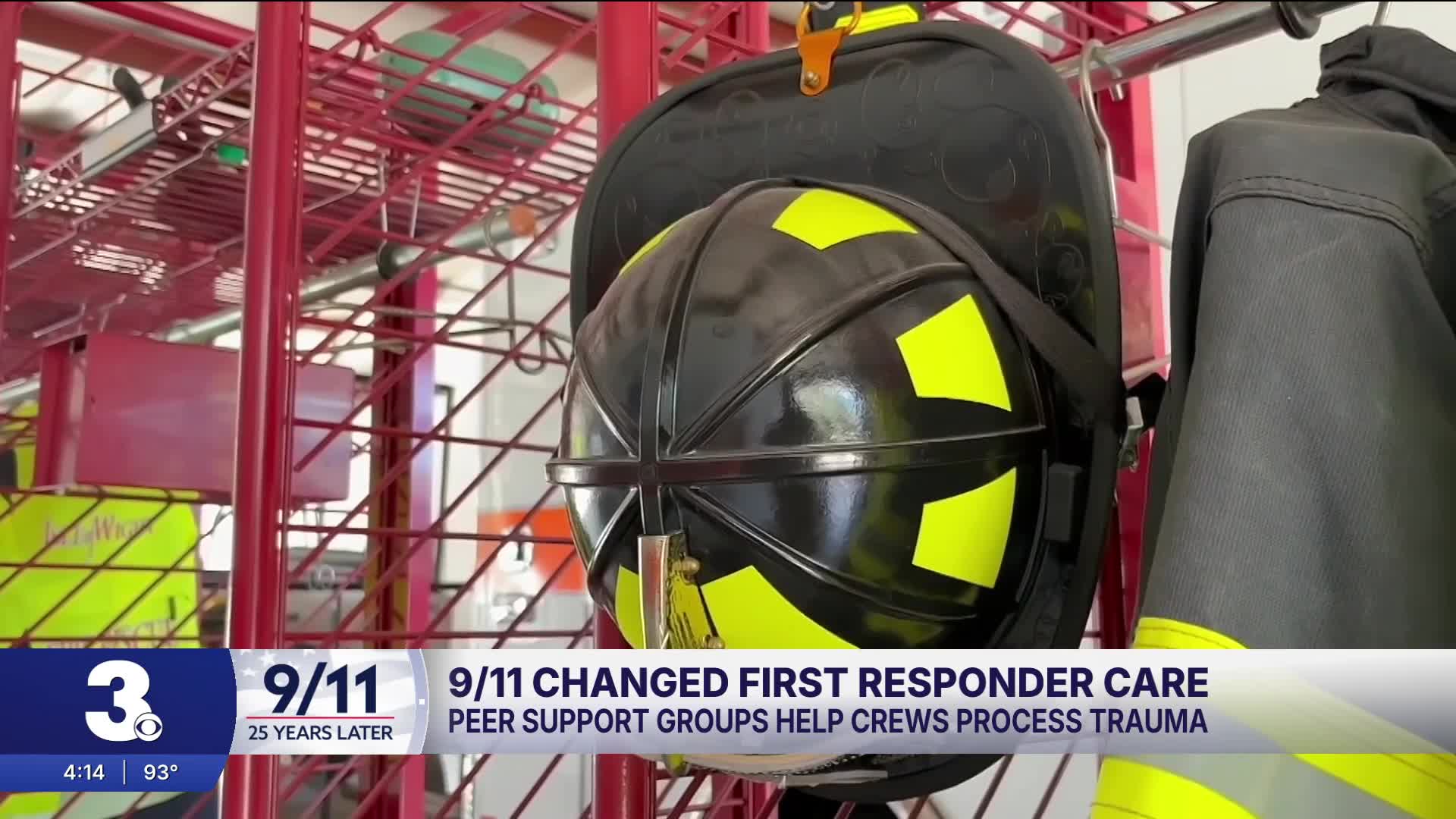


WINDSOR, Va. — Twenty-five years after the September 11 terror attacks, the way first responders prepare for — and recover from — critical incidents has been transformed.
Medics, law enforcement, and healthcare workers describe how 9/11 reshaped emergency response and how they take care of themselves after the worst days on the job. Molly Harrison has been a fire medic with Isle of Wight County Fire Rescue for decades. She says the job demands constant readiness.
"You just never know what you're gonna face. Just prepare for the worst day that you're ever gonna have and that somebody else is ever gonna have," Harrison said.
Harrison remembers exactly where she was on September 11, 2001.
"I was right here at this station [in Windsor] 25 years ago," Harrison said.
She was not working that day but had come in to speak with the crew.
"I actually was not working but I came in to talk to the crew [and] looked up at the TV, and we saw the towers get hit," Harrison said. "I knew in an instant that things were going to be very, very different."
For Harrison, that moment marked the beginning of a new era — not just for the country, but for everyone running toward danger. In the years that followed, the scope of emergency response expanded significantly.
"Chemical attacks, those things became much more in the front [and] trauma-related things, like how we react to an active shooter," Harrison said.
"First responders were getting tasked with more and more and more," Harrison said.
In the years after the attacks, Isle of Wight County created a peer support group (Isle of Wight Peer Support) for first responders who experienced trauma from critical incidents. Harrison says the program was modeled after a Marine Corps framework developed in the aftermath of 9/11.
"The peer support group that we started definitely was based out of a Marine Corps model that came after the beginning of 9/11 where they were trying to take care of their warriors so they could keep their warriors doing the jobs they were built to do," Harrison said.
Peers are active and retired members of local agencies who understand the demands and unspoken struggles of the job.
That support model extends from the firehouse to the hospital. Will Armstrong, supervisor of Sentara Health's employee assistance program, works with fire and law enforcement to support mental health.
"The concept of trauma bonding is real," Armstrong said.
Armstrong says acknowledging the weight of difficult calls is a critical part of the recovery process.
"At the end of their shift is really important just to acknowledge this was heavy, this was hard and try to stabilize and identify who might need ongoing support," Armstrong said.
That support begins on day one of an incident and can extend for years. Armstrong says one lasting impact of 9/11 was a significant investment in understanding trauma.
"There was significant federal funding dedicated to the research for trauma research, for treatment of post-traumatic stress disorder," Armstrong said.
Virginia State Police also placed a large focus on counterterrorism and improving public safety in the years following the attacks.
"We've increased our attention in addressing a plethora of threats, you know, and that can involve criminal interdiction, intelligence collections, detection," Robin Lawson, spokesperson for Virginia State Police, said.
The Virginia Fusion Center was created after 9/11 to close gaps in intelligence sharing across all levels of government.
"We can better spot, prevent, and respond to criminal and terrorist threats," Lawson said.
Despite the sweeping changes in training, technology, and mental health support, Lawson says the mission at the core of the work has never changed.
"The core of our heart and why we're out there remains the same. And that's to be the first person to run to a critical incident, we don't run away," Lawson said.
When the call is over, the work is not done. The peer support programs built in the shadow of 9/11 are now part of what keeps first responders able to answer the next call.
"We've grown and we've made some good out of such a horrible situation," Harrison said.
"You can still work a cardiac arrest in the back of the medic going 90 miles an hour. You can still be involved in a hostage situation. You can still do your job, but you have to take care of yourself," Harrison said.
This story was reported on-air by a journalist and has been converted to this platform with the assistance of AI. Our editorial team verifies all reporting on all platforms for fairness and accuracy.
Click here to see how we use AI at WTKR News 3.
