

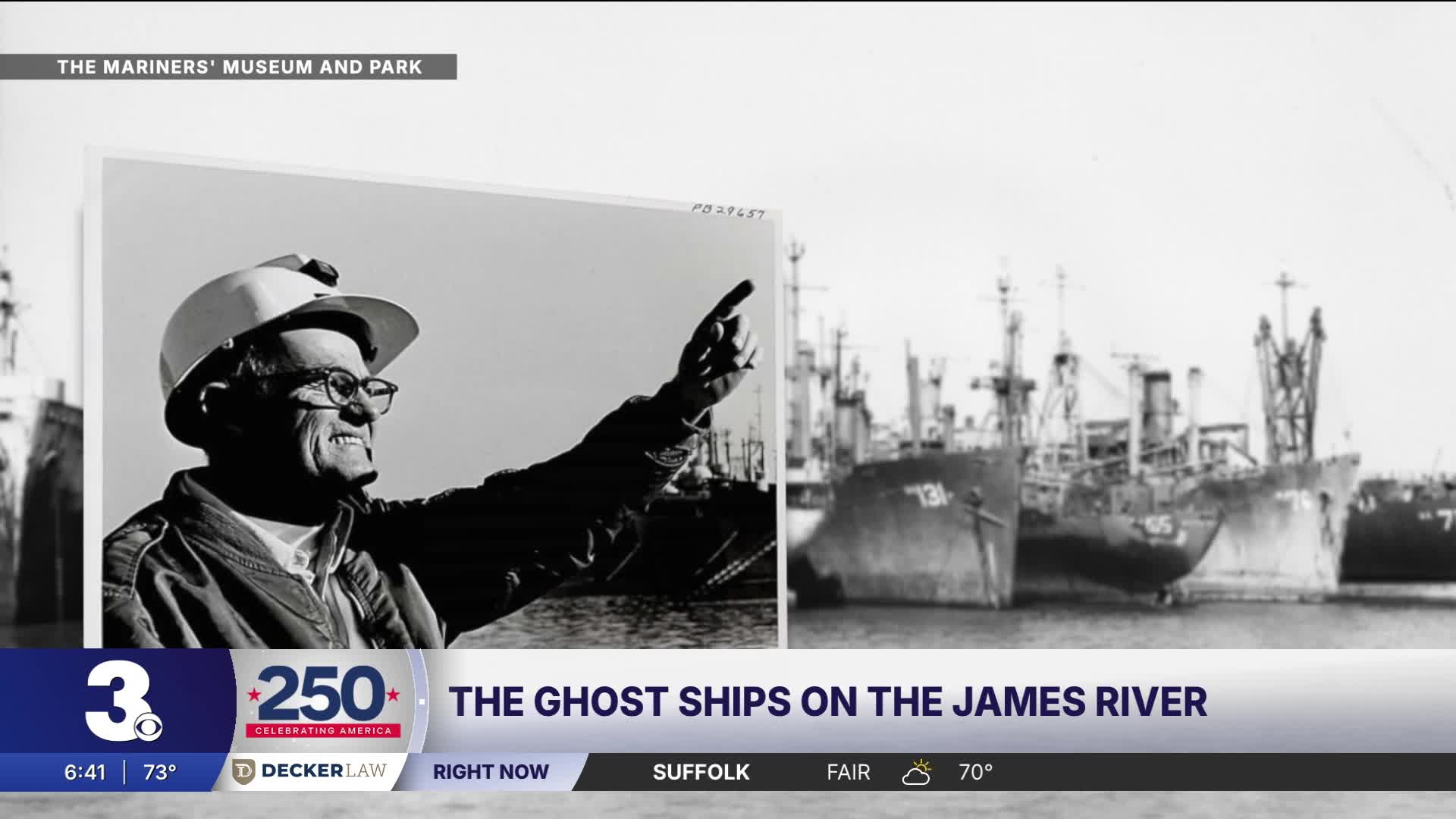


NEWPORT NEWS, Va. — The gray ships moored just beyond the shoreline of the James River, near Fort Eustis, have long carried a mysterious nickname — the Ghost Fleet. But the name doesn't tell the whole story.
Ed Moore, a volunteer in the Mariners' Museum curatorial department, said the vessels are anything but dead.
"The reason why to call it a ghost fleet is a misnomer because they're not ghosts. They still function. They still operate," Moore said.
Moore said the fleet dates back to the end of World War One, when the United States found itself with surplus vessels.
"In 1919, the United States government decided after World War One that it was a bad idea to mothball all the ships in case of future need," Moore said.
The ships were situated on the James River, an area chosen in part for its calm, brackish waters and access to the Chesapeake Bay and Atlantic Ocean. Over the following century, the number of ships ebbed and flowed. By 1950, a peak of 800 were moored, according to the Maritime Administration.
The fleet has never been limited to a single branch of service.
"There are not only cargo ships there, but there are ships that are owned by the Navy, the Marines, the Coast Guard, and NOAA also has ships in the fleet," Moore said.
Keeping the fleet mission-ready was demanding work — particularly for the crews who, decades ago, had to live on board.
"They had no electricity and they had no running water [dealing with] unbearable heat [and] unbearable cold," Moore said.
All of it was in service of one goal: being ready when called upon.
"The idea was they could be seaborne in three to five days, so you have to maintain the engines, kitchens, water supply, the hulls, the electrical," Moore said.
Some ships from the reserve fleet played a role in one of history's most pivotal military operations.
"Some of the ships from the James River Reserve Fleet were taken to Normandy and sunk to create artificial harbors," Moore said.
According to the Mariners' Museum, other ships whose technology didn't keep pace with the times were sold to different countries or used for military training.
Today, only a fraction of the original fleet remains in the James River. The ships still moored there have been reassessed for safety, particularly with hurricanes in mind.
"In the past, the primary concern was if we need these for a war, let's have them ready. Now the idea is still that, but the idea is also while they're sitting there just in case, let's make them as safe as possible," Moore said.
Moore said the fleet is a living reminder of America's maritime strength.
"There's no more important place in the United States from the ship standpoint than Hampton Roads," Moore said.
According to the Mariners' Museum, there are about 10 ships in the James River Reserve Fleet now. It is operated by the Maritime Administration, which is within the Department of Transportation.
This story was reported on-air by a journalist and has been converted to this platform with the assistance of AI. Our editorial team verifies all reporting on all platforms for fairness and accuracy.
Click here to see how we use AI at WTKR News 3.
