

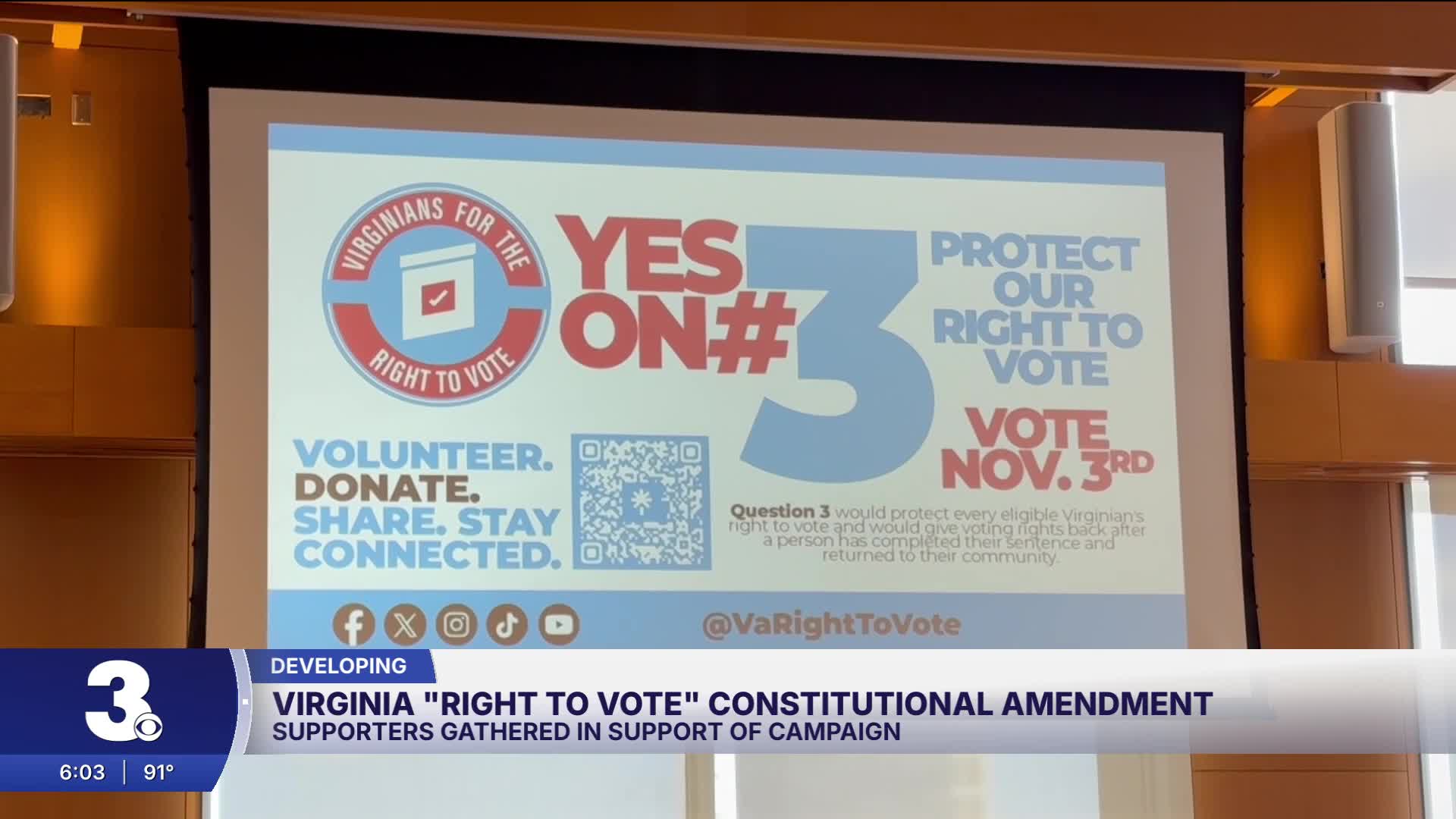


NORFOLK, Va. — Supporters of a proposed Virginia constitutional amendment gathered in downtown Norfolk on Thursday to launch a statewide campaign encouraging voters to approve Ballot Question No. 3 this November.
The campaign, called "Yes on 3," aims to persuade voters to support the constitutional amendment, which would guarantee the right to vote for eligible Virginians and establish an automatic process to restore voting rights to people convicted of felonies after they complete their incarceration.
The kickoff event at The Slover brought together elected officials, voting rights advocates and Virginians whose voting rights have previously been restored.
Del. Marcia Price, D-Newport News, said the launch was intentionally held on the 61st anniversary of the signing of the federal Voting Rights Act of 1965.
"So August 6 is the 61st anniversary of the signing of the 1965 Voting Rights Act," Price said.
Earlier Thursday, Gov. Abigail Spanberger signed several election-related bills before joining supporters as the campaign officially launched in Norfolk.
Price said the amendment would not only create a permanent restoration process for Virginians convicted of felonies but would also protect voting rights more broadly.
"I am beyond hopeful that Amendment Three will pass," Price said. "If people understand redemption, then they understand that that automatic process of restoration is really important. But even if they're not there, they should be so self-concerned that they want to put their own right to vote in the Constitution."
Among those sharing their stories was Virginia Beach resident Jamel Ridgenal, who lost his voting rights after serving a felony sentence before eventually having them restored in 2017.
Ridgenal told News 3 he initially struggled to rebuild his life after leaving prison, finding it difficult to secure steady employment because of his criminal record. While attending a job fair, he learned more about voting rights restoration and eventually began helping others navigate the process—even before he could vote himself.
"I was getting people to register to vote and helping people get their rights back," Ridgenal said. "I said, 'Let me go to the areas I be in and to the communities and tell them, "Hey, you can get your rights back to vote."' ... Eventually I got my rights back, which made it feel good because I'm helping everybody else do it."
Ridgenal said finally casting his first ballot after his rights were restored was an emotional experience.
"It was like relief, man — like freedom," he said. "I'm paying taxes and I'm a citizen and I'm doing everything else everybody can do. It's just one thing held me back. You don't really realize it until you lose it. Just having the option to vote is the craziest part."
He said he hopes Virginians who remain unable to vote because of felony convictions will soon have that opportunity.
"We're working on it," Ridgenal said. "Once you do your time, you should be set to do anything you want to after that. We're out here fighting for everybody."
If approved by voters, the amendment would remove the current requirement that people convicted of felonies petition the governor individually to have their voting rights restored after completing their incarceration. Supporters argue the current process leaves restoration dependent on whichever administration is in office.
Opponents of the amendment argue voting rights should continue to be restored on an individual basis rather than automatically. They contend the existing process allows governors to review each case individually and provides accountability before voting rights are returned.
Virginia voters will decide Ballot Question No. 3 during the Nov. 3 general election.
Click here to see how we use AI at WTKR News 3.
