



HERTFORD, N.C. — The long-talked-about, two-lane tolled bridge connecting the Currituck mainland to Corolla is now at a crossroads. Officials say the $1.2 billion project isn't feasible without a major funding boost.
"There's over an $800 million gap, pretty much any way you look at it," said Ronnie Sawyer, NCDOT Division One engineer.
Dare and Currituck county leaders, the towns of Duck and Southern Shores, NCDOT, members of the Albemarle Rural Planning Organization and concerned citizens met in Hertford on Wednesday for a public meeting about where the Mid-Currituck Bridge project — which had gained momentum in the permitting process in 2025 — currently stands.
"The theme of the presentation was, there's a financial gap. There's financial challenges in funding the bridge, whether we fund it as a traditional toll or a public private partnership," said Sawyer.
The project currently has $173 million set aside for it, and alongside the annual expected toll revenue it would generate, comes out to around $400 million. But there's still the question of where the other $800 million is going to come from. In late 2024, the project missed out on a $425 million grant from the U.S. Department of Transportation. Federal grants have been identified as a major potential revenue booster for the project.
Southern Shores Town Councilwoman Paula Sherlock is disappointed about where the project stands. Southern Shores and Duck town leaders have expressed their support for the project to alleviate traffic and road conditions through their towns during peak summer season and to provide an evacuation route during hurricanes.
"In my lifetime, I don't know that we're going to see it. I do worry not only about the impact on our Town of Southern Shores, but also about the safety factor of having 1000s of 1000s of people on those northern beaches and no way to get them out of there. I think it's an unsafe situation that doesn't seem to fit into the financial model," said Sherlock.
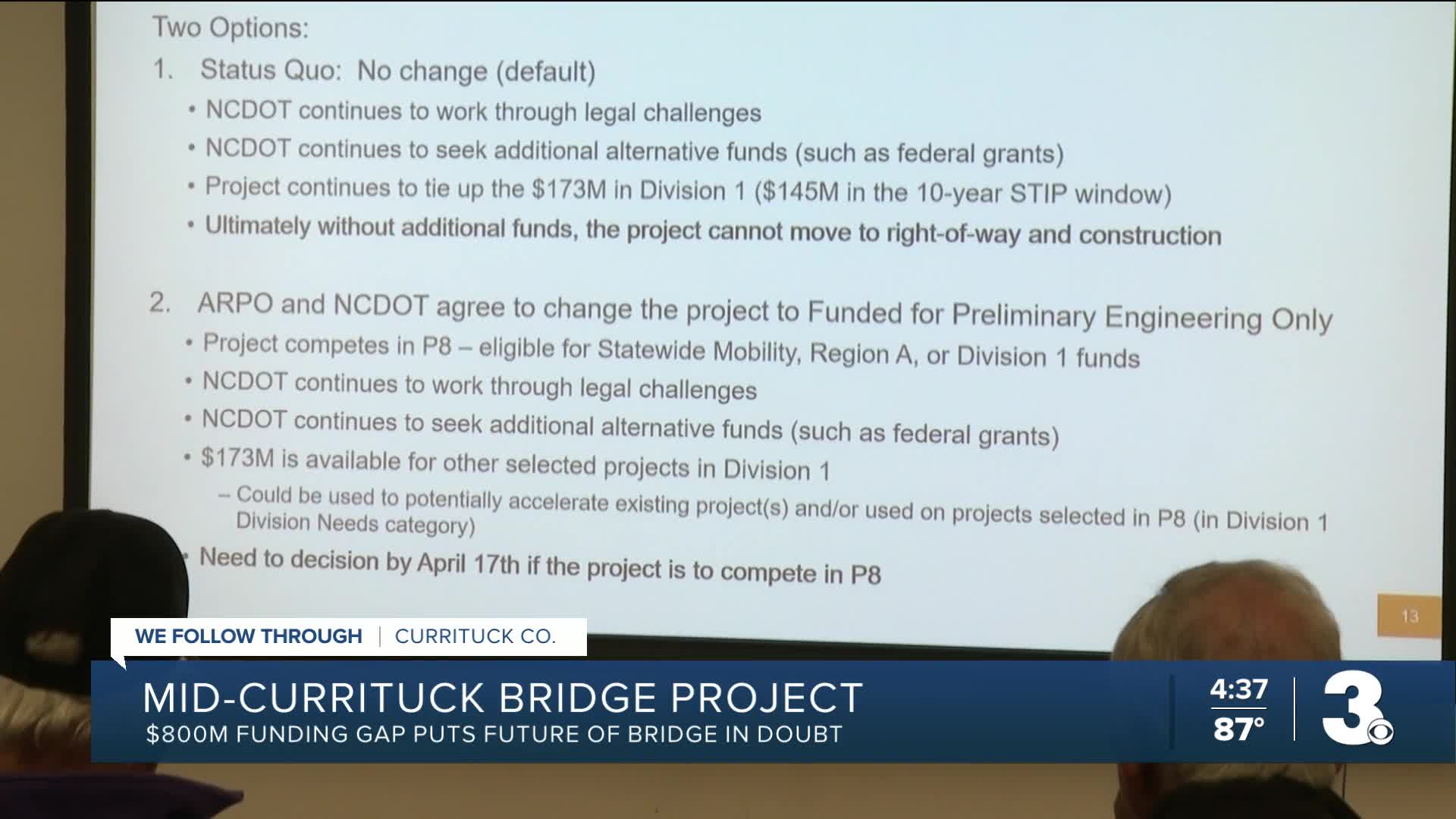
NCDOT officials are now asking the Albemarle Rural Planning Organization, also known as ARPO, to help decide between two options:
- Staying the current course of project planning and exploring funding options.
- Or freeing up the $173 million for other transportation projects across northeast North Carolina's Division One — though this option would mean the project would start at square one financially.
"The other option is to pull it out of division funds and see how it scores in regional and statewide levels. If we did that, it would free up those funds. So the project will be starting at zero again as far as the scoring process goes," said Sawyer.
Two Currituck County residents who attended the meeting have long opposed the project and feel there are more pressing transportation needs that $173 million could go toward. They also believe it's time for leaders to close the chapter on this project entirely.
Despite a discouraged feeling among many at the meeting, there was still significant support for one day making the project a reality. Some of the only realistic options to close the funding gap are federal grants, help from the state legislature or increasing the expected toll rates on the bridge.
"I also thought their projections on tolls were way too low. I think people would pay far more than that to cut off hours of time on the road in the middle of the summer, particularly if they've already been on the road for 6, 7, 8, 10 hours, they want to get to their vacation home, and paying $50 probably wouldn't be out of the question," said Sherlock.
ARPO members will need to decide which option they'd like to go with by April 17. But no matter the decision, the funding gap isn't just going to go away, and there are real concerns about what the future of this project looks like.
"A lot of people in the area would prefer the project. It has a lot of benefits, but it's a long bridge, and it costs a lot of money, and we're not there yet," said Sawyer.
