

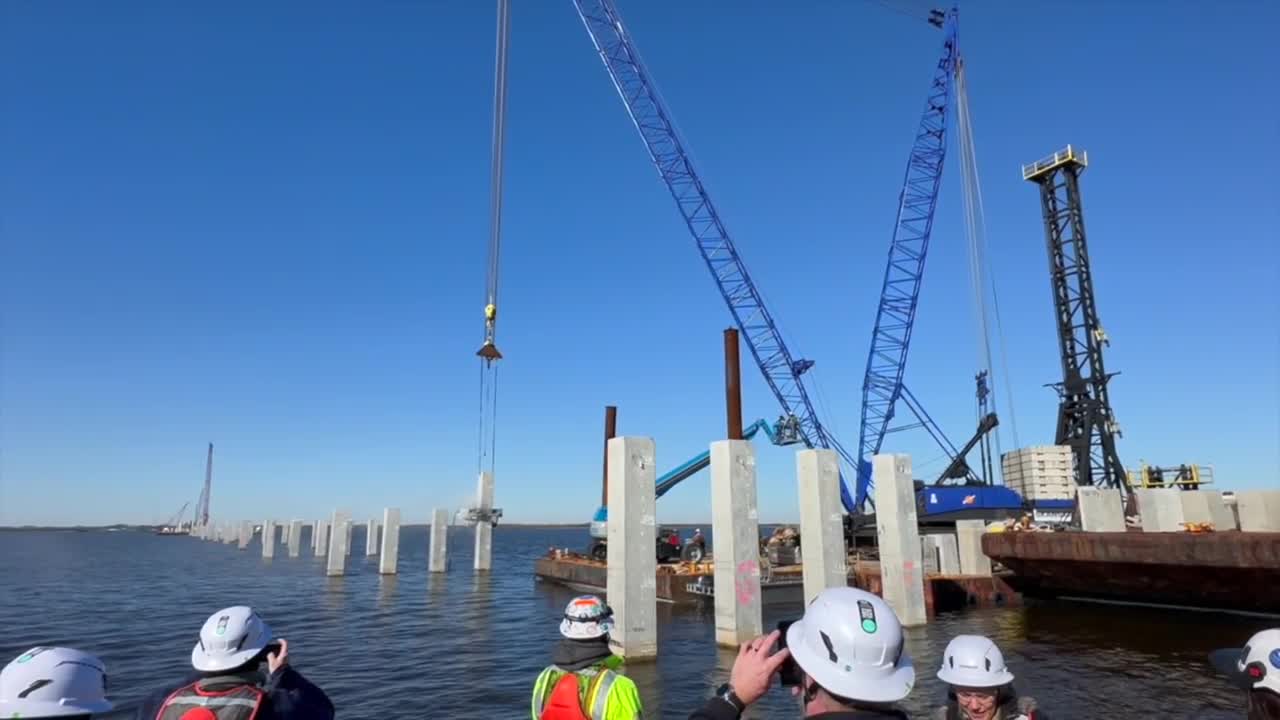


DARE COUNTY, N.C. — Nearly a year ago, construction began to replace the Lindsay C. Warren Bridge, also known as the Alligator River Bridge, that has been a vital connector to the Outer Banks for six decades.
A brand-new 3.3-mile, two-lane bridge sporting 12-foot lanes and 8-foot shoulders and 65-foot vertical and 135-foot horizontal clearance for vessels underneath has seen significant progress just 11 months in.
"To be in this position where we're at 11 months and have close to 710 piles installed for the entire structure, I'm still absorbing that," said Pablo Hernandez, NCDOT resident engineer.
Hernandez shared during a media tour of the project Monday that the progress made so far has been nothing short of remarkable. So far, 682 of the 710 piles have been driven into the ground in the Alligator River, which will serve as part of the massive bridge's foundation.
"With the equipment selection that they made, along with some surveying and engineering techniques, by using GPS positioning versus stand alone templates or frames to install piles, has really accelerated the production," said Hernandez.
The "they" that Hernandez is talking about is Skanska, the $445 million contractor making the project a reality. When it comes to pile installation, the company is bringing new technology for bridge building in North Carolina.
"A lot of our positioning is done off of anchors and GPS systems, as opposed to the typical pile driving through templates and installation of a preinstalled template and piles into that. We've eliminated the template by using the software and the GPS technology," said Phillip LeFave, Skanska's project executive in the Southeast.
"It is a new technique for us here in North Carolina. Fortunately, Skanska has used this method and these types of pile driving rigs in other projects in Virginia and Maryland. So we're taking that experience and applying it here, and as again, they're delivering a success to us," said Hernandez.
New techniques and also materials meant to combat corrosion of the foundations are being used on the project. This approach is meant to ensure safe crossing for drivers and captains, durability and lifespan of the structure.
"By incorporating new design techniques, also new materials, such as a glass reinforced rebar as well as carbon fiber strand and other composites, we're going to ensure that we get a 100-year design life out of this structure," said Hernandez.
Over the next year, neighbors will see columns and caps installed on the pilings that will one day be the foundation for the structure they will be driving on or underneath. For lack of better terms, it will begin to look like a bridge.
LeFave is proud of the progress made so far and hopes to continue meeting milestones year after year, but also gives credit to the approximately 90 employees working day in and day out on the project.
"A lot of the pace and the progress that that's out here belongs to the men and women that are out there doing the work. We got equipment, we have tools, we have all that. But, if these people don't show up every day and work and do what we need them to do each and every day in harsh conditions, we don't end up where we are," said LeFave.
The expectation is for the bridge to be open by fall 2028, and when that happens, the original bridge will be demolished.
