

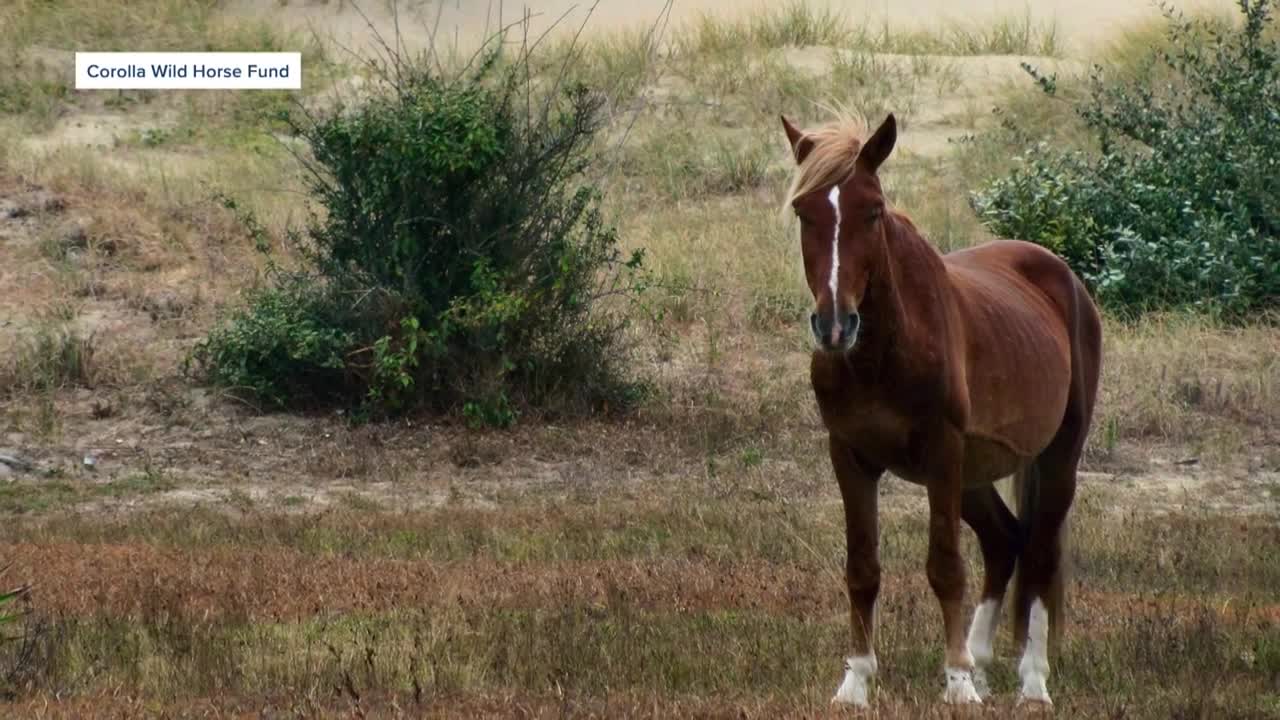


GRANDY, N.C. — The Corolla Wild Horse Fund's farm in Grandy has a new resident nicknamed Topnotch. The wild horse will now spend the rest of his life on the farm with fellow wild horses that have been relocated — a decision the CWHF says is never easy, but at the end of the day, is where he'll be safe.
"It's heartbreaking that he did not get to live out all of his days in the wild as he should have, but on the other hand, now he's safe, he's cared for," said Meg Puckett, director of herd management for the organization.
More than 100 wild horses call the northern Outer Banks home. But for Topnotch, that chapter of his more than 30-year life is now over. For the last five years, he's grown more and more comfortable with human interaction, specifically when it comes to food.
"It's something that we had been monitoring for about five years or so, we had started to see that kind of behavior begin to escalate. So it's not something that's happened overnight. Now it is very clear that he was very purposely fed food, and he knows what it is. Once that kind of habit starts, it's very hard to stop. And then the more and more he's fed, the more people he's going to approach, whether they have food or not," said Puckett.
Puckett explains that over the years these interactions have become dangerous for Topnotch and people.
"The issue begins to get especially bad when people don't have food, they don't have anything to offer him. He was becoming very defensive, and so rather than moving away, he was trying to get you to move away by kicking, biting, striking out," said Puckett.
This summer, CWHF was already having conversations about Topnotch's relocation, but those conversations were accelerated by local resident concerns. The CWHF decided to relocate the horse this fall, and a week ago, Topnotch became the newest resident at the farm.
"When you start to have members of the community come to you and express concerns, at that point, we knew that we were dealing with a very serious situation," said Puckett.
Puckett feels this is an example of why laws are in place prohibiting people from feeding the horses and the importance of everyone following them for the health and survival of the wild herd.
"Humans are really these horses greatest threat, which is sad, but at the same time, we can fix that. We're asking people to use this as an example of that, because he shouldn't have ended up here," said Puckett.
The CWHF staff has a journey ahead with domesticating Topnotch and making him comfortable. Right now, it's a week-by-week process.
"Our main goal with him is to keep him comfortable, make sure that he feels secure here, that he starts to trust us, he stops seeing us as any kind of a threat or anything like that, and then to feed him. We have now got him on a diet that's more appropriate for him, that's appropriate for a horse's age, and so that, that's kind of been our main goal this week. From there, we start with domestication and luckily we can take it slow with him. We can kind of go at his own pace, he can be difficult, he's got that behavior, and it's never going to change, and so we have to be very careful with him," said Puckett.
Puckett says that though this will be a process, the farm is the best and safest place for him to be for the rest of his life.
"He will always be food conditioned and aggressive, that's never going to change. We are very grateful that we have the resources and the experience to keep him happy and healthy here and safe," said Puckett.
