

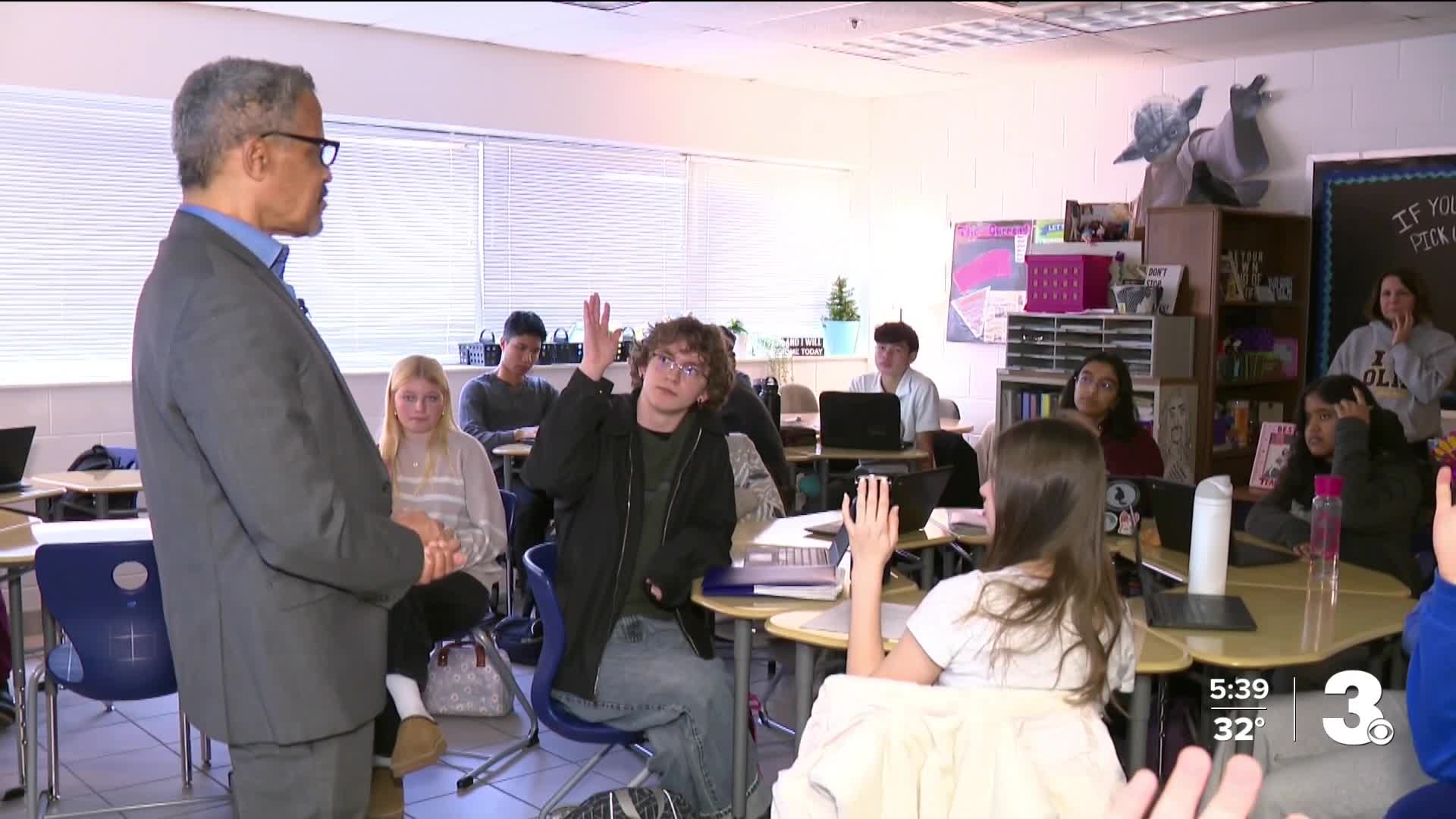


VIRGINIA BEACH, Va. — In an advanced journalism class at Virginia Beach's Ocean Lakes High School, students are grappling with a challenge that's becoming increasingly difficult for adults too: identifying news content impacted by artificial intelligence.
As these young journalists work on the digital version of their high school newspaper, The Current, they're developing skills to detect AI-influenced media that appears in their social media feeds and news sources.
And they are serious about where they go for their news, says 11th grader Mihika Sakharpe, "I generally revolve between AP, BBC, Reuters."
Their English and journalism teacher Fara Wiles frequently discusses the growing impact of artificial intelligence with her students, a topic that has become central to modern media literacy.
"Sometimes there are definitely times when just by the writing itself you wouldn't really know 100% if it's AI," said Austin Stegerwald, an 11th-grade student.
Fellow student Dominic Zdan noted the limitations of current detection methods. "When you're putting it in an AI checker a lot of them don't work so have to go to the edit history," Zdan said.
The issue extends beyond the classroom. When asked how many students have seen news content they believe was influenced by AI, a number of hands went up.
Students have developed their own methods for spotting AI-generated content. Zdan pointed to visual cues in videos. "AI tends to make things look very cartoonish, like they're moving weird and strangely," Zdan said.
Sakharpe says she has learned to recognize patterns in AI-generated text. "When I read it I can just tell that this is AI like AI always does things in groups of three they always use the like 'not only this but blank' they always use that construct," Sakharpe said.
She credits the journalism class with helping her develop these detection skills. "I would say this class because we just talk about it so much and we also get experience editing other people's drafts we get to actually see it," Sakharpe said.
However, the technology continues to improve rapidly. Zdan expressed concern about newer AI tools.
"But it's definitely getting like better because it's like very quickly and in a very alarming way like the new Google Gemini is like so good at making images that I don't think you can even tell anymore," Zdan said.
The stakes are particularly high when AI-generated content involves breaking news events. Zdan referenced recent coverage of deadly shootings involving protesters and federal agents in Minneapolis.
"And so many other videos about ICE agents right now, there's a lot of AI ones and there's a lot of real ones and the line is so blurry and also so important to have the line be straight because it needs to be. I think it's like the most important story in the country right now," Zdan said.
To combat misinformation, Stegerwald has developed a verification strategy. "I mean I always try to cross check with something from a more mainstream source," Stegerwald said.
He admits he tries to apply this approach as well when content involves his personal beliefs. "I mean I try even for my own like political opinions like even when it's something that I guess would favor, you know, my side, I, I still try to do it," Stegerwald said.
Stegerwald looks for coverage from established news organizations as a verification method. "I mean at the end of the day if something is verifiably a true video and it's that groundbreaking as this video is making it seem, like you know you'd think New York Times Washington Post would be reporting on this story," Stegerwald said.
The broader implications of AI-generated news content concern these young media consumers.
"I am pretty scared, especially within terms of news content and the way people consume media that if we don't really do anything to—- I don't, I don't know exactly how we would regulate this is obviously a very big question that a lot of people are in government are thinking about," Stegerwald said.
