

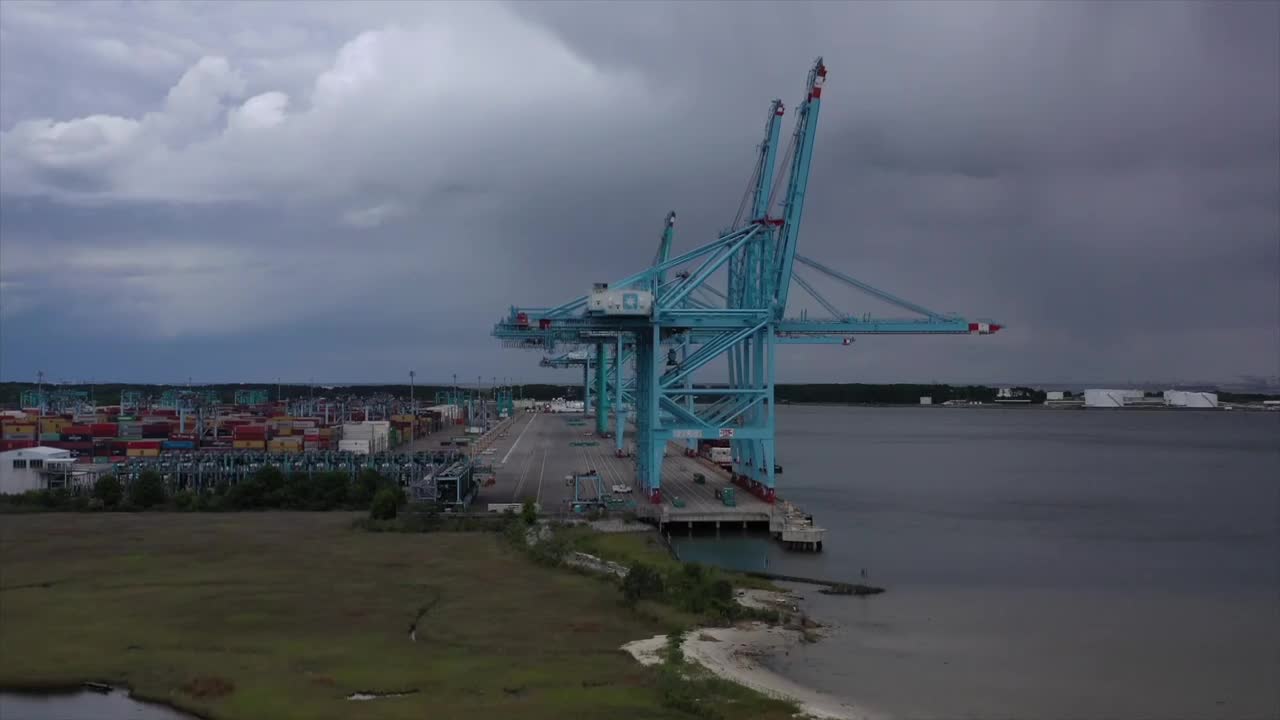


NORFOLK, Va. — As the Port of Virginia enters a new phase of multi-billion-dollar upgrades, leaders say the benefits won’t just be measured in cargo volumes — but in how those changes affect daily life for families across Hampton Roads.
Along Hampton Boulevard, one of the busiest corridors near the port, the impact is already visible — trucks, trains and cargo moving in and out of the region.
On Thursday, Sarah J. McCoy, interim CEO and executive director of the Virginia Port Authority, outlined that vision as the keynote speaker at the State of the Port event at the Virginia Beach Oceanfront.
Watch related: Port of Virginia expansion aims to enhance cargo flow
Her message focused on speed, efficiency and stability — and what that means for the people who live near the port and rely on the goods moving through it.
“Time creates cost. Cost is what you and I — the consumer, the family — ultimately pays,” McCoy said. “We want to minimize that time and that cost.”
That idea — moving cargo faster to help control costs — is driving years of investment now coming online.
In her speech, McCoy said the port has been “engineered for speed, certainty, and scale,” with improvements spanning the shipping channel, rail connections and terminal capacity.
Watch related: Port of Virginia gets $380M grant from the EPA
Those upgrades include deepening the harbor to 55 feet — making it the deepest on the East Coast — and expanding berth space to handle some of the world’s largest container ships.
“We have built the most accessible harbor in Atlantic trade,” McCoy said. “And with room for two-way vessel movement… we’ve cut port stays by up to 15%.”
For families, officials say that efficiency can have a direct impact.
“You look at everything we’re wearing, eating… it was likely made somewhere around the world,” McCoy said. “Virginia wants to be that gateway to make sure families can get what they need in a timely manner.”
Watch previous coverage: Biden admin announces $3B clean energy investment for ports
But for neighbors in Norfolk, Larchmont and near Old Dominion University, concerns remain about what increased cargo could mean for traffic on already busy roads.
Port leaders say part of the solution is shifting more cargo off trucks and onto trains — a strategy McCoy emphasized in both her speech and remarks afterward.
“We expanded rail and terminal capacity to move cargo more efficiently beyond the waterfront,” she said.
The goal is to move goods through the region while limiting the impact on neighborhood streets.
At the same time, the global supply chain remains unpredictable, with tariffs and shifting trade patterns continuing to reshape how goods move.
McCoy said the port has adapted to that uncertainty and is now operating in what she described as a “new normal.”
“We’re finding kind of a new normal… even though the future is uncertain, we’re confident we can overcome it,” she said.
Part of that stability comes from a diverse mix of trading partners, reducing reliance on any single region and helping keep cargo flowing even as global conditions shift.
The impact locally is significant. According to the port, roughly one in 10 jobs in Virginia is directly or indirectly tied to its operations.
McCoy said that economic role is central to the port’s mission.
“We want to run the most efficient port in America so that it is a business magnet,” she said. “We want businesses to locate close for the speed and reliability in the supply chain.”
Port leaders say the current round of expansion projects — including continued work at Norfolk International Terminals — is expected to wrap up by 2027, adding even more capacity in the years ahead.
As those changes take shape, officials say the focus remains on balancing growth with the needs of the surrounding communities.
“We want to provide certainty when the rest of this is a little uncertain,” McCoy said.
Click here to see how we use AI at WTKR News 3.
