

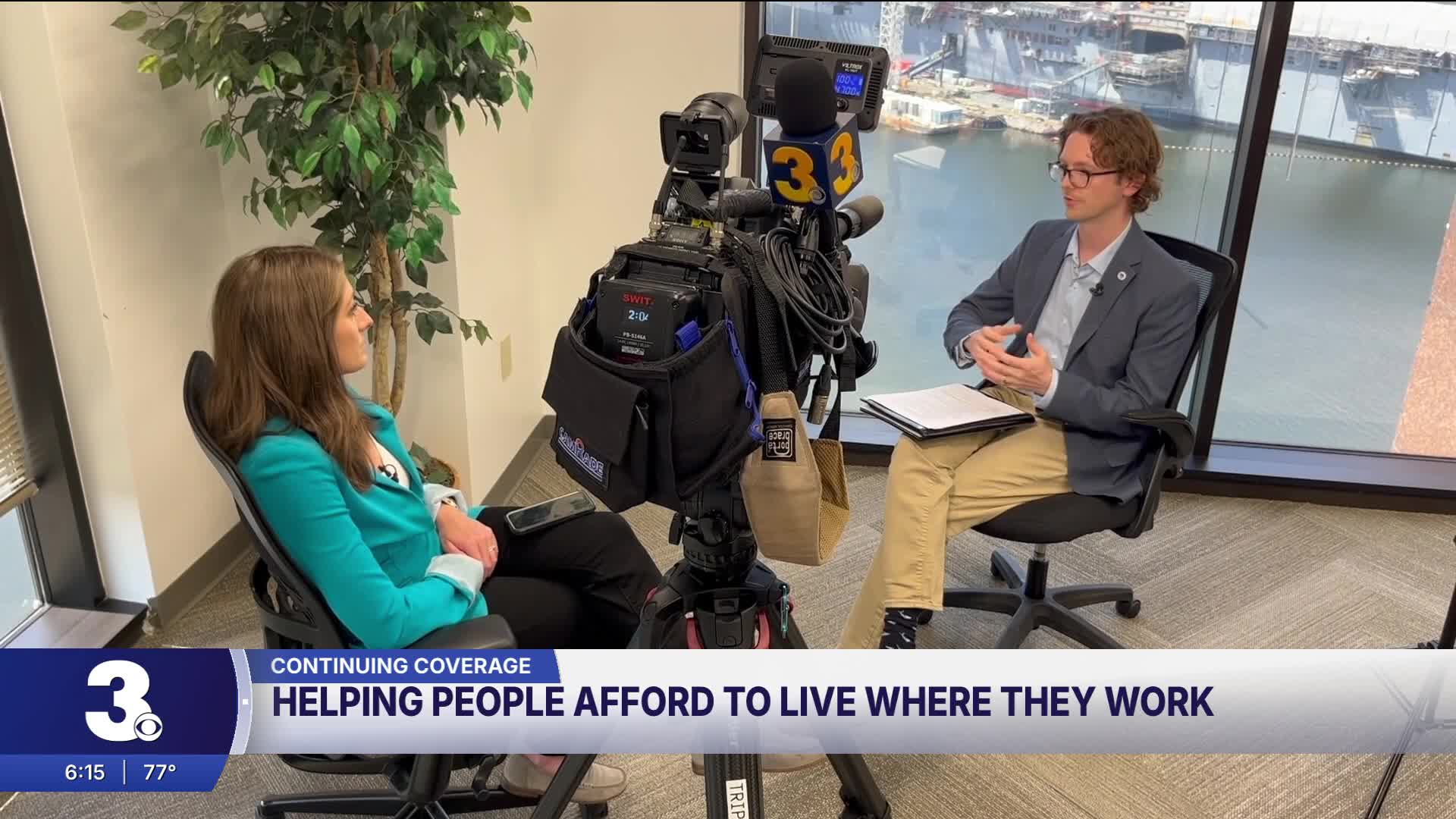


NORFOLK, Va. — The Hampton Roads Workforce Council is working to connect job seekers with employers in the region's fastest-growing industries — but a question looms over those efforts: Can workers afford to live where they work?
Andrew Nissman, the senior director of development and communications with the Hampton Roads Workforce Council, said housing is directly tied to whether people can participate in the workforce at all.
"Housing absolutely can be a barrier to workforce participation or to education and training," Nissman said.
The council works to match people looking for a job with employers across several high-demand industries.
"We continue to see some of our biggest industry clusters in the region; in particular our maritime industry, that is shipbuilding, ship repair, advanced manufacturing, port logistics, and several other sort of component industries, " Nissman said. "We’re also seeing a lot of continued growth in the healthcare sector as well.”
Electricians, HVAC technicians, commercial drivers, machinists, and workers in other advanced manufacturing and infrastructure roles are also consistently in demand, according to metrics from the workforce council.
For workers who land jobs in those industries — particularly maritime — Nissman said wages can support life in Hampton Roads.
"I like to think that in some of our most important industries, the maritime industry in particular, you know, these are high wage positions. If you are earning those industry recognized credentials and are getting to work in those industries, yes, definitely you're gonna be able to make ends meet and hopefully thrive in Hampton Roads," Nissman said.
Still, Nissman said more structural support is needed to make housing accessible for working people.
"Workforce housing in particular is a very promising concept that the Hampton Roads Workforce Council and our partners would like to see a more structural effort towards in order to make housing more affordable and to make it easier for people to get to work," Nissman said.
Some employers have already begun making adjustments to help workers, like offering more flexible scheduling, adjusting shift times, and providing transportation assistance.
The Samaritan House, a local nonprofit, is also working to address the intersection of housing and employment. The organization runs a landlord partnership program that places working individuals in stable housing with participating property owners.
This story was reported on-air by a journalist and has been converted to this platform with the assistance of AI. Our editorial team verifies all reporting on all platforms for fairness and accuracy.
Click here to see how we use AI at WTKR News 3.
