

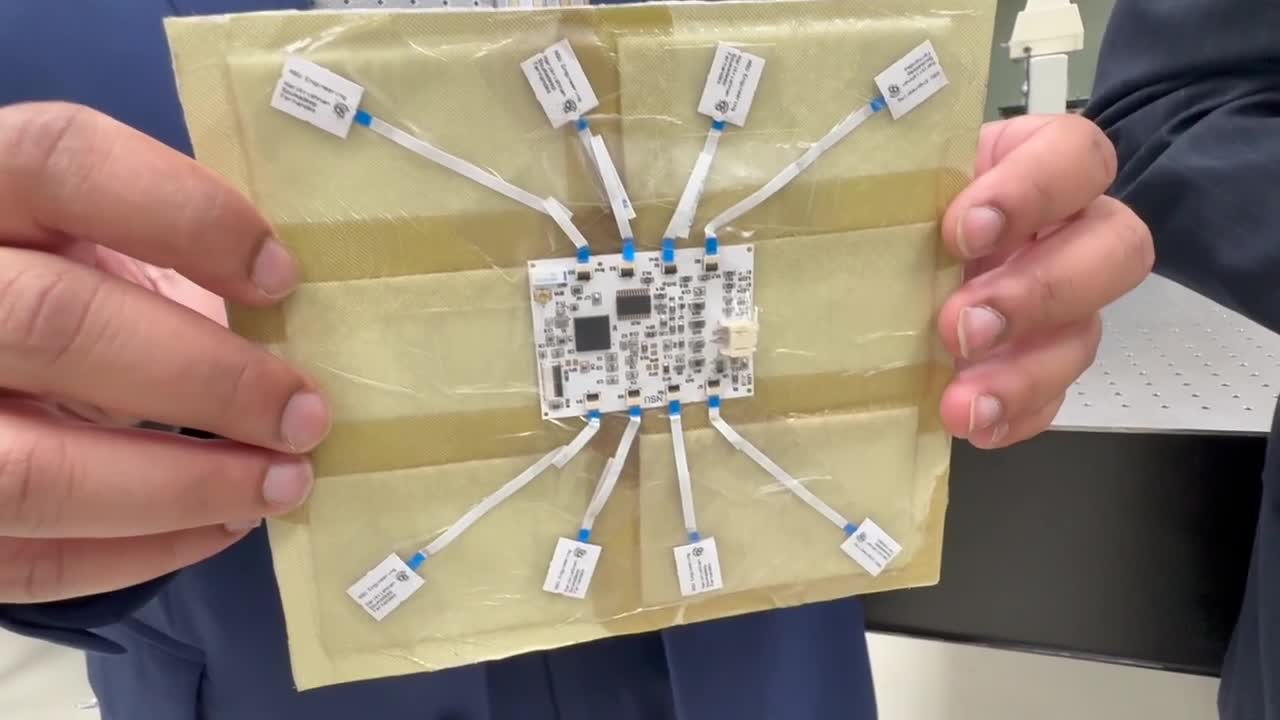


NORFOLK, Va. — What if your bandage could tell you how well your wound is healing or alert you when something is wrong?
Inside a research lab at Norfolk State University, students are working to make that a possibility. They're developing smart wearable technology that combines wireless sensors, artificial intelligence and flexible electronics with the goal of improving patient care.
The research is being led by Dr. Renny Edwin Fernandez, an associate professor in NSU's Department of Engineering.
While the team's latest innovation is a smart bandage, its research into wearable technology began during the COVID-19 pandemic with the development of a smart mask capable of measuring humidity in a person's exhaled breath. The team later developed a smart helmet designed for laboratory workers.
Now, researchers are turning their attention to wound care.
The smart bandage prototype is equipped with eight sensors capable of monitoring conditions including temperature, humidity and gas resistance. Using machine learning, the technology is designed to interpret that information and assess how a wound is healing.
“It can take all the data and then think, and then it will decide whether the wound is healing inside the bandage or not, whether how much time it will take,” said Santhosh Adhinarayanan, a graduate student in NSU's Department of Engineering. “It can do some predictions.”
Unlike conventional bandages, the team's technology is designed to continuously monitor conditions beneath the dressing.
What makes the research particularly distinctive is the ability of multiple smart bandages to communicate with one another. Researchers are using a concept known as swarm intelligence, allowing multiple devices to work together and share information.
That information could then be transmitted wirelessly to a smartphone or another display, potentially giving healthcare professionals a more comprehensive understanding of a patient's recovery.
“So it can gather all the data, and this data you know it can communicate with each bandage together, and it can create some kind of like a swarm network,” said Harikrishnan Muraleedharann Jalajamony, a doctoral student studying materials science and engineering at NSU.
Another challenge for researchers has been developing technology small enough and energy-efficient enough to be practical for patients.
Soumadeep De, a member of the research team who developed the software that controls the bandage's processor, said the current prototype can operate for approximately 57 to 60 hours on a single charge.
The bandage is also Bluetooth-enabled, and its design allows researchers to remove and incorporate different sensors as the technology evolves. The team hopes to eventually incorporate sensors capable of measuring pH and cortisol levels.
One potential application would be allowing patients to monitor their wounds after leaving the hospital, helping them recognize when they may need to seek additional medical attention.
“It can it can tell you if how good the wound is healing, like if it is doing well or not, or it can also tell you if it is going bad and you need to go see the doctors,” De said.
Researchers believe the technology could be especially beneficial for people with diabetes who experience nerve damage and may have difficulty feeling pain associated with a wound.
But developing the technology is only part of the challenge. The team is also exploring how to get it out of the laboratory and into the hands of healthcare professionals.
During the summer of 2026, the research team received $50,000 in funding through the National Science Foundation's I-Corps program to explore the commercial potential of its smart bandage technology.
As part of that effort, researchers traveled across the United States and conducted more than 100 interviews with healthcare professionals, including doctors, nurses and wound care specialists.
Adhinarayanan served as the entrepreneurial lead for the project, helping the team better understand the challenges healthcare professionals face and how the technology might address them.
He said the experience helped researchers look beyond the technical aspects of their work and consider the needs of the people who would ultimately use it.
One of the challenges identified during those conversations was getting patients and healthcare professionals comfortable with incorporating electronics into wound care.
“Nobody want to put some electronics on their wound or something if they are not used to anything,” Adhinarayanan said.
Building trust in the technology, he said, will be an important part of getting people to adopt it.
The team has also worked with Norfolk State's nursing department, testing the system on a medical mannequin. The technology remains in development, and researchers are still exploring potential pathways toward commercialization and practical healthcare applications.
Beyond its potential medical applications, the project is providing hands-on research opportunities for undergraduate, master's and doctoral students at Norfolk State.
Other students involved in the smart wearable technology project who are featured in News 3's video coverage include Samuel Kwawukume, Charles Gaba, Solomon Adjokatcher, Daniel Brookman and Justin Patrice.
Students working on the project have had opportunities to design flexible circuit boards, develop embedded electronic systems and build their own prototypes, gaining experience that extends beyond traditional classroom instruction.
For the researchers, the prospect of eventually seeing technology developed in a Norfolk laboratory being used to help patients is a source of pride.
Asked what it would mean to see the technology being used in hospitals years from now, Adhinarayanan said he would be proud.
“Definitely, this kind of technology will be in the future,” he said.
Click here to see how we use AI at WTKR News 3.
