

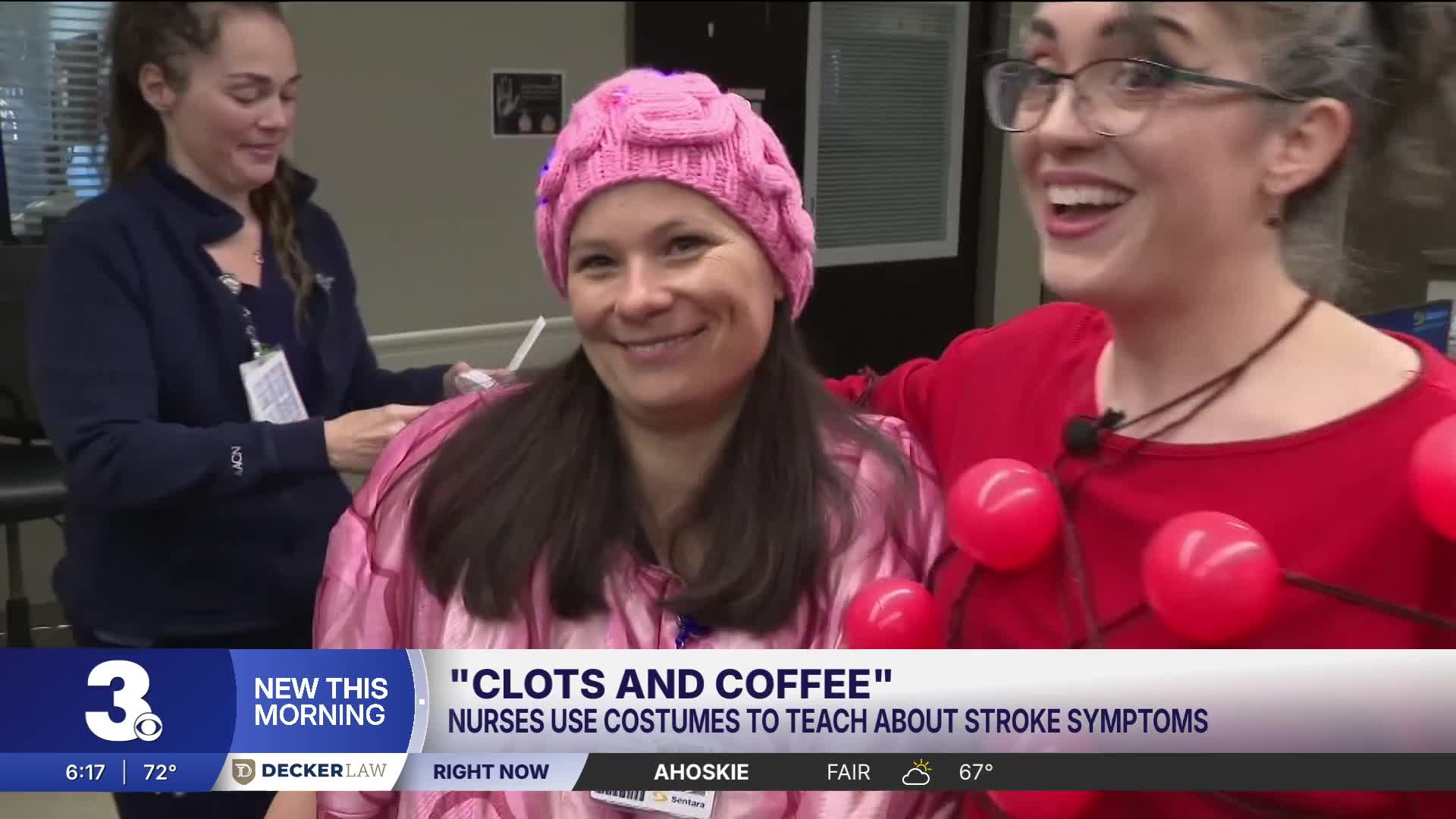


NORFOLK, Va. — Two stroke program coordinators at Sentara Norfolk General Hospital are using costumes, coffee, and treats to teach their colleagues how to recognize the signs of a stroke.
Mary Stern and Karolina Lethueur De Jacquant call their initiative "Clots and Coffee." The pair dress in unconventional costumes and roll a cart through the hospital, handing out coffee and treats while engaging staff, and sometimes visitors, across all units.
"She showed up [dressed in a red sweatsuit with balls, acting as ‘platelets’ and yarn acting as ‘thrombin]. She was like, ‘we're going to walk around, and we're going to hand out coffee and treats and we're going to get [people] engaged,’" Lethueur De Jacquant said.
The costumes are part of the story they've built around their message.
Because every unit in the hospital treats stroke patients, Lethueur De Jacquant and Stern say recognizing the signs is the critical first step.
Stern said the approach is intentional.
"We have processes in place in the hospital where we need staff to be able to recognize the signs of a stroke, and studies have shown you're more likely to remember something if you had fun while you were learning it," Stern said.
The two teach the "BE FAST" method — a framework for identifying stroke symptoms.
"It stands for balance, eyes, face, arms, speech, and time," Stern said.
Stern said time is brain health. A stroke happens when a blood clot blocks blood flow to the brain, and the person experiencing it often doesn't realize what is happening.
"Your brain doesn't know that it's broken, so we need other people to be able to recognize it and to be able to signal for help," Stern said.
Stern said too many people dismiss symptoms like one-sided weakness as simply being tired. According to the Sentara team, high blood pressure is the number one cause of strokes, followed by diabetes and high cholesterol.
"With every minute that passes you lose more of your ability to function, live, and take care of yourself," Stern said.
According to the American Stroke Association, “stroke is a leading cause of long-term serious disability, and up to 80% of clot-related strokes are preventable.”
Stern and Lethueur De Jacquant also do community outreach beyond the hospital. They shared a story about a 7-year-old who remembered "BE FAST," and called 911. His grandmother was transported to the hospital in time to be treated for a stroke.
This story was reported on-air by a journalist and has been converted to this platform with the assistance of AI. Our editorial team verifies all reporting on all platforms for fairness and accuracy.
Click here to see how we use AI at WTKR News 3.
