

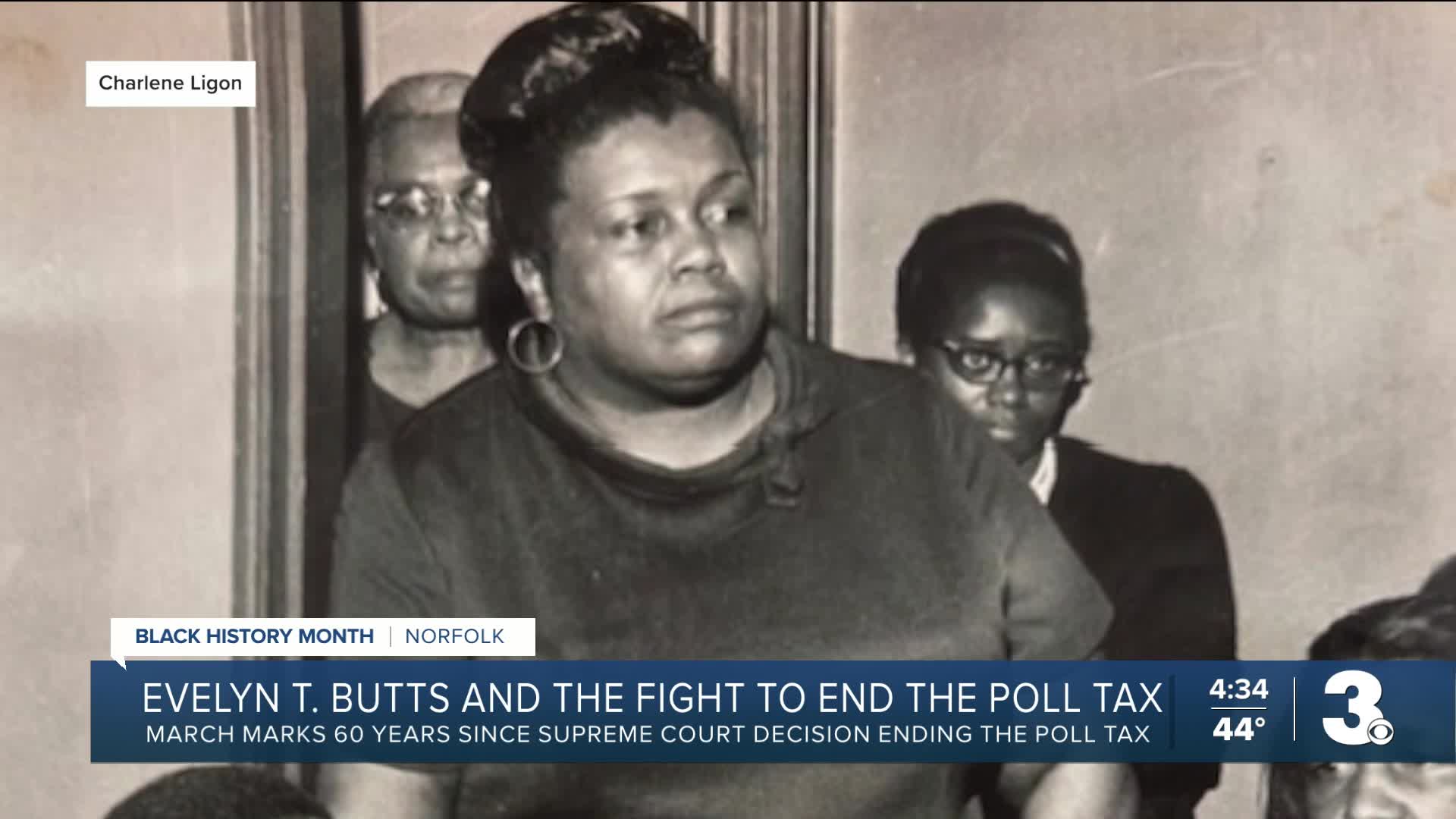


NORFOLK, Va. — March marks 60 years since the U.S. Supreme Court struck down poll taxes for all elections, but the first federal lawsuit was filed three years prior by Norfolk mother Evelyn T. Butts.
Poll taxes were enacted in the late 1800s, mostly in southern states, shortly after Black men were given the right to vote.
“There was this perception that voting wasn’t free, so to speak. You had to show that you were leaning into your responsibilities as a citizen," said Dr. Cassandra Newby-Alexander, a history professor at Norfolk State University.
In other words, you had to pay to show you were serious about voting. But, she says, there were other reasons for the tax.
“The tax was designed to keep poor people from being able to vote and, in particular, it targeted African Americans," she told News 3, adding that early poll taxes included clauses that exempted white people from paying, if their grandparents had voted before 1860.
By the middle of the 20th century, the poll tax was $1.50 per year for three consecutive years before an election. It may not seem like much, but Newby-Alexander says, for lower-income families, it was cash they couldn't afford to part with.
“You’re talking about people who are struggling to survive on a daily basis," she said.
And if you could pay, you had to navigate a confusing registration process.
“They just gave you a blank sheet of paper and you had to know what you needed to put on that blank sheet of paper in order to register, so a lot of people weren’t getting registered," said Charlene Ligon — who's mother, Evelyn T. Butts, filed the first federal lawsuit to eliminate poll taxes in 1963.
Butts, who lived in Norfolk, worked with local civil rights attorney Joseph Jordan for the lawsuit. It was denied, Ligon says, but Butts appealed.
In 1964, the 24th Amendment ended poll taxes for federal elections, but they were still in place for local and state elections.
Eventually Butts' appeal was added into Harper v. Virginia Board of Elections, a case that led the Supreme Court to strike down poll taxes in all elections in March 1966.
“It will encourage the participation of Virginians in their government," said Sen. Edward L. Breeden, a Democrat who represented Norfolk in the Virginia General Assembly at the time.
Though Butts name wasn't on the Supreme Court case, she still gained recognition.
Norfolk named a street after her off Little Creek Road in 1995. A bus station also carries her name, as does a historical marker on Church St.
Newby-Alexander says, although poll taxes were eliminated, the debate over them is still relevant today.
“I remind people all the time, if voting was not important, if it did not make a difference, why would lawmakers have spent over the past 250 years finding ways to create barriers for your ability to vote," she said. “It helps to remind us that as Americans as we go into this 250th anniversary of the American Revolution that it wasn’t the leaders that carried that revolution. It was the common people.”
She says Butts, who died in 1993, was one of those people.
Ligon, who now lives in Isle of Wight County, says people can honor her mother by making sure their voices are heard.
“Protect the vote, use the vote and never take it for granted," she said.
